Occasional thoughts of an Anglican Episcopal priest

Category: Worship (Page 62 of 107)

Saying “Yes” – Sermon for Advent 4: December 22, 2013 – Revised Common Lectionary, Year A

====================

This sermon was preached on the Fourth Sunday of Advent, December 22, 2013, at St. Paul’s Episcopal Church, Medina, Ohio, where Fr. Funston is rector.

(The Revised Common Lectionary, Advent 4A: Isaiah 7:10-16; Romans 1:1-7; Psalm 80:1-7,16-18; and Matthew 1:18-25. These lessons can be read at The Lectionary Page.)

====================

Maria TheotokosA couple of weeks ago our choir and the brass quartet offered a really lovely service of Advent Lessons and Carols on the evening of Second Advent. We had things set up a little differently than you usually see our chancel and I hear later that someone had asked, “What’s all that Catholic stuff doing on the altar?” I was confused by the question because we always have “Catholic stuff” on the altar!

We have seasonally colored frontals. We have this pure white “fair linen” and this smaller piece of linen with a funny Latin name on which we set the Bread and Wine of the Eucharist. We have a chalice and a patten and a colored veil. We have candles! All of that is “Catholic stuff” and we always have it here on the altar, so I was confused by the question.

Then I realized that what the questioner was asking about were these . . . the icons that we place on the altar during our services of Compline on the last Sunday evening of each month and that I had thought would make a nice addition to the prayerful atmosphere of lessons and carols. This one is a representation of the Madonna and Child known in Greek as Maria Theotokos — which means “Mary the God-Bearer.” The other is called the Christus Pantokrator (the words mean “Christ All-Mighty”) and depicts Christ as a teacher or as the stern-but-merciful, all-powerful judge of humanity. They are actually not so much Catholic as Orthodox. In the Eastern Orthodox tradition, icons are an aid to prayer; they are called “windows into heaven.”
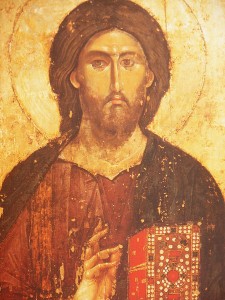
Christus PantokratorFor that reason, icons are typically not realistic; they are very “wooden,” very simple, almost cartoonish. Much is left to the viewer’s, the prayer’s imagination. I love to pray with icons and with other “visual aids,” with paintings, photographs, candles, flowers, all that “Catholic” stuff. It is one of the beauties of our Anglican tradition that we understand worship and prayer to be an activity of the whole person, to engage all of our senses. “Taste and see that the Lord is good,” the Psalmist wrote. (Psalm 34:8) We take those words seriously and so we don’t exclude any form of prayer or spirituality; we don’t distinguish between what is catholic or what is protestant. If it’s helpful in prayer, if it offers an aid to our understanding or our relationship with God, we thinks it’s fine. We draw on the catholic tradition, on the protestant traditions, on the orthodox tradition, even on non-Christian traditions. We’re willing to say “Yes” to anything that aids our connection to God.

But it’s so much easier to say “No,” isn’t it? I have a suspicion that the person who asked, “What’s all that Catholic stuff doing on the altar?” was also thinking something the along the lines of “We’ve never done that before.” That’s what we mean when we say “No.” “No” means we can keep with the status quo; we don’t have to face and deal with something we’ve never done before. That’s what Ahaz, the king of Judah, tries to do in the reading from the prophet Isaiah this morning. The prophet tells the king to ask God for a sign, but Ahaz declines to lest he be thought to put God to the test and be guilty of what Scripture elsewhere denounces as spiritual presumption. He knows that doing so can cause trouble for the asker, so he prefers to the status quo. He says, “No!” God gives him a sign anyway: “Look! A virgin will bear a son and name him ‘Emmanuel’.”

We’re all a bit like Ahaz; we prefer to stick with the way things are. The status quo may not be comfortable, but it is familiar. We know how to deal with it; we may not know how to handle something we’ve never encountered before.

“Yes” opens the future. It opens us to the unknown; it opens us to what we’ve never done before. Saying “Yes” is pregnant with possibility. But saying “No” is so much easier, so much safer!

The icons came to mind today because of the Gospel story.

On the Fourth Sunday of Advent, we like to say that we honor Mary and, to an extent, that’s true. Usually, in two of the three years of the lectionary cycle, we hear about the Annunciation when the angel Gabriel informed Mary that she had been chosen to bear God’s Son. But this year, we hear the other story, the annunciation to Joseph when an angel, not named by Matthew but often also portrayed as Gabriel, appeared to Joseph in a dream and explained Mary’s condition to him. They were betrothed, almost but not quite married, when it was discovered that Mary was pregnant. Joseph knew he wasn’t the father, but he didn’t want to embarrass this young girl, so he planned to divorce her (in a sense) in a quiet, private way. The angel visits him to convince him otherwise.

The icons came to mind today because when I contemplate Bible stories, when I pray about these tales, I like to use art, to look at the way these stories of the faith have been portrayed by painters and sculptors. There are two paintings, in particular, of this story that I like, and one of the Annunciation to Mary that is absolutely my favorite painting of a biblical tale.

The Annunciation by Sandro BotticelliThe Mary painting is by Sandro Botticelli, a Renaissance Florentine painter of the late 15th Century. In his painting, Mary is a Medici princess! She’s all decked out in these Renaissance robes, standing in a beautiful palace in front of window looking out over a lovely formal garden. Not very a very realistic depiction, of course, since she was a 1st Century Palestinian peasant girl! In any event, what is important is not how she’s dressed, but the emotions the painting conveys, and not only hers but also the angel Gabriel’s.

As Mary is depicted, she seems to be flinching away from the angel, holding her hands out as if fending him off. The expression on her face is nearly unreadable, but it is certainly not one of acceptance. Gabriel, also decked out as if he were a Medici courtier but these lovely, golden, semi-transparent wings billowing behind him, is kneeling before her. His hands are reaching out as if pleading. The expression on his face is one of apprehension. You can almost hear him thinking, “Oh, no! She’s going to say, ‘No!’ I’m going to have to go tell God that I blew it!” Of course, she didn’t say, “No.” But . . . what if she had?
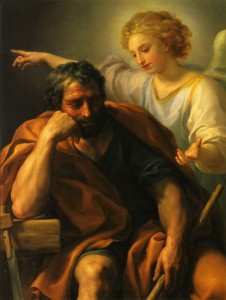
St Joseph's Dream by Raphael MengsThe paintings of Joseph are, first, a painting by an 18th Century German Bohemian painter named Raphael Mengs. Other than this painting, I don’t know this painter, but I did see this painting in the Kunsthistorisches Museum in Vienna. It is notable, first of all, for it’s depiction of Joseph as a relatively young man. Usually in art, Joseph is portrayed as an old man because of a legend that he was very old, had been previously married, had other children (who are those identified in the Bible as Jesus’ brothers and sisters), and passed away early in Jesus’ life. Scholars generally disagree with that: most now believe that Mary was probably only 13 or 14 years of age, Joseph perhaps 16 to 20.

In Mengs painting Joseph is perhaps a bit older than that but still a young man. He is fit and muscular, clearly a hard working man; Joseph, of course, was a carpenter. He has fallen asleep at his workbench, and the angel is speaking to him from behind, sort of over his shoulder. Joseph’s sleeping face is somewhat shrouded in shadow and hard to read. Sometimes when I look at this painting, he looks puzzled or confused; sometimes he looks angry; sometimes, simply uncaring. He does not look like someone who is going to readily agree to whatever the angel is telling him.

The Dream of St Joseph by Georges de la TourThe second painting of Joseph is by another 18th Century painter, the Frenchman Georges de la Tour. De la Tour is more conventional. He portrays Joseph as an elderly man, bald with a bushy beard. He appears to be in bed and to have fallen asleep while reading; a book is in his hand. The angel stands next to him; the scene is lighted by a single candle standing on a bedside table between them. We cannot see the candle, but only its light on the angel’s face and on Joseph’s. Joseph appears to be waking up, but not quite awake. He seems to be in that in-between, liminal stage — not quite asleep but not quite awake. I don’t know about you, but if someone tries to get me to do something when I’m just waking up like that, they’re going to get a resounding “No!”

Again, just like Mary, we know that Joseph did not say, “No.” He did not divorce Mary; he carried through with the marriage. Jesus was born and Joseph reared him as his own son. This is terribly important to Matthew, who traces Jesus’ lineage to King David through Joseph; as the acknowledged foster-adoptive son of Joseph, who is a blood descendent of David (the angel addresses him as “son of David”), Jesus also is “of the house and lineage of David.” This, for Matthew, legitimizes the claim that Jesus is the Davidic Messiah predicted by the prophets.

Think, for a moment, what might have happened if either of these young people had said, “No.” If Mary had declined to bear the Son of God, there would have been no Jesus. Oh, surely, God would have worked the plan of salvation in a different way, but it wouldn’t have been the way we know; there wouldn’t have been a Jesus Christ, a Christian church, the history of the world as we know it. We cannot imagine what it would have been, but it wouldn’t have been this!

If Mary had agreed but then Joseph refused, what might the childhood of the Son of God have been like. As it was, he was reared in a typical 1st Century Jewish family. He learned his lessons, worked with his foster father, learned the craft of carpentry, went to school at the local synagogue, learned the Scriptures and the traditions of his faith, obtained all the knowledge that was the necessary foundation of his life and ministry. But if he had been not the son of a merchant craftsman? What if he’d been the illegitimate son of an unwed mother? Again, we can be sure that God would have worked with that, but the story of salvation would have been radically different!

We have made it nearly all the way through Advent, this introspective season of preparation for the Feast of the Nativity, the celebration of the Incarnation of God in the birth of Jesus of Nazareth. But it is more than that; Advent bids us prepare not only to celebrate Christmas, but to get ready for what we call “the Second Coming,” the Messiah’s return at the end of time. Christmas (which technically hasn’t even started yet) will be over soon. As a church season, it lasts only twelve days starting Tuesday night. For many of us, it will be shorter than that. The tree will be taken down, the gift wrap thrown away, many of the gifts returned to stores and other gifts already broken long before Twelfth Night! But there’s still that unknown and unpredictable “last great day” when Christ will return to “judge the quick and the dead.”

Between now and then, we will have many opportunities to say “Yes” or “No.” We will have many opportunities to open the future. Will we do so? Will we say “Yes” and embrace the unknown pregnant with possibility? Will we play it safe, maintain the status quo, say “No?”

As we come to the end of Advent, give that some thought, give some thought to Mary’s “Yes,” to Joseph’s “Yes,” and prepare yourself again. Get ready! Keep awake! Be alert! When the opportunity comes remember Mary and Joseph, and say “Yes!” Open the future!

Amen!

====================

A request to my readers: I’m trying to build the readership of this blog and I’d very much appreciate your help in doing so. If you find something here that is of value, please share it with others. If you are on Facebook, “like” the posts on your page so others can see them. If you are following me on Twitter, please “retweet” the notices of these meditations. If you have a blog of your own, please include mine in your links (a favor I will gladly reciprocate). Many thanks!

====================

Father Funston is the rector of St. Paul’s Episcopal Church, Medina, Ohio.
Bird Brained – From the Daily Office – December 21, 2013

From the Gospel according to Matthew:

When the Son of Man comes in his glory, and all the angels with him, then he will sit on the throne of his glory. All the nations will be gathered before him, and he will separate people one from another as a shepherd separates the sheep from the goats, and he will put the sheep at his right hand and the goats at the left.

(From the Daily Office Lectionary – Matt. 25:31-33 (NRSV) – December 21, 2013.)

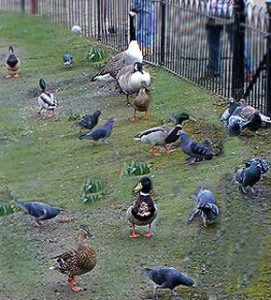
Ducks Geese and PigeonsI ought to be thinking “purer thoughts” or something . . . .

But I’ve been pondering this gospel bit all day, and although there are many things I could say about it, what keeps coming back to my mind is that (given the Phil Robertson, Duck Dynasty, A&E kerfluffle of the past several days) I’m glad that Jesus chose to make his point by separating sheep from goats, not geese from ducks.

I must be punchy (or maybe bird-brained) from Christmas preparations and sermon writing.

====================

A request to my readers: I’m trying to build the readership of this blog and I’d very much appreciate your help in doing so. If you find something here that is of value, please share it with others. If you are on Facebook, “like” the posts on your page so others can see them. If you are following me on Twitter, please “retweet” the notices of these meditations. If you have a blog of your own, please include mine in your links (a favor I will gladly reciprocate). Many thanks!

====================

Father Funston is the rector of St. Paul’s Episcopal Church, Medina, Ohio.

Broken Hearts – From the Daily Office – December 20, 2013

From the Psalter:

Open my lips, O Lord,
and my mouth shall proclaim your praise.
Had you desired it, I would have offered sacrifice;
but you take no delight in burnt-offerings.
The sacrifice of God is a troubled spirit;
a broken and contrite heart, O God, you will not despise.

(From the Daily Office Lectionary – Psalm 51:16-18 (BCP Version) – December 20, 2013.)

Broken Heart_by_eReSaWThe Episcopal Church includes Psalm 51 in its liturgy of Ash Wednesday. After ashes are imposed on the faithful and just before the recitation of a litany of penitence, the psalm is recited in its entirety. It’s a perfect piece of scripture for that use with its plea for forgiveness — “Have mercy on me, O God, according to your loving-kindness” (v. 1) — its acknowledgement of sinfulness — “For I know my transgressions, and my sin is ever before me” (v. 3) — and its petition for amendment of life — “Create in me a clean heart, O God, and renew a right spirit within me (v. 11).
I am so familiar with it in that Lenten liturgical setting that when it rolls around in the Daily Office cycle it always surprises me and usually seems oddly inappropriate for whatever other time of year it is appointed. Today, however, these ending verses strike me as particularly apposite.

In planning my Advent and pre-Christmas activities, I had set aside today for the preparation of my sermons for Advent IV (often the story of the Annunciation, but this year the tale of Joseph’s dream about Mary’s pregnancy) and Christmas. It was not a good decision; I should have started earlier, but I know myself well and usually do just fine “working to deadline.”

It was not a good decision for two reasons, one I knew about well ahead of time and one just occurred. The first is that tomorrow is the 14th anniversary of my mother’s death. I thought that it had been long enough (more than a decade, for pity’s sake!) that I could overlook that residual sadness, and probably I could have but for the second reason. Yesterday morning I received word (via Facebook) that an old friend, a colleague in ordained ministry, had passed away this week.

This is the week our Sunday School children have been rehearsing for Sunday’s annual pageant. This is the week our choir has held its annual Christmas party and dinner. This is the week our new Gallery addition to the Parish Hall has become nearly finished and is gorgeous beyond expectations. This is the week when Christmas cards are pouring in from friends old and new, from family, from colleagues, from people we haven’t seen in years but whom we remember with fondness. This is a week in which one’s cup should be overflowing with all the joys of the holidays!

Then that news and with it the old sorrow of missing Mom. The wisdom of Book of Proverbs is shown once again: “Even in laughter the heart is sad, and the end of joy is grief.” (Prov. 14:13)

But this morning, I get to read Psalm 51 and to pray as every preacher surely does in one way or another, “Open my lips, O Lord, and my mouth shall proclaim your praise,” and to be reminded that “the sacrifice of God is a troubled spirit.” Writing out my sermon for Christmas will be no different than preparing any sermon! Sure, the crowd will likely be bigger than a Sunday morning congregation and it will include people I’ve never seen before and people I haven’t seen since Easter and people I haven’t seen since last Christmas, and a small piece of me wants to preach the zinger that will change their hearts and get them returning to corporate worship on a weekly basis . . . and a larger part of me scoffs at that idea! Sure, it’s a big, grand show we put on on Christmas Eve, and a small part of me wants to preach an eloquent and stirring homily that will be remembered as people head home (and beyond) . . . and a larger part of me reminds that small piece of me that people don’t go out humming the sermon. The larger part of me knows full well that writing this sermon is no different than preparing any sermon.

Every sermon a priest or pastor preaches, on the days it is conceived and researched, on the day it is written, on the day it is preached, must be larger than his or her peculiar situation, whether it is a Sunday sermon, a funeral homily, or the oration on a principal feast. Every preacher must set aside his or her personal concerns and issues, his or her griefs and sorrows, his or her individual joys. Every preacher must, I think, begin and continue the homiletic process with two biblical prayers: first, from John the Baptizer who said, “[Christ] must increase, but I must decrease” (John 3:30); second, from today’s psalm, “Open my lips, O Lord, and my mouth shall proclaim your praise.”

So today, as I prepare to write some sermons, I do so in the midst of personal sadness, but I am reminded that “a broken and contrite heart [the Lord] will not despise,” and a line from a favorite song occurs to me:

Ring the bells that still can ring
Forget your perfect offering
There is a crack in everything
That’s how the light gets in.
(Anthem by Leonard Cohen)

From the cracks in a preacher’s broken heart, the Light can and will get in!

I offer these thoughts to my colleagues in ministry with a prayer and an assurance that their Christmas homilies will touch the hearts, the broken hearts, of the people entrusted to their care.

====================

A request to my readers: I’m trying to build the readership of this blog and I’d very much appreciate your help in doing so. If you find something here that is of value, please share it with others. If you are on Facebook, “like” the posts on your page so others can see them. If you are following me on Twitter, please “retweet” the notices of these meditations. If you have a blog of your own, please include mine in your links (a favor I will gladly reciprocate). Many thanks!

====================

Father Funston is the rector of St. Paul’s Episcopal Church, Medina, Ohio.

Bible Study – From the Daily Office – December 19, 2013

From the Gospel according to Matthew:

[Jesus said:] “Then the kingdom of heaven will be like this. Ten bridesmaids took their lamps and went to meet the bridegroom. Five of them were foolish, and five were wise.”

(From the Daily Office Lectionary – Matthew 25:1-2 (NRSV) – December 19, 2013.)

Open Bible with EyeglassesThe parable of the bridesmaids has always bothered me. Whenever I have to preach from it I have to get passed my first reaction, which is, “Really? People will be kept out of heaven for being stupid?” Of course, that is a misreading, or perhaps I should say “over-reading,” of the metaphor.
The message of this parable is once again the Advent message of preparation: it is an admonition to be ready for the unexpected return of the Lord, for the in-breaking of the kingdom of heaven. It has nothing to do with “getting into heaven;” it says nothing of the judgment of God, much less of the mercy of God. It is simply about being alert and prepared. The metaphor goes no further.

Extending metaphors beyond their point is often a danger with the things Jesus says! It is, truth be told, the danger with the whole of Scripture. Stories of God have to be read in the context of the whole of the Bible and understood to be limited in themselves; they tell only a part of the much-larger story.

I meet once a week with a group of people studying the Old Testament. The past couple of weeks we’ve been reading and discussing the books of Joshua and Judges. If one were to understand God solely on the basis of the stories of the conquest and settlement of Canaan, one’s picture of God would be that of a petty tyrant interested only in ritual, the acquisition of territory, and racial purity. You would read how God gave victory to the Israelite army and helped them annexed Canaanite territory simply because, with no military preparation at all, they marched around behind priests blowing trumpets. You would read how God then ordered them to slaughter all the men, women, children, and even livestock in some of the towns they captured simply to prevent them from intermarrying with the conquered Canaanites. You would read how God rewarded the Israelites for the behavior of Jael who lied, violated the laws of hospitality, and murdered a guest in her tent. You would read how God empowered Samson to be a judge over Israel, Samson who was, at best, a womanizer and a dolt! Not a pretty picture of God . . . although God’s granting power to Samson goes a long way toward countering the bridesmaids metaphor’s suggestion that God does not reward the stupid.

No. One cannot read selected bits of Scripture, whether they be the ritualized (and largely legendary) military history of the occupation of Canaan or the parabolic words of God Incarnate, out of the larger context of the entire witness of the Bible.

Perhaps that is part of “being prepared,” reading and appreciating the testimony of the entire Scriptures, being biblically literate, knowing the story in its grander dimensions. Advent is nearly over, but it is never too late to begin. Even a foolish bridesmaid or a stupid judge should understand that!

====================

A request to my readers: I’m trying to build the readership of this blog and I’d very much appreciate your help in doing so. If you find something here that is of value, please share it with others. If you are on Facebook, “like” the posts on your page so others can see them. If you are following me on Twitter, please “retweet” the notices of these meditations. If you have a blog of your own, please include mine in your links (a favor I will gladly reciprocate). Many thanks!

====================

Father Funston is the rector of St. Paul’s Episcopal Church, Medina, Ohio.

Filthy Clothes – From the Daily Office – December 18, 2013

From the Prophet Zechariah:

Now Joshua was dressed in filthy clothes as he stood before the angel. The angel said to those who were standing before him, “Take off his filthy clothes.” And to him he said, “See, I have taken your guilt away from you, and I will clothe you in festal apparel.

(From the Daily Office Lectionary – Zech. 3:3-4 (NRSV) – December 18, 2013.)

Dirty ShirtClothing is a common metaphor in Holy Scripture. Clean clothing is often a portrayal of righteousness or forgiveness. Everyone is familiar with the vision of John of Patmos recorded in the Book of Revelation:

One of the elders addressed me, saying, “Who are these, robed in white, and where have they come from?” I said to him, “Sir, you are the one that knows.” Then he said to me, “These are they who have come out of the great ordeal; they have washed their robes and made them white in the blood of the Lamb.” (Rev. 7:13-14)

I’m not aware of any other use of “filthy clothes” to represent sin or guilt, although Paul comes close in his admonition to the Ephesians: “Put away from you all bitterness and wrath and anger and wrangling and slander, together with all malice. . . .” (Eph 4:22) The Greek verb translated here as “put away” is the same that would be used to describe the act of removing one’s clothing, airo.

In Zechariah’s vision, angelic attendants remove Joshua’s filthy clothes, but in our lives it is up to us to do it ourselves, to “put away” such things as Paul lists.

There is one week left until the celebration of the Nativity. In that week, getting ready for Christmas, what “filthy clothes” do I need to take off?

====================

A request to my readers: I’m trying to build the readership of this blog and I’d very much appreciate your help in doing so. If you find something here that is of value, please share it with others. If you are on Facebook, “like” the posts on your page so others can see them. If you are following me on Twitter, please “retweet” the notices of these meditations. If you have a blog of your own, please include mine in your links (a favor I will gladly reciprocate). Many thanks!

====================

Father Funston is the rector of St. Paul’s Episcopal Church, Medina, Ohio.

Stir Up – From the Daily Office – December 17, 2013

From the Book of Revelation:

You are neither cold nor hot. I wish that you were either cold or hot. So, because you are lukewarm, and neither cold nor hot, I am about to spit you out of my mouth.

(From the Daily Office Lectionary – Rev. 3:15-16 (NRSV) – December 17, 2013.)

Hand Stirring a CupWhen I was in college I was part of group that liked to go backpacking on weekends. Because we were in Southern California, this often meant a trek into some desert wilderness where there was no local water. As a result, we each had to carry enough water for the weekend; as a rule of thumb, that would mean one gallon of water for each day of the hike.

We had found these one-quart, cube-shaped, collapsible water bladders that weighed just an ounce or two, and were easily packed into a backpacked. Pack four of those per day and you were set.

Of course, the cubes weren’t insulated and neither were the water bottles or canteens we carried outside our packs for easy regular access. One’s water was whatever temperature the day was; most of the time that meant the water was tepid, or as this verse says “lukewarm.” It satisfied the body’s need for hydration, but it was not terribly refreshing or stimulating!

I’ve always understood these two verses from Revelation (part of the message to the angel of the church in Laodicea to be metaphorical. I have considered that being “hot” or “cold” equate to loving or hating God; being lukewarm, to being indifferent. Understood in this way, the verse encourages emotional commitment.

But as I think about drinking that tepid water on those college hikes and how much more I appreciated the water if it was chilled or used to make a hot beverage, I’m wondering if maybe the passage should be understood somewhat more literally. What if God really does want to be refreshed? What if God really wants to be stimulated? (I won’t say “needs to be,” but that would be an even more interesting question.)

That God enjoys refreshment and finds it good is witnessed in Scripture. In the Book of Exodus, God commands the Israelites to honor the sabbath because “it is a sign forever between me and the people of Israel that in six days the Lord made heaven and earth, and on the seventh day he rested, and was refreshed.” (Exodus 31:17)

That God might be stimulated by human beings was explored by the poet Louise Glück as she described an afternoon hike:

Even as you appeared to Moses, because
I need you, you appear to me, not
often, however. I live essentially
in darkness. You are perhaps training me to be
responsive to the slightest brightening. Or, like the poets,
are you stimulated by despair, does grief
move you to reveal your nature? This afternoon,
in the physical world to which you commonly
contribute your silence, I climbed
the small hill above the wild blueberries, metaphysically
descending, as on all my walks: did I go deep enough
for you to pity me, as you have sometimes pitied
others who suffer, favoring those
with theological gifts? As you anticipated,
I did not look up. So you came down to me:
at my feet, not the wax
leaves of the wild blueberry but your fiery self, a whole
picture of fire, and beyond, the red sun neither falling nor
rising —
I was not a child; I could take advantage of illusions.
(“Vespers” in The Wild Iris)

I wonder if God finds me refreshing or stimulating . . . or just lukewarm, tepid, and dull.

On Sunday, the Third Sunday of Advent, in the Episcopal Churches, we began our worship with this prayer, “Stir up your power, O Lord, and with great might come among us.” Perhaps it is us who need to stir up in Advent, who need to become hot or cold, stimulating or refreshing.

====================

A request to my readers: I’m trying to build the readership of this blog and I’d very much appreciate your help in doing so. If you find something here that is of value, please share it with others. If you are on Facebook, “like” the posts on your page so others can see them. If you are following me on Twitter, please “retweet” the notices of these meditations. If you have a blog of your own, please include mine in your links (a favor I will gladly reciprocate). Many thanks!

====================

Father Funston is the rector of St. Paul’s Episcopal Church, Medina, Ohio.

Corporate Responsibility – From the Daily Office – December 16, 2013

From the Psalter:

We have heard with our ears, O God, our forefathers have told us,
the deeds you did in their days, in the days of old.

(From the Daily Office Lectionary – Psalm 44:1 (NRSV) – December 16, 2013.)

Mouth Speaking into EarToday’s evening psalm begins with a verse reminiscent of the psalm verse from which my blog takes its name:

That which we have heard and known,
and what our forefathers have told us, *
we will not hide from their children. (Ps 78:3)

These psalms speak to the obligation of the generations to communicate from one to another the lore of the faith, the stories that make us who we are, the tales that cement the People of God together. This is a duty which is common across the gulfs of religion, culture, and nationality; any group of people which considers itself a unified society must communicate generation to generation the knowledge and the values around which the society coheres. One generation must tell and the next must listen; the older must teach; the younger, learn.

In the past few days two news items caught my attention. The first was a report of findings of sociologists that Americans are less mobile in the second decade of the 21st Century than we were 20 or 30 or 40 years ago. People in our country are not moving from place to place, not changing residences as frequently as they used to. Those doing the research did not venture an explanation of why this is, but they offered possible reasons including the much higher costs of relocation, the change from a manufacturing to a service economy, and the homogeneity of both the current workforce and the current job market. Whatever the reasons, the nation seems to be returning to a more settled way of life, perhaps one similar in some ways to the agrarian society of the nation’s youth. This means that stories of affinity and location, the tales that form neighborhoods and cultures, the social economy of the small community will become more important.

The second news item, however, suggests that settled communities and social economies are not forming, that they are instead being destroyed. The story concerned the way in which the large corporations that form the basis of our service and information based economy (Facebook, Google, Twitter, cell phone companies, and so forth) are moving into and taking over the urban landscape. Because these companies need large amounts of space, their entry into the urban real estate market as buyers drives up the cost of office and commercial space, often to a rate that small retailers, cafes, restaurants, and other local businesses cannot afford. This, in turn, leads those smaller businesses to go out of operation. In addition, these corporations are providing “full service campuses” for their employees – providing gymnasiums and recreational facilities, dining facilities, all the ancillary services previously provided by the smaller businesses. This exacerbates the small, local businesses’ problem and accelerates their demise. The full-service corporate campuses and the absence of those small retail firms, cafes, and restaurants mean that the normal “meeting places” of society are disappearing. The employees of different businesses, the constituencies of competing corporate societies no longer have either need or place to interact.

These two trends seem to me to be incompatible. As we become more settled and have greater need for the organs of society that create communal coherence, we are also being fractured by the economic engines driving us to be more settled; the corporations which undergird the service-information economy are (perhaps inadvertently) demolishing the small-business economy that fosters human community in settled societies.

Now someone will say, “But there is the internet. Those service-information corporations, through the internet, provide an alternative to the public spaces, the small-business and social interactions of earlier settled communities.” Yes, to an extent that is so. But the internet and social media cannot replace the one-on-one, the one-with-many flesh-and-blood interactions of humankind. We need those in-the-flesh moments, to see another’s face, to hear his or her inflections, tones-of-voice, sighs, and chuckles, even to smell his or her sweat, breath, or perfume.

I am not blaming the Googles, the Twitters, the Facebooks for the loss of what sociologist Robert Putnam called “social capital” (see Bowling Alone), but I am suggesting that it is our responsibility to use the technologies and media they offer in appropriate ways, ways that enhance rather than disrupt the formation and sustaining of human community. I am suggesting that the owners, executives, managers, employees, and customers of those corporations share in that responsibility.

We cannot with integrity and authenticity say that we “have heard with our ears [what] our forefathers have told us” if we have only seen a Tweet, viewed a Facebook page, or read a blog entry. We cannot with integrity and authenticity say that we are not hiding the story of our community from our children if we are not sharing that story with one another in person. If we are to sing these psalms authentically, we must tell with our own voices, hear with our own ears, see with our own eyes, not with those of technology. It is our corporate responsibility.

====================

A request to my readers: I’m trying to build the readership of this blog and I’d very much appreciate your help in doing so. If you find something here that is of value, please share it with others. If you are on Facebook, “like” the posts on your page so others can see them. If you are following me on Twitter, please “retweet” the notices of these meditations. If you have a blog of your own, please include mine in your links (a favor I will gladly reciprocate). Many thanks!

====================

Father Funston is the rector of St. Paul’s Episcopal Church, Medina, Ohio.

The Highway of Salvation – Sermon for Advent 3, RCL Year A – December 15, 2013

====================

This sermon was preached on the Third Sunday of Advent, December 15, 2013, at St. Paul’s Episcopal Church, Medina, Ohio, where Fr. Funston is rector.

(The Revised Common Lectionary, Advent 3A: Isaiah 35:1-10; Canticle 15 (The Song of Mary, Luke 1:46-55); James 5:7-10; and Matthew 11:2-11. These lessons can be read at The Lectionary Page.)

====================

Highway though Blooming Desert

There are some numbers that made the news this week: 194 and 11,507. They are important numbers, numbers which represent an unpleasant reality of the world in which we live. I’ll return to them in a moment. but first let’s explore the Scriptures assigned to this, the Third Sunday of Advent, the second week in a row the Gospel focuses on John the Baptizer.

Last week we heard from John himself, this week we have Jesus asking people why they paid attention to John: “What did you go out into the wilderness to look at?” he asks them. “A prophet,” would be the correct answer, but more than a prophet – the forerunner of the kingdom of God. Jesus draws on the tradition of the prophet Malachi through whom God had said, “See, I am sending my messenger to prepare the way before me . . . . ” (Mal. 3:1) It was Malachi who predicted that the Messiah would be heralded by the return of Elijah: “I will send you the prophet Elijah before the great and terrible day of the Lord comes.” (Mal. 4:5) This was and remains in Judaism a traditional expectation known to all Jews. By equating John with Elijah, Jesus was announcing to one and all that, in himself, the reign of heaven had begun, that salvation was at hand. Some who heard him took this testimony seriously, but many others rejected. We take it seriously and because we do, we are preparing once again to celebrate Jesus’ birth.

We take it seriously that salvation is at hand, but what do we really mean when we use that word, “salvation”?

I know that many will say that salvation is a personal thing. “If you confess with your lips that Jesus is Lord and believe in your heart that God raised him from the dead, you will be saved,” wrote Paul to the Romans. Many people believe that what this means is that, doing those two things, each person will get into heaven when he or she dies.

On the other hand, we have the witness of the prophet Isaiah in today’s reading from the Old Testament that salvation is more communal than personal. God “will come and save you,” he says: “Then the eyes of the blind shall be opened, and the ears of the deaf unstopped; then the lame shall leap like a deer, and the tongue of the speechless sing for joy.” Hands that are weak will be strengthened, knees that are feeble will be made firm, and those who are fearful of heart will be made strong. Salvation is something that happens for the whole human community.

And not only is salvation communal, it is universal! Not only is salvation for the human community, it is for the whole of creation! “Waters shall break forth in the wilderness” and “the burning sand shall become a pool.” “The desert shall rejoice and blossom; . . . it shall blossom abundantly.”

Isaiah makes it clear that salvation is so much more than personal; it is so much more than simply getting into heaven when we die. Salvation is for everyone; it is for everything; and it is for the here-and-now. Jesus affirms this when John sends word to Jesus and asks, “Are you the one?” Jesus replies: “Tell John what you hear and see: the blind receive their sight, the lame walk, the lepers are cleansed, the deaf hear, the dead are raised, and the poor have good news brought to them.” Notice that everything Jesus says is present tense! It’s here! It’s now! It’s not “will be;” it’s not “might be;” it’s not sometime in the future. It’s not in heaven when we die! It’s here and it’s now!

So why, then, if salvation is for everyone and everything in the here-and-now, are we told to wait “until the coming of the Lord?” Why in our Epistle Lesson does James tell us to “be patient [as] the farmer waits for the precious crop from the earth, being patient with it until it receives the early and the late rains?” That question haunted me during my prayers and my meditations this past week as I thought about what to say this morning. As I pondered the question, however, I came to realize that I was focusing on the wrong things. I was looking at and questioning the waiting and the patience, and I should have been fixing my attention on the farmer.

I grew up in a farming family. My nuclear family weren’t farmers, but my maternal great-grandfather, Hinrich Buss, homesteaded several thousand acres of Kansas farmland in the late 1800s and quite a few of my Buss cousins to this day run farms on that land. Some grow corn and soybeans; others run dairy farms. I know from family example that while farmers do a lot of waiting and have to be patient people, they are never idle. “Waiting with patience” doesn’t mean sitting around doing nothing; to wait and be patient as a farmer patiently waits is to be active, to be attentive, to take a hand in bringing about that for which one is waiting.

Salvation that transforms the human community, that enables all creation to sing together in present and eternal joy happens as people’s eyes are opened to see and their ears are unstopped to hear both the Good News of God in their own lives and the needs of others to know that Good News in their lives. When that happens, the desert wilderness blooms and becomes a verdant landscape.

Passing through that lush landscape, says Isaiah, there will be a highway. “It shall be called the Holy Way” and the redeemed shall walk upon it to Zion, singing and rejoicing as they go. How will that highway get there? In a few more chapters, Isaiah will answer that question by saying to the People of God, “In the wilderness prepare the way of the Lord, make straight in the desert a highway for our God.” That highway, the highway of salvation, will get there because the People of God will build it!

There is an old story about a time of economic depression in France. The government decided that it would put the unemployed to work building roads. Initially, this worked well: the workers received paychecks, their spirits were high, and the government was pleased with itself. But then some of the laborers began to ask where the roads were leading. The government had to admit that these roads were simply make-work; they were going nowhere, just out into a swamp or something. The workers became dispirited; they lost a sense of purpose in their work. In a very real sense, their eyes were shut and their ears were closed up because they had been robbed of the hope that they were making life better for others and for themselves.

Salvation happens, the highway in the wilderness gets built, when there is hope; hope is there when our eyes and ears are opened to perceive that God is in our midst and to know that amazing things are possible. People of God have known this in every generation and they have seen it in every generation. God “has mercy on those who fear him in every generation.” God shows “the strength of his arm” and “scatter[s] the proud in their conceit” in every generation. God “cast[s] down the mighty from their thrones” and “lift[s] up the lowly” in every generation. God “fill[s] the hungry with good things” and sends “the rich . . . away empty” in every generation.

God does these things through God’s People who in every generation have seen Isaiah’s vision of a God of infinite and unstoppable hope, who in every generation have wondered how to see it more clearly, how to believe it more firmly, and how, like the patiently waiting farmer, to actively and attentively take a hand in transforming the often unpleasant desert realities in which they live.

I mentioned some numbers earlier, numbers that I suggested represent an unpleasant reality of the world in which we live: 194 and 11,507. Yesterday was the one-year anniversary of the murder of 20 children and six adults at Sandy Hook Elementary School in Newtown, Connecticut. We were tragically reminded of that massacre by another shooting incident on Friday at Arapahoe High School in suburban Denver, Colorado. In our country during the year between those two incidents, 11,507 people have died from gunshots; 194 of them have been children 12 years of age or younger. It is an unpleasant reality of the wilderness in which we still live, where we are still called to build the highway of salvation.

Let us pray:

Almighty God our heavenly Father, you have promised to come and save us as the eyes of the blind are opened and the ears of the deaf unstopped: Open our eyes and unstop our ears that we may know that you are in our midst and may share your vision of infinite and unstoppable hope, that we may do the work of transforming unpleasant realities and building the highway of salvation for all; for the sake of him who was and is and is to come, your Son Jesus Christ our Lord. Amen.

====================

A request to my readers: I’m trying to build the readership of this blog and I’d very much appreciate your help in doing so. If you find something here that is of value, please share it with others. If you are on Facebook, “like” the posts on your page so others can see them. If you are following me on Twitter, please “retweet” the notices of these meditations. If you have a blog of your own, please include mine in your links (a favor I will gladly reciprocate). Many thanks!

====================

Father Funston is the rector of St. Paul’s Episcopal Church, Medina, Ohio.

Shaking Grammy – From the Daily Office – December 14, 2013

From the Prophet Haggai:

Thus says the Lord of hosts: Once again, in a little while, I will shake the heavens and the earth and the sea and the dry land; and I will shake all the nations, so that the treasure of all nations shall come, and I will fill this house with splendor, says the Lord of hosts.

(From the Daily Office Lectionary – Haggai 2:6-7 (NRSV) – December 14, 2013.)

Antique KitchenI remember a movie scene, maybe a cartoon? A character is picked up by his ankles and shaken, and all the change in his pockets rattles out and collects on the ground beneath him . . . . That is what first came to mind when I read these verses of Haggai, still going on about rebuilding the Temple in Jerusalem immediately after the Babylonian Exile.

Then another memory, a memory of being shaken myself.

I spent many childhood summers with my paternal grandparents in a small town in southeastern Kansas. They had moved there in 1919. My grandfather had purchased five city lots. On one he built there home, a three-bedroom bungalow. On another he built a similar home to rent out for income; eventually, it would be the home of my father’s older brother and his family who lived there during those childhood summers. On a third, Granddad built a large structure which might have been called a barn if it were on a farm or a ranch; we just called it “the garden shed.” That lot also was the location of the chicken coop where my grandmother collected eggs every morning. The remaining two lots were my grandfather’s garden and fruit orchard, where I worked and played with my cousins summer mornings; in the afternoon, we would go to the city swimming pool or to the library or to the movies.

My grandfather was a very good gardener, so there always seemed to be plenty of beans, tomatoes, cucumbers, corn, okra, you-name-it for my grandmother to can, make into preserves, cook fresh, blanch and freeze, and so forth. When I think of her, I most often picture her in the kitchen.

Grammy Funston was a small woman. If she was fully five feet tall, I’d be surprised. Because kitchen counters were just a bit too tall for her, she preferred to sit at the kitchen table to do her vegetable and fruit preparation, the peeling, dicing, slicing, sorting, and what-all that is required to cook, preserve, or can garden produce.

Grammy’s kitchen was the way into the house from the garden, the orchard, the play yard, and the work shed: up the back porch steps, into the mudroom, past the stairs to the basement, into and through the kitchen to get to wherever else you might be headed. With all that cooking and canning going on, boiling pots of water on the stove, pans of cooking jams and jellies, stacks of glass mason jar and jelly glasses, it was also a busy and sometimes dangerous place. She didn’t mind people coming and going through her work space, but she had one hard-and-fast rule – no running in the kitchen.

Violate that rule and you would find yourself snagged! For a woman as petite as she was, she was incredibly strong and had a grip like iron. Run past her in that kitchen and her arm would flash out like a bull-whip; her hand would latch on to your upper arm like a vice; and you would find yourself planted right in front of her about to get a stern talking-to. She had a habit of placing her hands on both your upper arms and shaking you as she made her points: “You could get seriously hurt!” SHAKE “Do you understand me?” SHAKE “This is a dangerous place!” SHAKE

“I will shake the heavens and the earth and the sea and the dry land; and I will shake all the nations. . . .” I picture God as a grandmother working in her kitchen, making all sorts of good things, and occasionally snagging an unruly creation by the arm, grabbing the world by both shoulders. “This is a dangerous place!” SHAKE “You need to pay attention!” SHAKE “Do you understand me?” SHAKE

It’s the message of Advent, again! “Be alert; I have already told you everything.” (Mark 13:23) SHAKE!

====================

A request to my readers: I’m trying to build the readership of this blog and I’d very much appreciate your help in doing so. If you find something here that is of value, please share it with others. If you are on Facebook, “like” the posts on your page so others can see them. If you are following me on Twitter, please “retweet” the notices of these meditations. If you have a blog of your own, please include mine in your links (a favor I will gladly reciprocate). Many thanks!

====================

Father Funston is the rector of St. Paul’s Episcopal Church, Medina, Ohio.

Spiritual Center – From the Daily Office – December 13, 2013

From the Prophet Haggai:

Now therefore, thus says the Lord of hosts: Consider how you have fared. You have sown much, and harvested little; you eat, but you never have enough; you drink, but you never have your fill; you clothe yourselves, but no one is warm; and you that earn wages earn wages to put them into a bag with holes.

(From the Daily Office Lectionary – Haggai 1:5-6 (NRSV) – December 13, 2013.)

Spiral GalaxyIt never ceases to amaze me how directly Scripture can speak to the present day! The admonition to “Consider how you have fared,” and its description of an economy in a shambles, where the people work but do not enjoy the produce of their labor, continue to be hungry and thirsty, cannot find warmth, and find their earnings dribbling away to nothing, could be addressed to anyone anywhere in today’s world, I think.

Haggai’s purpose in speaking his prophecy is to encourage the rebuilding of the Temple in the years immediately following the end of the Babylonian Exile, sometime around 520 BCE. His thesis seems to be that if the Jews can reclaim their spiritual center, in his eyes quite literally the physical center of the universe, the Temple of God, their lot will improve. It’s a good point, I think.

I’ve noticed over the past few days that a lot of people were remarking that today would be “Friday the 13th,” not a few with noticeable dread. Many of the same people regularly check their horoscopes and will make it a point of telling others, “I’m a Sagittarius,” or will explain someone’s behavior with, “Well, he IS a Leo!”

My late mother was one such person. She didn’t put much stock in concern about the number 13 (live and work in Las Vegas, Nevada, and you see and learn to dismiss a lot of that sort of thing), but she sure seemed to pay attention to astrology. She was a Cancerian; she constantly reminded my brother and me that he was a Leo and I, a Libra. Whatever personality traits we exhibited were explained by the stars! But all that changed when she entered her 70s.

Something else changed then, too. Her son became a priest. About a year after my ordination, my family and I were visiting my parents and I noticed on her nightstand a copy of The Book of Common Prayer, an old study bible that had been on their bookshelves unused for years, and a newcomer’s pamphlet from a local Episcopal Church. I picked up the BCP and walked into the living room.

“Uh . . . what’s this?” I asked innocently.

“Well,” she said in that almost-sarcastic tone of voice on which I think she had a trademark, “I guess you’re serious about this, so I thought I’d better check it out.”

And check it out she did. Both she and my step-father became official members of the Episcopal Church later that year. He became a regular handyman volunteer around the church, and she became an active member (and even an officer) in the Episcopal Church Women. They attended Mass every week, took part in social events, and worked in the church’s outreach ministry. Both pre-planned their memorial services using the burial rites of the Prayer Book, and their ashes are now together in the memory garden next to the larger church sanctuary their capital contributions help to build.

Here’s the interesting thing: after that day when she admitted she was “checking out” religious faith, I never again heard a word about horoscopes or the zodiac. God, Jesus, and the Christian faith had made astrology unnecessary in her life.

I have atheist and agnostic friends who will scoff at that. In their minds there is no difference between belief that the stars control our destiny and belief that there is a God who loves us. There is, however, a significant difference and it is exactly in that verb I just used – love. The stars, the number 13, rabbit’s feet and lucky clovers, the things of superstition are indifferent to human beings; God is never indifferent.

When we put the indifferent (indeed, the inanimate) at the center of our lives, life suffers. Whether that indifferent thing is a distant star or a bank account, a good luck piece or a career, that thing cannot give back any of our devotion. Center on the indifferent, we will sow much and harvest little. When God is at the center of life, our devotion is returned. Our hunger and our thirst are satisfied.

Haggai was on the right track and his prophecy does address our current situation. A religious re-centering was needed and perhaps the Temple was a visible sign of that re-centering of the returned exiles, but one does not really need a physical center. The people, each individually and all together as a society, needed a spiritual center. The people, each of us individually and all of us together as a society, still do.

It is Advent: the Advent call to self-examination continues in Haggai’s prophecy. What is at our spiritual center? As the morning psalm says today, God is our “strong rock, a castle to keep [us] safe,” and God will lead us and guide us. (Ps. 31:3)

====================

A request to my readers: I’m trying to build the readership of this blog and I’d very much appreciate your help in doing so. If you find something here that is of value, please share it with others. If you are on Facebook, “like” the posts on your page so others can see them. If you are following me on Twitter, please “retweet” the notices of these meditations. If you have a blog of your own, please include mine in your links (a favor I will gladly reciprocate). Many thanks!

====================

Father Funston is the rector of St. Paul’s Episcopal Church, Medina, Ohio.

« Older posts Newer posts »