From Matthew’s Gospel:
[Jesus said:] “Woe to you, scribes and Pharisees, hypocrites! For you clean the outside of the cup and of the plate, but inside they are full of greed and self-indulgence.”
(From the Daily Office Lectionary – Matt. 23:25 (NRSV) – December 12, 2013.)
 The devisers of our Episcopal Church Daily Office Lectionary were a clever bunch, weren’t they?
Here we are less than two weeks from Christmas Day, in the middle of that great orgy of greed and indulgence which is the holiday gift buying season, and they give us Jesus saying this!
Yesterday, TIME Magazine announced that their selection of the 2013 Person of the Year is Pope Francis, the current Bishop of Rome and Supreme Pontiff of the Roman Catholic Church. Interesting choice, especially at this time of year given that less than a month ago he said:
The worship of the ancient golden calf has returned in a new and ruthless guise in the idolatry of money and the dictatorship of an impersonal economy lacking a truly human purpose. The worldwide crisis affecting finance and the economy lays bare their imbalances and, above all, their lack of real concern for human beings; man is reduced to one of his needs alone: consumption. (Evangelii Gaudium, published 24 November 2013, Paragraph 55)
I am not a Roman Catholic, but I find myself fully in agreement with the pope’s insistence that unfettered capitalism and unrestrained “free markets” are contrary to the Gospel mandate. His insistence that the church and society are called by Christ, compelled by the Spirit to help “those who are in thrall to an individualistic, indifferent and self-centered mentality to be freed from those unworthy chains and to attain a way of living and thinking which is more humane, noble and fruitful, and which will bring dignity to their presence on this earth (Para. 208),” is fully in accord with what I understand Jesus to be saying in this (and other) verses of Scripture.
There is little that any one person can do in this regard. I’ve done this Advent what I can — I stayed away from all retail activity on Thanksgiving and Black Friday, not giving into or being part of the feeding frenzy of “holiday sales” — I am trying to “buy local” both for gifts and for personal needs — I do my banking at a local financial institution, not with one of the national conglomerates — I plan to give few gifts this year, but instead to make dedicated contributions to Episcopal Relief & Development, Médecins sans Frontières, Habitat for Humanity, and similar organizations.
These are small things. In the vast, global financial network that is our dysfunctional economy, they are a drop in the ocean. But they are something. The American Unitarian clergyman Edward Everett Hale is quoted as saying, “I am only one, but I am one. I can’t do everything, but I can do something. The something I ought to do, I can do. And by the grace of God, I will.” If each of us does something to clean the inside of the cup which is our economy of greed and indulgence, perhaps we can change it.
The clever compilers of our lectionary and the pope have reminded us that Jesus calls us to do so. This Advent, I am doing what I can.
====================
A request to my readers: I’m trying to build the readership of this blog and I’d very much appreciate your help in doing so. If you find something here that is of value, please share it with others. If you are on Facebook, “like” the posts on your page so others can see them. If you are following me on Twitter, please “retweet” the notices of these meditations. If you have a blog of your own, please include mine in your links (a favor I will gladly reciprocate). Many thanks!
====================
Father Funston is the rector of St. Paul’s Episcopal Church, Medina, Ohio.
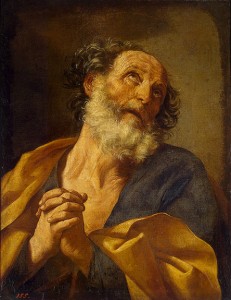 I thought, “Surely, this is wrong! There can’t be anything as weak and lifeless in Scripture (especially in the Psalms) as the plaintive little cry, ‘I’m sorry . . . .'” So instead of the New Revised Standard Version, I turned to The Book of Common Prayer, sure that I would find a stronger statement, perhaps “I repent.” But, no. The BCP version of this psalm is really even worse because it renders the verb in the future tense: “I will confess my iniquity and be sorry for my sin.” Come on! “I will be sorry”? Really?
 In truth, this is Amos objecting to Amaziah, the priest at Bethel, that he, Amos, is not an official prophet, not a member of one of the recognized or sanctioned schools of prophecy, but the first part of it has always sounded to me as if Amos is protesting his commission to prophesy, trying to get out of doing what God wants him to do. “Hey, that’s not what I do! I can’t be a prophet because I have these sheep and these figs to take care of!”
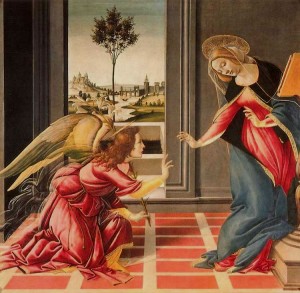 First, a confession: I’m not fond of the Book of Revelation. Although it has occasionally brilliant passages and some incredible metaphoric imagery, it is probably the most abused and misused piece of scripture in the entire Christian canon! I remember hearing or reading at one time that, during the formation of the canon, bishops in what is now the Eastern Orthodox wing of the church opposed the inclusion of this book. If that had been the way things went, it would have been relegated to that collection of interesting historical literature which includes The Shepherd of Hermas, The Didiche, and the Letters of Clement. But it wasn’t, so we have it and we have to take it seriously. (When dealing with the Apocalypse, it is well to remember the meme about Episcopalians, though: “We take the Bible too seriously to take it literally!”)
 I have a pair of cufflinks with part of this verse inscribed on them in Latin: “Sacerdos in Aeternum” (“Priest Forever”). They were given to me as an ordination present. I seldom have reason or opportunity to wear them as I don’t generally wear long-sleeved, let alone French-cuff, shirts. But yesterday I did.
 Nelson Mandela, an example of justice, courage, wisdom, patience, strength, love, hope, faith, forgiveness, and reconciliation, known to his countrymen and people of grace around the world as “Madiba,” died yesterday evening at the age of 95. His death was not unexpected; he had been ailing for quite a long time. This may be St. Nicholas Day, but really there’s no choice but to consider and write about Mr. Mandela!
 What a great couple of verses to illustrate metaphoric thinking!
  I’m sitting here this morning knowing full well that I should be writing something about Advent and, truth be told, there are other parts of today’s daily readings that would lend themselves to an Advent reflection. But…. yesterday a federal court in Michigan decreed that the city of Detroit could carry on with a restructuring of its debt through bankruptcy and, more importantly and more destructively, that among the obligations that could be discharged are its pension responsibilities to former municipal employees. I was deeply troubled by that news when I heard it yesterday morning and I’ve been pondering it since.
 This series of questions is asked by Amos just before he asks, “Does disaster befall a city unless the Lord has done it?” (v. 6b) He’s provoking his readers (originally, his listeners) to answer each preliminary question, “Of course not” so that their answer to his capper will also be “Of course not.”
 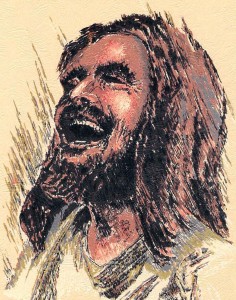 In the library of my parish church is a pen-and-ink drawing of Jesus laughing. It’s not a picture I particularly like, nor is it particularly well executed. In fact, if someone hadn’t told me that it is supposed to show Jesus laughing, I would have thought he was angry! Whenever I look at it, this verse from the Psalter comes to mind.

