From John’s Gospel:
Jesus and his disciples had also been invited to the wedding. When the wine gave out, the mother of Jesus said to him, “They have no wine.” And Jesus said to her, “Woman, what concern is that to you and to me? My hour has not yet come.” His mother said to the servants, “Do whatever he tells you.” Now standing there were six stone water jars for the Jewish rites of purification, each holding twenty or thirty gallons. Jesus said to them, “Fill the jars with water.” And they filled them up to the brim. He said to them, “Now draw some out, and take it to the chief steward.” So they took it. When the steward tasted the water that had become wine, and did not know where it came from (though the servants who had drawn the water knew), the steward called the bridegroom and said to him, “Everyone serves the good wine first, and then the inferior wine after the guests have become drunk. But you have kept the good wine until now.” Jesus did this, the first of his signs, in Cana of Galilee, and revealed his glory; and his disciples believed in him.
(From the Daily Office Lectionary – John 2:2-11 – August 10, 2012)
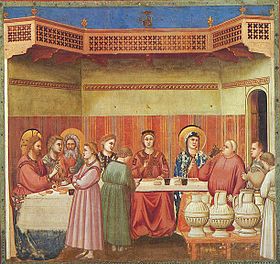 A year ago I was in Ireland, camped out in a cottage outside of the village of Banagher, County Offaly, on sabbatical. As my study project, I was translating old Irish hymns into metrical, rhyming English such that they could be sung to the music of the original. The hymns were published in the early 20th Century in a collection titled Dánta Dé Idir Sean agus Nuadh compiled by Uná ní Ógáin. Dánta Dé includes a communion hymn which elaborates on John’s story of the wedding feast; it is entitled The Blessed Wedding at Cana and is attributed to Maighréad ní Annagáin. I found I could not directly translate the hymn, so instead I wrote a poem of my own. Reading this story today, I recall working on that piece and offer it again.
This is my poem inspired by the gospel story and the old Irish hymn:
King of love,
King of glory,
King of graces, guest at a wedding.
With his mother, with his friends,
seated at the marriage feast waiting.
Came the word: “There is a problem!”
Mary told her son to help them.
“What is this to me?” he asked her;
but to servants she was speaking.“There is no wine
for the feast.
Do as he says, no hesitation.”
Empty vessels standing there
for the rites of purification.
“Fill them,” he says, “with plain water;
and then draw some for the steward.”
“What is this now?” asks the steward,
“Finest wine in the nation!”Blessed Mary,
Virgin pure,
Mother of God, you knew that even
that your Jesus was the Christ;
that he was the High King of Heaven.
But did you know he would become
the free way for us to our home?
Through baptism buried with him,
we, too, shall all be risen!O Lord Jesus,
glorious King,
holy savior who bore the Thorn Crown,
you were beaten, crucified,
killed, and buried, layed in the cold ground.
In fulfillment of the promise,
you broke the bars closed against us.
With your own blood you have freed us!
Death is conquered! Life is newfound!Your own Body
and your Blood
give us sinners true liberation;
Bread of Heaven, Blessed Cup,
holy table, feast of salvation.
Giving blessings beyond measure;
wedding banquet, splendid treasure.
At the marriage feast of the Lamb,
we are God’s new creation!
For those interest in the hymn as Gaeilge, here is the Irish original:
Ag an bpósadh bhí i gCána bhí Rí na ngrás ann i bpearsain,
É féin is Muire Máthair, is nárbh áluinn í an bhainfheis?
Bhí cuideacht ós cionn chláir ann, agun fíon orra i n-easnamh,
‘S an t-uisge bhí h-árthaibh nár bh’áluinn é bhlaiseadh?A Dhia dhíl, a Íosa, ‘s a Rí ghil na cruinne,
D’iomchuir an choróin spíne is iodhbairt na Croise,
A stolladh is a straoilleadh idir dhaoinibh gan cumann,
Na glasa do sgaoilis, a d’iadhadh n’ár gcoinnibh.Is ró-bhreágh an stór tá ag Rígh na glóire dúinn i dtaisge,
A chuid fola agus feóla mar lón do na peacaigh’.
Ná cuirigidh bhur ndóchas i n-ór bhuidhe nó i rachmas
Mar is bréagán mar cheó é, seachas glóire na bhFlaitheas.
====================
Father Funston is the rector of St. Paul’s Episcopal Church, Medina, Ohio.
 OK. I know I shouldn’t get into this . . . I know that someone is going to give me a hard time; I can almost predict that someone will tell me they are planning to “leave the church” over this. But here goes.
 Just a few days ago the Public Religion Research Institute issued a new report entitled A Generation in Transition: Religion, Values, and Politics among College-Age Millennials. A “millennial” is somone currently 18 to 24 years of age, the youngest cohort of adults. (From my point of view at nearly 60 years of age these are children; my son and daughter are both older than this group!) According to the report, these young adults are more likely then the general population to be religiously unaffiliated; one-quarter of them so identify themselves. Interestingly, most of those who do so were reared in religiously affiliated households. The greatest movement away from religious affiliation was seen among those raised in Catholic and white mainline Protestant families. It would appear that we have not been doing a very good job of teaching our children “that they in their turn might tell it to their children”!
 Reading these oh-so-familiar words in the introduction to John’s Gospel, I remember other words I read on another blog yesterday:
 It is intriguing how often in stories of Holy Scripture food plays a role. From the “apple” in the Garden, to Abraham offering a meal of cakes and meat to the three men (who turn out to God) at the Oaks of Mamre, to this story of Gideon, to David and his men eating the Bread of the Presence, to all the food items listed as items of sacrifice in Leviticus, the Old Testament (indeed, the whole Bible) is food focused. The People of God define themselves through the annual reenactment of a ritual meal celebrating the Passover; the new People of God define themselves (in my tradition and others) by the weekly reenactment of a ritual meal celebrating the death and Resurrection of Christ and anticipating his return. It’s intriguing but not surprising. The Jewish and Christian faiths are not, in the long run, about following rules of ritual or moral conduct; they are about being in an intimate relationship with that which is the source of being, that which we call “God” and address as “Father” or brother or redeemer. And, other than sex, there is probably no more intimate activity two or more people can share than eating together.
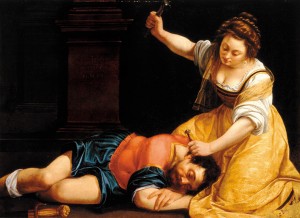 “Most blessed” be a murderess? What is this? Yesterday, a friend and colleague who was only a little older than I am passed away after several months of pancreatic cancer, so I’m a little sensitive on the subject of death this morning. So, really! What is this?
  These are the words spoken by the great crowd of Jews and others who thronged the streets of Jerusalem for the Festival of Shavu’ot when the Twelve, empowered by the Holy Spirit, begin to tell the story of Jesus in languages they had never before spoken. Shavu’ot is a celebration with both agricultural and historical significance in Judaism. It is known as the “festival of the first fruits,” a harvest feast when the first fruits were brought as offerings to the Temple; it is also known as the “festival of the giving of the Law,” a celebration of the handing down of Torah on Mt. Sinai. It was called Pentecost, a Greek word meaning “fiftieth”, because it always falls on the fiftieth day after the Passover. That year it fell on the fiftieth day after the Resurrection and, thus, the Christian feast of the Holy Spirit carries that name, as well.
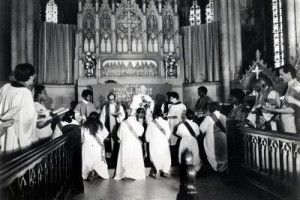 This past Sunday, the Episcopal Church marked the 28th anniversary of the women known as “the Philadelphia Eleven” who were ordained on July 29, 1974. Four retired bishops (Daniel Corrigan, Robert DeWitt, Edward Welles and George Barrett) chose to defy the General Convention of the Episcopal Church which, at its regular triennial meeting in 1973, had voted against opening the priesthood to women; women were already eligible for ordination as deacons. Joined by male presbyters who supported them and the candidates, they ordained eleven women deacons to the priesthood: Merrill Bittner, Alla Bozarth-Campbell, Alison Cheek, Emily Hewitt, Carter Heyward, Suzanne Hiatt, Marie Moorefield Fleisher, Jeannette Piccard, Betty Bone Schiess, Katrina Martha Swanson, and Nancy Hatch Wittig. Shortly thereafter, four additional women were also “irregularly” ordained: Eleanor Lee McGee, Alison Palmer, Betty Powell, and Diane Tickell. A firestorm of controversy erupted in the church: charges were filed against these dissident bishops (Daniel Corrigan, Robert DeWitt, Edward Welles and George Barrett) and an emergency meeting of the Episcopal House of Bishops was convened on August 15, 1974.
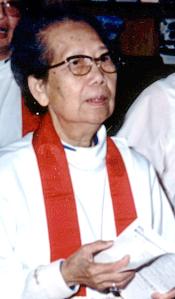 These women were not the first to be ordained to the Anglican priesthood, however. During the Second World War, Florence Li Tim-Oi was ordained to the presbyterate on January 25, 1944, by the Rt. Rev. Ronald Hall, Bishop of Hong Kong, in response to the crisis among Anglican Christians in China caused by the Japanese invasion. No male clergy could be found who were willing to take on the onerous ministry, but Ms. Li was, so she was ordained and served with distinction. After the war, the Archbishop of Canterbury sought to make the bishop and the priest rescind the ordination, but neither did. Ms. Li voluntarily ceased serving as a priest until more than 30 years later when she immigrated to Canada where the Anglican Church, following the Episcopal Church’s lead, had begun to ordain women. Her priesthood was recognized and she served as an honorary canon in Toronto, ministering among the immigrant Chinese population.
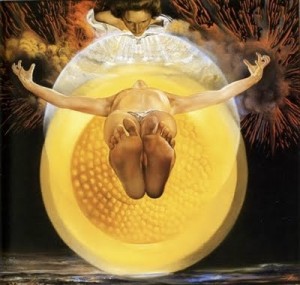 Have you ever done that thing on a public street corner where a couple of people stand there looking up and pretty soon some passing pedestrian, wondering what they are gazing at, will stop and look up, and then another and then another and so on until a lot of people are looking up into the sky at nothing for no reason? I have an image of that in my mind when I read the this passage, although in this case the “men of Galilee” are not looking at nothing for no reason. They are looking at something they can no longer see, except in their minds’ eye, and it is certainly not “for no reason” that they are doing so. Something phenomenal has happened to them; someone they thought had been killed by the authorities had returned from the dead, had eaten with them, talked with them, appeared to them over the course of over seven weeks, and now he had “ascended into heaven.” They had plenty of reason to stand there staring into the sky into which he had apparently gone.

