That Which We Have Heard & Known

Occasional thoughts of an Anglican Episcopal priest

Page 59 of 130

I Don’t Know – From the Daily Office – May 13, 2014

From the Book of Exodus:

Moses said to Aaron, “What did this people do to you that you have brought so great a sin upon them?” And Aaron said, “Do not let the anger of my lord burn hot; you know the people, that they are bent on evil. They said to me, ‘Make us gods, who shall go before us; as for this Moses, the man who brought us up out of the land of Egypt, we do not know what has become of him.’ So I said to them, ‘Whoever has gold, take it off ‘; so they gave it to me, and I threw it into the fire, and out came this calf!”

(From the Daily Office Lectionary – Exodus 32:21-24 (NRSV) – May 13, 2014)

Golden Calf“I threw it into the fire, and out came this calf!”

I chuckle every time I read this story and get to this point. In fact, when the story of the golden calf has been read in church and the reader gets to Aaron’s disclamation of responsibility, I’ve been known to laugh out loud.

Once, years ago, in a bible study group reading Exodus, I asked, “How old was Aaron?” No one knew, but we were all pretty certain that Moses and his brother were not young children at the time of this story. Nonetheless, a young child is exactly what Aaron sounds like: “I threw the gold in the fire, and out came this calf!” No mention of his forming the mold, pouring the molten the gold, breaking the mold, polishing the casting, and all the rest that goes into the making of a metal statue. The calf just “came out.”

There was a phantom in our house when my children were very young. We’d find that someone had opened the orange juice and not only taken some, but also spilled a good deal on the kitchen counter and floor. “Who did this?” we would ask. “I don’t know,” would be the answer. The contents of my wife’s purse were spilled there was lipstick smeared on things. “Who did this?” we demanded of the little girl with red all over her face. “I don’t know,” she told us. Someone once tried to make sand castles in the cat box. “Who did this?” we asked the little boy with sand fingers. With a straight face he replied, “I don’t know.”

We never caught I Don’t Know doing any of these things (or many others), but there was plenty of evidence of his (or was it “her”?) existence. I Don’t Know was a very active sprite! Apparently, I Don’t Know was much older than we thought. He or she appears to have been with the Hebrews in the desert. — “Who made this golden calf?” — “I don’t know. I threw the gold in the fire and out came this calf!”

In the modern adult world, I Don’t Know has gotten more adapt at hiding his or her identity. “Who made that decision?” we ask. The answer is often one of I Don’t Know‘s alter egos: a committee, the vestry, the (unnamed) higher-ups, the council, management, the administration. Could it be that I Don’t Know is being scapegoated?

Imaginary friends are a healthy part of maturing. Research shows that children with imaginary companions tend to be less fearful, laugh more, smile more, engage more with peers, and are better able to imagine how someone else might think. An imaginary friend can aid a child to handle fear, explore ideas, or gain a sense of competence, but children with imaginary friends will sometimes blame them for misbehavior in an attempt to dodge the displeasure of adult authority. I Don’t Know is not exactly an imaginary friend, but disclaiming responsibility and deflecting blame is certainly child-like (if not childish) behavior.

“When I was a child, I spoke like a child,” wrote St. Paul, “I thought like a child, I reasoned like a child; when I became an adult, I put an end to childish ways.” (1 Cor 13:11) Jesus once told a story about someone who decided to stop blaming I Don’t Know. The man in the story “put an end to childish ways” and said to himself, “I will get up and go to my father, and I will say to him, ‘Father, I have sinned against heaven and before you.'” (Lk 15:18)

We human beings of all ages when challenged still seem invoke I Don’t Know to avoid personal responsibility on a pretty regular basis. Christian maturity, coming (as Paul said) “to the measure of the full stature of Christ,” (Eph 4:13) no longer laying things at the feet of I Don’t Know is something for which we all need to strive. We need to give up being like Aaron; we need to put an end to childish ways.

Is that going to happen on a general basis any time soon?

I could answer, “I don’t know.” But the truth is, I think I do.

====================

A request to my readers: I’m trying to build the readership of this blog and I’d very much appreciate your help in doing so. If you find something here that is of value, please share it with others. If you are on Facebook, “like” the posts on your page so others can see them. If you are following me on Twitter, please “retweet” the notices of these meditations. If you have a blog of your own, please include mine in your links (a favor I will gladly reciprocate). Many thanks!

====================

Father Funston is the rector of St. Paul’s Episcopal Church, Medina, Ohio.
We Could Have Been Friends – A Poem (May 12, 2014)

Man's Blue Eyes

My God, you were beautiful!
tall, trim, slender
fit and muscular
wavy hair, black and thick
piercing blue eyes set
in a finely featured face
that could have launched ships

You carried yourself
with such grace,
a dancer’s grace,
emotions played out in your steps
sadness
you tread as if on the ballet stage
happy
you foxtrotted and tangoed through life
unthinking
you waltzed down the boulevards of existence

I was so jealous!
I had the height
but on me it was dumpy
average
more than average — overweight
bulbous nose
muddy, tired, deepset eyes
thin, straight hair hanging limp
to the scraggly beard
I grew trying hard to look
the adult I thought I was
in my twenties

I watched you, staring
attempting
not to be noticed noticing
I saw the girls
light up when you entered
breathe little sighs
of unrequited desire
when you left
I sighed, too
sighs of
that will never be me
I will never be that
why try?

But you were friendly,
pleasant
when I stumbled past
your pirouette
in the hallway
you smiled and said
“Hello” or
“How ya doin’?”
we chatted at parties
studied together
in a group
a professor engineered
shared a drink in a pub
was it a friendship?
it might have been a beginning

That day in the gym
we chanced an encounter
a conversation
we talked about fiction
we talked about physics
we talked about physiques
we talked about . . .
that look in your eye
when I knew
the girls wanted you
but
you didn’t want them . . .

Me!
you wanted me
overweight limp-haired muddy-eyed me

I fled, I ran
You pursued, you cried
“Just friends!”
your beautiful blue eyes
piercing
pleading
crying
“Just friends!”
I couldn’t do that
I wouldn’t do that
I wouldn’t . . .
risk
that

I watched you, staring
not even caring
if I was noticed noticing
I saw the girls
light up when you entered
breathe little sighs
of unrequited desire
when you left
I sighed, too
sneers of
that will never be me
I will never be that
not me!

I was so jealous!
I was so angry!
I was so . . .
confused
I treated you badly
not like
the adult I thought I was
in my twenties
and now
I regret

If I could
I would
say “I’m sorry” because
my God, you were beautiful!
in ways I never saw
and we could have been
we should have been
friends

by C Eric Funston
12 May 2014

Wrestling in Prayer – From the Daily Office – May 12, 2014

From the Letter to the Colossians:

Epaphras, who is one of you, a servant of Christ Jesus, greets you. He is always wrestling in his prayers on your behalf, so that you may stand mature and fully assured in everything that God wills.

(From the Daily Office Lectionary – Colossians 4:12 (NRSV) –May 12, 2014)

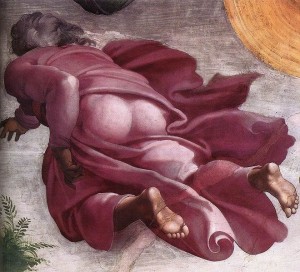
Hercules and Diomedes by Vincenzo de Rossi“Wrestling in his prayers” seems such an odd turn of phrase! Aren’t prayers supposed to be peaceful? The image of prayer as athletic competition (and vigorous, muscular, and very personal competition, at that) just seems contradictory. But the contradiction calls to mind two thoughts.
The first is that I remembered Jacob: “Jacob was left alone; and a man wrestled with him until daybreak. When the man saw that he did not prevail against Jacob, he struck him on the hip socket; and Jacob’s hip was put out of joint as he wrestled with him.” (Gen 32:24-25)

Doing early morning study of Koine Greek is probably a mistake . . . but I wondered, “Does Paul use the same word to describe Epaphras as the Septuagint uses to describe Jacob?” Short answer — no. Long answer — In Genesis, the wrestling contest is described using the word palaío; in Colossians, the word is agonizomai. The former is specific; the latter refers in general to athletic competition and may also mean “to struggle” or “to labor.”

Nonetheless, I wonder if Paul is calling Jacob’s late-night wrestling match with God to mind. If Jacob’s dream-time contest is a metaphor for prayer (and I think it is), then there is a striking contrast between first-party prayer (petition) which leaves the supplicant limping, and third-party prayer (intercession) which permits the subject to “stand mature and fully assured.” I don’t know what to make of this. Is there a suggestion that the prayers of others are more effective for our well-being than our own?

An Indian guru once said, “Prayer is not asking. It is a longing of the soul. It is daily admission of one’s weakness.” Was Jacob’s hip put out of joint by his encounter with God? Or was it always out of joint and the encounter merely led to a recognition or an admission of that fact? Prayer for oneself always does, in my experience, bring one up face-to-face with one’s own inadequacies. And, I have to say, I rely much more upon the prayers and prayerful support of others than upon my own. So perhaps there is something in the contrast Paul may be making.

The second, unrelated thought, is how often I struggle to find the “right words” with which to pray, both in private meditation and in public worship. As a priest, I am often asked to pray in public and, when that happens, I am grateful that, as an Episcopalian, I have been steeped in the language and cadences of The Book of Common Prayer. When I cannot think of anything original to say, I can rely on the prayerful words of generations of Anglicans and, from memory of the prayer book’s beautiful phrases, cobble something quickly together.

It is not always so in my private devotions. But that same Indian guru said of prayer, “It is better in prayer to have a heart without words than words without a heart.” So if my struggle to find the right words is unsuccessful, I just let it go and sit quietly, sure that God will understand me.

====================

A request to my readers: I’m trying to build the readership of this blog and I’d very much appreciate your help in doing so. If you find something here that is of value, please share it with others. If you are on Facebook, “like” the posts on your page so others can see them. If you are following me on Twitter, please “retweet” the notices of these meditations. If you have a blog of your own, please include mine in your links (a favor I will gladly reciprocate). Many thanks!

====================

Father Funston is the rector of St. Paul’s Episcopal Church, Medina, Ohio.

Parisian Friendship 1973 – A Poem (May 11, 2014)

Bois-de-Boulogne-Park

The foggy wood beyond my kitchen
beckons with chill fingers dripping dew;
gray mist’s obscure invitation,
to half-recalled memories of you.

Half-naked, a picnic, the Bois de Boulogne –
your hand on my chest; mine, your thigh.
Desire unanswered and passion unknown;
unspeakable craving left but to sigh.

Morning fog in the woods sparks memory;
the coffee grows cold in my hand.
Passion’s rekindled, but sadly,
“Tu est un fantôme dans mon âme.”

Our last night we talked on the hillside
overlooking the Seine’s rolling march.
We shared Gauloises, we laughed, and we lied;
I dared not speak the pain in my heart.

The moment passed, the summer ended.
A beautiful sadness in your eyes –
we parted friends, or so we pretended;
“Au revoir, mon ami!” is just a pack of lies!

by C Eric Funston
11 May 2014

Grandparental Nicknames – From the Daily Office – May 10, 2014

From Matthew’s Gospel:

As he walked by the Sea of Galilee, he saw two brothers, Simon, who is called Peter, and Andrew his brother, casting a net into the lake — for they were fishermen.

(From the Daily Office Lectionary – Matthew 4:18 (NRSV) –May 10, 2014)

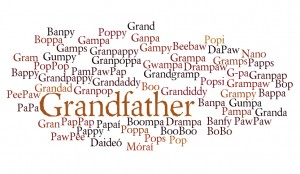
Grandfather NicknamesSometime this fall, probably during October, my wife and I will become grandparents for the first time. Last night, a friend asked, “What will you be called?” Because the question came out of the blue (we hadn’t been discussing children or grandchildren), I didn’t know what he was asking — and my face must have shown it. “As grandfather,” he clarified, “what will you be called as a grandparent?”

Good question. Is it really up to me? Do I get to say, “I want to be called [something]”? If so, I’d like to be called by one of the Irish nicknames: “Daideó” (pronounced “DAH-doe”) or “Móraí” (pronounced “MO-ree”) or “Papaí” (pronounced “PAH-pee”). The actual word for “grandfather” in Irish is seanathair which means “old father” or (in older Irish) “wise father”; an alternative is athair mór which means “great father” (“great” here is more akin to “big” than to “wonderful”).

But is it really up to me? Families have long-running traditions about naming grandparents, I think. Every grandmother (for the three generations I have known) on both sides of my family was known as “Grammy” — my mother called hers “Grammy Buss” and “Grammy Sargent”; mine were “Grammy Grace” and “Grammy Edna” (we were a less formal generation, I guess), and my mother was “Grammy Betty” to our children.

Grandfathers were less uniformly addressed. I don’t know what my greatgrandfathers were called; both were long dead when I was born. My maternal grandfather, Richard Sargent, was “Daddy Rich” (a combination of what my mother and grandmother called him); my paternal grandfather was “C.E.” (what everyone called him) or, less frequently, “Granddad.” My father was deceased when his grandchildren were born, so if he was referred to at all it was as “your grandfather, York”; my stepfather, Stan Shivers, was called “GrandStan” by my niece and nephew and my children.

One thing I’ve noticed is that the first-born grandchildren get to make the decision. My brother was nearly ten years older than me, and I had two older paternal cousins, so by the time I came along grandparental names were pretty much cast in stone. We have nieces and nephews several years older than our own children, so they had settled the issue on both sides long before our kids had a say.

All of this comes to mind this morning because of “Simon, who is called Peter.” It was Jesus who gave him that name: “I tell you, you are Peter, and on this rock I will build my church.” (Mt 16:18) For many years, I wondered why Jesus gave Simon this nickname and thought it was simply out of affection — it’s nearly the equivalent of “Rocky” and since Simon Peter often seems as dense as a bag of rocks, that made sense.

But I’ve come recently (while studying the prophets with an Education for Ministry group) to believe that Jesus is following in the tradition of Isaiah and, since he has no son to name, he is giving Simon a symbolic prophetic nickname in the same way that prophet named his children. Isaiah named his sons Shear-jashub, which means “the remnanet shall return,” and Maher-shalal-hash-baz, which means “he has hurried to plunder,” as signs against Judah and Jerusalem. I think Jesus gave Simon the new name Peter in a similar way, as a prophetic sign to the church.

Shear-jashub, Maher-shalal-has-baz, and Simon Peter had no say in the matter. So I still wonder with respect to this question of grandparental naming, is it really up to me?

And I wonder if grandparental naming is a prophetic activity. Does the name chosen shape the relationship? Does it portend what the relationship will be? Certainly, one would suspect that if a child is taught to call its grandfather “Grandfather,” that relationship will be rather different than that of a child who calls his or her grandfather “Grampa.” But do “Granddad” or “Papaí” or “Nano” shape the bond differently? And, if so, how?

This matter of choosing a grandparental nickname is serious stuff . . . assuming it really is up to me.

====================

A request to my readers: I’m trying to build the readership of this blog and I’d very much appreciate your help in doing so. If you find something here that is of value, please share it with others. If you are on Facebook, “like” the posts on your page so others can see them. If you are following me on Twitter, please “retweet” the notices of these meditations. If you have a blog of your own, please include mine in your links (a favor I will gladly reciprocate). Many thanks!

====================

Father Funston is the rector of St. Paul’s Episcopal Church, Medina, Ohio.

The Sacrament of Money – From the Daily Office – May 9, 2014

From the Book of Exodus:

The Lord said to Moses: Tell the Israelites to take for me an offering; from all whose hearts prompt them to give you shall receive the offering for me. This is the offering that you shall receive from them: gold, silver, and bronze, blue, purple, and crimson yarns and fine linen, goats’ hair, tanned rams’ skins, fine leather, acacia wood, oil for the lamps, spices for the anointing-oil and for the fragrant incense, onyx stones and gems to be set in the ephod and for the breastpiece. And have them make me a sanctuary, so that I may dwell among them.

(From the Daily Office Lectionary – Exodus 25:1-8 (NRSV) – May 9, 2014.)

Gold silver and bronze barsADDED LATER: Oops!!! I just realized late on May 9 that I had read the lessons for May 10 one day ahead of time. This lesson is actually for the next day . . . . mea culpa, mea culpa, mea maxima culpa! Apologies, faithful readers!

It occurred to me as I read this passage this morning that God is ordering Moses to conduct the first capital campaign.

In 24 years of ordained ministry I have been involved in three major capital campaigns in as many parishes. Each time, the parish leadership turned to professional fundraising consultants to assist them and each consultant told us the same thing: capital campaigns do not impact regular financial stewardship because people give to the operating budget out of income, but they give to the capital campaign out of wealth. In other words, our regular weekly support of our churches comes from our paychecks, but what we give to capital projects we take from savings and investments.

How is it that the Hebrews have all this wealth? These people are wandering around Sinai not carrying enough food to feed themselves — hence the manna and the quail in Exodus 16 — and yet they have gold, silver, bronze, spices, incense, and precious stones? That raises all sorts of issues for me about human priorities and the spirituality of possessions and wealth.

So, too, does Tuesday’s report that the 25 highest-earning hedge fund managers in the United States took home a total of $21.15 billion in compensation last year! That’s an average annual take-home for those investment advisors of $860 million each! That kind of compensation blurs the distinction between “income” and “wealth.” I would argue that this is not “income;” it is, rather, transfer of “wealth.”

In my most recent experience of capital campaigning, our goal was $500,000; we didn’t quite make it – we raised about 76% of the goal in five-year pledges. Because the work we were undertaking could not be postponed, our governing board made the “leap of faith” decision to finance the rest. For us, this was a difficult and painful decision. For any of those 25 hedge fund managers, it would have meant spending less than 6/10 of one percent of their annual compensation.

It has been suggested that money is a sacrament: it is a sign of the work we do, a symbol of our sweat and toil, an indicator of our values. I think I would refine that argument, however, to say that income is a sacrament of these things. Which then raises the question, of what is wealth a sacrament? Our security? Our faith in the future? Our faith in God? And just how sacramental (either as income or wealth) is a transfer of more millions of dollars than most people can even imagine, or an expenditure of less than one percent of our compensation?

I figured it out. 6/10 of one percent of my wife’s and my combined annual income is almost exactly what I spent a couple of days ago on a tankful of gasoline. That purchase was not a gut-wrenching decision; it required no thought at all, no spiritual or emotional investment, no “leap of faith” like the vestry’s decision to go forward with our recent capital improvement project. One of those hedge fund managers could have paid for that project with as little thought or spiritual reflection as I spent pumping gas into my car.

And, I suggest, that lack of thought and reflection about income and wealth permeates our society. A confession: This is the second time in a few months that I’ve read this passage of Exodus. The first was in the context of a bible study group at church. The first time the question of what the Hebrews were doing carting around that sort of wealth as they wandered the desert for forty years never occurred to me. It didn’t occur to me until it was juxtaposed with the report of hedge fund manager compensation and the inordinate wealth transfer it represents. But it should have. I should have, we all should have a spirituality of money, a theology of wealth and income.

And a theology of money, at the very least, should demand that we pause and engage in at least a bit of thought and spiritual reflection on what we do routinely — filling our tanks, buying books for leisure reading or study, letting the bank automatically pay our internet access fees. It requires us to get some perspective, to step back and think about the course we are charting, to consider what our spending says about us, what our saving says about us. What is money as a sacrament saying? What are the gold, silver, bronze, spices, incense, and precious gems we cart around our particular deserts saying about us?

====================

A request to my readers: I’m trying to build the readership of this blog and I’d very much appreciate your help in doing so. If you find something here that is of value, please share it with others. If you are on Facebook, “like” the posts on your page so others can see them. If you are following me on Twitter, please “retweet” the notices of these meditations. If you have a blog of your own, please include mine in your links (a favor I will gladly reciprocate). Many thanks!

====================

Father Funston is the rector of St. Paul’s Episcopal Church, Medina, Ohio.

Roadside Vision – A Poem (May 9, 2014)

Concrete Drainage Ditch

Priesthood:
broken concrete
drainage ditch
staunching the flood
bleeding over the roadway
endangering travelers
washing away the grit and grime
from lives spent
journeying
lurching
meandering
from one emotional oasis
of love
or hate
or depression
or ecstasy
one spiritual respite
to the next
always asking
seeking to know
hoping to confirm
does this have
does this really have
any
meaning?

by C Eric Funston
May 9, 2014

Pain – From the Daily Office – May 8, 2014

From the Letter to the Colossians:

I am now rejoicing in my sufferings for your sake, and in my flesh I am completing what is lacking in Christ’s afflictions for the sake of his body, that is, the church.

(From the Daily Office Lectionary – Colossians 1:24 (NRSV) – May 8, 2014.)

Hip PainToday, the Feast of Dame Julian of Norwich, is the 24th anniversary of my ordination to the diaconate. I am spending it, at least the morning, in the company of several fellow presbyters and a few deacons at a clergy conference. I am also spending it in some discomfort because yesterday morning I slipped and fell in the hotel bath; I wrenched my back and it appears I did something (only soft-tissue-ish, I hope) to my right hip.

I am also discomfited by Paul who “rejoiced” in his suffering and claims in this verse to do something I really don’t think needed to be done nor was (nor is) possible to do: “complete what is lacking in Christ’s afflictions.” In fact, I’m not even sure I understand what he is trying to say by that phrase and I find it so annoying I’m not even sure I can! Just who does Paul think he is? Who is he to suggest that something is “lacking” in the afflictions of the Lord? Who is he to think he can “complete” them?

It has been argued that this verse is more rhetorical than substantive. Paul, it is suggested, is not implying that Christ’s suffering and death failed in some way or fell short. Rather, he is simply submitting that Christ left work for us (Paul and all subsequent disciples through the ages) to do, and that whatever suffering Paul has been put through is a part of that work. OK . . . maybe so. I don’t have as much confidence in Paul’s humility as the commentator who made that argument seems to have had, but I’ll be charitable and give Paul the benefit of the doubt.

Does that mean I can claim my hip and back pain, the result of taking part in a clergy conference, are also contributing in some manner to the work of the church, to the world’s salvation? I certainly hope so, although I would never really make that claim. But perhaps my brother and sister clergy and I can make that claim about the deep-seated pain we often feel as we go about our ministry, the misery and turmoil we feel as we empathize with and enter into the pains of our parishioners, the doubt and conflict we feel about whether what we do and how we are doing it make any difference at all, the soul sickness we feel when we know that we have failed in some way to address the needs of those among whom we minister, the anger (and then the remorse and spiritual malaise) we feel when the expectations of the church are unwarranted and unreasonable. Perhaps some of that pain is salvific.

I love being a priest. There is great joy in ordained ministry. That was what I expected when I was made a transitional deacon 24 years ago and a priest a year later. I thought I knew there would be discomfort; I had no idea it would be as frequent or as painful as it has been. I wish there were a way to convey to ordinands that that is going to be the way it is, but I don’t think that can be done. You have to live through standing at a bedside with a family “pulling the plug” on a beloved parent or child, leaving the hospital convinced that everything you did and said was hopelessly inadequate. You have to live through watching an active parishioner abandon your congregation because of some stupid, silly thing you did or said. You have to live through being treated badly by people you thought were friends and being excluded from the social events and parties of parishioners who didn’t think you were. You have to live through shrinking budgets, declining attendance, and cold shoulders. You have to live through the pains of ordained ministry. Being told about them just isn’t enough.

After I’d been in parish ministry as a priest for about seven years, I started working with a spiritual director who was also a parish rector and had been in ministry for many years. When I would bemoan the pains of ministry (like making that list in previous paragraph), he’d ask, “And how did they treat Jesus?” and give me a look that fairly shouted, “And you expect them to treat you any better?” It was therapeutic. With his guidance, I came to believe that that pain is actually hope. It’s hopeful caring. I once broke down in tears telling my late mother about the difficulties I had experienced as a priest. Her response was, “If you didn’t care so much, it wouldn’t hurt so much.”

So I know who Paul was to make the statement he made in this verse; he was a fellow worker in ordained ministry and I suspect his suffering and pain was not just hip pain from falling in the shower; I think it was the soul-deep pain of hoping beyond hope that something you are doing is “completing what is lacking in Christ’s afflictions for the sake of his body, that is, the church.”

At clergy conferences we tell each other our stories; we share the pains we have lived through and we share the joys we have known. The science fiction author Spider Robinson once wrote, “Shared pain is lessened. Shared joy is increased. Thus we refute entropy.” Or, as Dame Julian might have said, “All shall be well, and all shall be well, and all manner of things shall be well.”

There are great benefits to clergy conferences. Shared joy is one of them. Shared pain is one of them. Hip pain from falling in the shower is not.

====================

A request to my readers: I’m trying to build the readership of this blog and I’d very much appreciate your help in doing so. If you find something here that is of value, please share it with others. If you are on Facebook, “like” the posts on your page so others can see them. If you are following me on Twitter, please “retweet” the notices of these meditations. If you have a blog of your own, please include mine in your links (a favor I will gladly reciprocate). Many thanks!

====================

Father Funston is the rector of St. Paul’s Episcopal Church, Medina, Ohio.

Cleaving to Dust – From the Daily Office – May 7, 2014

From the Psalter:

My soul cleaves to the dust; give me life according to your word.

(From the Daily Office Lectionary – Psalm 119:25 (BCP Version) – May 7, 2014.)

Handful of DustThe Gospel lesson today is the baptism of Jesus as told by Matthew. With it, for the evening, is coupled a portion of Psalm 119 which includes this verse. This image of a soul clinging to the dirt caught my attention. I wonder if baptism is efficacious if the soul being baptized steadfastly and stubbornly “cleaves to the dust” of its pre-baptismal life.

I sometimes wonder about my own baptism, which happened when I was 14 years of age and attending a private, residential high school affiliated with the Episcopal Church.

As part of the religious instruction required of all students, I had taken the confirmation class offered by the chaplain and was, thus, included in the list of young men upon whom the bishop was to lay hands during his official visit at one Thursday evening chapel service. Earlier in the day, going over his records, the chaplain noticed he had not record of my baptism.

That was not surprising since I’d not been baptized. Growing up in a largely unchurched home with a father estranged from the Methodist Church and a mother who’d been reared in (but left) one of those traditions that practice “believers’ baptism,” there had been no encouragement of nor opportunity for baptism.

So, in a hastily arranged private afternoon ceremony at the back of the chapel after gym class, with two members of the faculty standing as sponsors, I was quickly sprinkled and informed that I was now a Christian, eligible to be confirmed as an Episcopalian. That done, I went to my room to shower and dress for dinner and the obviously more important confirmation service later that evening.

What exactly happened that afternoon? Did my soul turn loose of the dust, or did it cleave to the dirt from which it was supposed to be cleansed? Does it matter? I’m not even going to try to answer those questions this morning, but the pairing of the baptismal story and the image of the soul clinging to the dust is certainly an odd lectionary coincidence.

====================

A request to my readers: I’m trying to build the readership of this blog and I’d very much appreciate your help in doing so. If you find something here that is of value, please share it with others. If you are on Facebook, “like” the posts on your page so others can see them. If you are following me on Twitter, please “retweet” the notices of these meditations. If you have a blog of your own, please include mine in your links (a favor I will gladly reciprocate). Many thanks!

====================

Father Funston is the rector of St. Paul’s Episcopal Church, Medina, Ohio.

« Older posts Newer posts »