 “You are the light of the world. … [L]et your light shine before others, so that they may see your good works and give glory to your Father in heaven.”[1]
Last week, I read this story on Facebook:
I own a small bakery. Business has been slow. Rent is up. I was thinking about closing. Last Friday, a teenager came in. He looked nervous. He counted out change for a cookie. He was short 50 cents. “It’s okay,” I said. “Take it.” He ate it at a table, looking at his math homework. I walked over. “Quadratic equations?” He nodded. “I don’t get it.” I sat down and helped him for 20 minutes. He got it. He left smiling. The next day, he came back with two friends. They bought cookies. The day after that, five kids came. Apparently, he told the school, “The lady at the bakery helps with homework.” Now, my bakery is the after-school hang-out spot. It’s loud. It’s messy. There are backpacks everywhere, Yesterday, I found a note in the tip jar. It was wrapped around a $20 bill. “Thanks for helping my son pass math. A Mom.” I’m not closing the bakery. I think I finally found my purpose. It’s not cookies. It’s community.
This baker is a light shining before others. I think that both Jesus and the prophet Isaiah would have approved of this baker.
 In any event, I know that Mother Lisa has been over all of that with them, so this sermon is not for them. It’s for you, their family and friends; it’s about their marriage, but it’s for you.
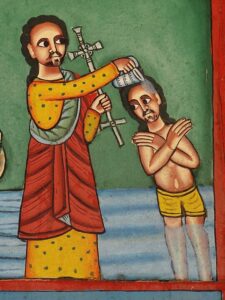
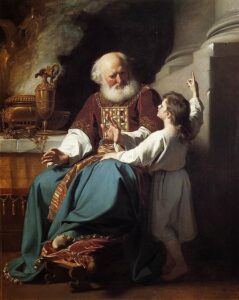 In the Episcopal Church, when we baptize a person, we pray that God will “give them an inquiring and discerning heart, the courage to will, and to persevere, a spirit to know, and love, [God], and the gift of joy, and wonder in all [God’s] works.”
 There’s a story about a pastor giving a children’s sermon. He decides to use a story about forest animals as his starting point, so he gathers the kids around him and begins by asking them a question. He says, “I’m going to describe someone to you and I want you to tell me who it is. This person prepares for winter by gathering nuts and hiding them in a safe place, like inside a hollow tree. Who might that be?” The kids all have a puzzled look on their faces and no one answers. So, the preacher continues, “Well, this person is kind of short. He has whiskers and a bushy tail, and he scampers along branches jumping from tree to tree.” More puzzled looks until, finally, Johnnie raises his hand. The preacher breathes a sigh of relief, and calls on Johnnie, who says, “I know the answer is supposed to be Jesus, but that sure sounds an awful lot like a squirrel to me.”
 Power and authority. These are the subjects of our lessons from Scripture this morning. Later this month they will figure as key concepts in a trial scheduled to begin in Fulton County, Georgia. That trial will focus on an alleged attempt to disrupt, even to stop, what we have come to call “the peaceful transfer of power.” Historian Maureen MacDonald wrote a few years ago:
 Do any of you know the story of Tubby the Cocker Spaniel? Well . . . remember Tubby’s name. We’ll come back to him, but first let’s put today’s gospel lesson in perspective.
 A book entitled Stories for the Heart was published a few years ago by inspirational speaker Alice Gray. It is a compilation of what Gray calls “stories to encourage your soul;” one of them is the following story, whose original author she says is unknown. It may not be true, but I (for one) hope it is:
 Two things happened last Saturday.

