 Their names were Curtis Adams, Mager Bradley, George Davis, Jr., Thomas Forte, Robert Green, James Leatherwood, Nathaniel Moss, George Motten, William Pritchett, James Stewart, and Due Turner. They came from Alabama, Mississippi, West Virginia, Texas, Arkansas. Thrown together by war, they were members of the 333rd Field Artillery Battalion, a segregated African American unit serving in Belgium during World War II. When the Germans began what came to be known as “the Battle of the Bulge” in December 1944, the 333rd stayed in place to support the withdrawal of the mostly white infantry regiments around them. These eleven men were captured by the Waffen-SS in a forest near the town of Wereth; they were tortured and murdered, and their bodies left unburied. Although the fact and nature of their sacrifice was well documented, it was never officially recognized by the U.S. government until 2017.[1]
Tag: Liturgy (Page 1 of 7)
 Do you all know what a tort is? Tort … T-O-R-T … no E on the end; I’m not talking about those wonderful little German or Austrian pastries. A tort is a civil wrong that causes harm to another person, resulting in legal liability for the person who commits the wrong. You leave a puddle of milk on the floor of your grocery store knowing it’s there, then someone slips in it and injures themselves: you have committed a tort. You speed through a stop sign, collide with another car, and injure the driver: you’ve not only broken the law, you’ve committed a tort.
A million years ago when I was in law school studying the law of torts with Professor Bill Lynch of blessed memory, I was introduced to the superhero of Anglo-American civil jurisprudence: the ordinary, reasonably prudent person, often called “ORPman”. ORPman’s super power, as you can tell from his name, is ordinary, reasonable prudence. His conduct is the standard against which allegedly tortious behavior is judged. His conduct is always sensible, never outrageous, not too timid, nor too bold. He is not a coward, but neither is he an excessive risk-taker. His expectations are rational; he is not demanding, but neither is he a doormat.
 Let’s have a show of hands: everyone who believes that there is a Constitution of the United States raise your hand. OK, good. Now everyone who believes in the Constitution of the United States raise your hand. Some of you might be thinking, “Wait. Didn’t he just ask us to do that?” Well, no. There’s a difference between “belief that” and “belief in.”
“Belief in” is an attitude toward a person or an institution, a sentiment or posture of trust, while “belief that” is just an attitude with regard to a proposition, one’s intellectual assent to its validity. One may believe that there is a Constitution establishing the government of the United States while not actually believing in the institutions and processes of governance that it creates and enshrines. That may be, perhaps, the source of some of our current social and political problems, but that’s another discussion for another time. With regard to our Christian faith, however, the intersection of these two different kinds of belief – “belief that” versus “belief in” – is at the heart of today’s lesson from the Gospel according to John.
This is probably going to come off as snarky criticism, but please take my word that I don’t mean it that way. It’s just that my diocese, the Episcopal Diocese of Ohio, promulgated a brochure-like document entitled “Vision Integration” at our most recent diocesan convention back in November. At the time, I didn’t pay it much attention: I’m retired, I’m not required to pay attention to these sorts of things any longer.
However, I more recently agreed to be part of a diocesan task force which, as I understand our mandate, is to develop one or two innovative programs or projects to assist our parishes with building maintenance and management issues. In preparation for our initial meeting, we were asked to review the “Vision Integration” document. Doing so, I have been reminded of a philosophical and spiritual position I have held about worship and liturgy for more than 35 years, which is to say “for longer than I’ve been an ordained person.” It is the belief that worship is central to the existence and mission of the church, moreso than any other ministry or activity the church may undertake. It is a position that is core to my ecclesiology, core to my understanding of the nature and purpose of the church.
 Again this week as last, our first reading today is from the First Book of Kings and like last week’s, it is a prayer spoken by King Solomon. Last week, it was a private prayer spoken in a dream late at night. Today, it is a public prayer. As long as it was, this reading is just a small part of the dedicatory prayer that Solomon offered when the Temple was finished and consecrated. In it, Solomon asks an important question, “[W]ill God indeed dwell on the earth?”[1] More specifically, Solomon is asking if God will dwell in the Temple, and the wise king immediately answers his own question: “[H]eaven and the highest heaven cannot contain you, much less this house that I have built!”[2]
The building of the Temple in 957 BCE[3] marked a very significant change in the Jewish religion. Well, really, let’s not call it the Jewish religion because it wasn’t that, yet. Let’s just say, “The religion of the people of Israel.” These people were not, though we often imagine them to be, strict monotheists. Even in this prayer, Solomon leaves open the question of whether there might be gods other than their God: “O Lord, God of Israel, there is no God like you in heaven above or on earth beneath.”[4] There might be other gods, lesser gods perhaps, demigods, or even demons, part of a heavenly pantheon of gods, but this God, the God of the People of Israel is greater than any of those others.
 The United States is, at least ostensibly, a very religious country. Nearly two hundred years ago, Alexis de Tocqueville wrote that “there is no country in the world where … religion retains a greater influence over the souls of men than in America; and there can be no greater proof of its utility and its conformity to human nature than that its influence is powerfully felt over the most enlightened and free nation of the earth.”[1] While recent polling data demonstrate that the influence of religion seems to have declined, it remains a powerful force.
According to an average of all 2023 Gallup polling, about 75% of Americans identify with a specific religious faith, and 71% say that religion is either “important” or “very important” in their lives; over 40% attend religious services at least monthly, more than half of those weekly.[2]
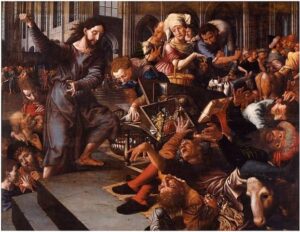 When I was about 8 or 9 years of age, my grandparents gave me an illustrated bible with several glossy, color illustrations of various stories. They weren’t great art, but they were clear and very expressive. My favorite amongst them was the illustration of today’s gospel lesson.
I know it was John’s version of the cleansing of the Temple because in that picture Jesus was swinging a whip. John’s is the only version of the story with that detail. The rest of the picture was filled with movement. Jesus was whirling about like a dervish, his long hair and the hem of his rob flaring out. Men were scattering, tables and cages sailing through the air, birds fluttering away, and coins flying everywhere.
A couple of decades ago, when several of my friends were wearing “WWJD?” (What would Jesus do?) bracelets, I’d think of that illustration and wonder, “Have you considered that time with the whip in the Temple courtyard?”
 What is Lent all about?
Some say it’s a time when we are supposed to find the presence of God in everyday life. The Most Rev. Dr. Jonn Sentamu, Archbishop of York from 2005 to 2020, suggested as much in his 2015 Ash Wednesday meditation when he said, “Lent is a time to get to know God better.”[1] The metaphor of keeping Lent as being a journey during which we search for, find, and come to know more of God is so widespread and prevalent, one cannot find its origin.
It seems to be the most common way to think about Lent. But that way isn’t working for me this year, especially as I contemplate Mark’s description of Jesus’ baptism and its aftermath. If in our Lenten discipline we are to be, in some way, doing what a Lenten hymn attributed to St. Gregory the Great says — “keep[ing] vigil with our heavenly lord in his temptation and his fast”[2] — then we should pay particular attention to what really was going on there and seek to do during Lent what seems to be going on with Jesus in the wilderness.
 Here we are at the end of the first period of what the church calls “ordinary time” during this liturgical year, the season of Sundays after the Feast of the Epiphany during which we have heard many gospel stories which reveal or manifest (the meaning of epiphany) something about Jesus. On this Sunday, the Sunday before Lent starts on Ash Wednesday, we always hear some version of the story of Jesus’ Transfiguration, a story so important that it is told in the three Synoptic Gospels, alluded to in John’s Gospel, and mentioned in the Second Letter of Peter.
Six days before, Jesus had had a conversation with the Twelve in which he’d asked them who they thought he was. They had said that other people thought Jesus might be a prophet and that some thought he might even be Elijah returned from Heaven or John the Baptizer returned from the dead. Jesus put them on the spot, though, and asked, “But who do you say I am?”[1] Peter answered, “You are the Messiah.”
 There’s a story about a pastor giving a children’s sermon. He decides to use a story about forest animals as his starting point, so he gathers the kids around him and begins by asking them a question. He says, “I’m going to describe someone to you and I want you to tell me who it is. This person prepares for winter by gathering nuts and hiding them in a safe place, like inside a hollow tree. Who might that be?” The kids all have a puzzled look on their faces and no one answers. So, the preacher continues, “Well, this person is kind of short. He has whiskers and a bushy tail, and he scampers along branches jumping from tree to tree.” More puzzled looks until, finally, Johnnie raises his hand. The preacher breathes a sigh of relief, and calls on Johnnie, who says, “I know the answer is supposed to be Jesus, but that sure sounds an awful lot like a squirrel to me.”
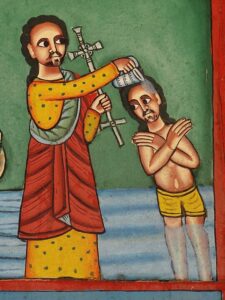
My best friend (another retired priest) and I often ask one another, “What are you preaching about on Sunday?” and our answer is always “Jesus.” For a preacher, the answer is always supposed to be Jesus. We’re supposed to take Paul as our model; he wrote to the Corinthians, “When I came to you, brothers and sisters, I did not come proclaiming the mystery of God to you in lofty words or wisdom. For I decided to know nothing among you except Jesus Christ, and him crucified.”[1] So we are to do the same, preach Christ and him crucified, or perhaps today preach Christ and him baptized.


