 Again this week as last, our first reading today is from the First Book of Kings and like last week’s, it is a prayer spoken by King Solomon. Last week, it was a private prayer spoken in a dream late at night. Today, it is a public prayer. As long as it was, this reading is just a small part of the dedicatory prayer that Solomon offered when the Temple was finished and consecrated. In it, Solomon asks an important question, “[W]ill God indeed dwell on the earth?”[1] More specifically, Solomon is asking if God will dwell in the Temple, and the wise king immediately answers his own question: “[H]eaven and the highest heaven cannot contain you, much less this house that I have built!”[2]
The building of the Temple in 957 BCE[3] marked a very significant change in the Jewish religion. Well, really, let’s not call it the Jewish religion because it wasn’t that, yet. Let’s just say, “The religion of the people of Israel.” These people were not, though we often imagine them to be, strict monotheists. Even in this prayer, Solomon leaves open the question of whether there might be gods other than their God: “O Lord, God of Israel, there is no God like you in heaven above or on earth beneath.”[4] There might be other gods, lesser gods perhaps, demigods, or even demons, part of a heavenly pantheon of gods, but this God, the God of the People of Israel is greater than any of those others.
 The United States is, at least ostensibly, a very religious country. Nearly two hundred years ago, Alexis de Tocqueville wrote that “there is no country in the world where … religion retains a greater influence over the souls of men than in America; and there can be no greater proof of its utility and its conformity to human nature than that its influence is powerfully felt over the most enlightened and free nation of the earth.”
 We have had more than enough of contempt,
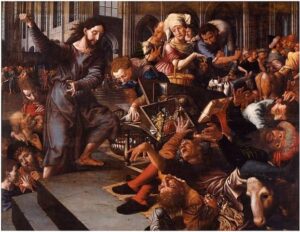 When I was about 8 or 9 years of age, my grandparents gave me an illustrated bible with several glossy, color illustrations of various stories. They weren’t great art, but they were clear and very expressive. My favorite amongst them was the illustration of today’s gospel lesson.
 What is Lent all about?
 Here we are at the end of the first period of what the church calls “ordinary time” during this liturgical year, the season of Sundays after the Feast of the Epiphany during which we have heard many gospel stories which reveal or manifest (the meaning of epiphany) something about Jesus. On this Sunday, the Sunday before Lent starts on Ash Wednesday, we always hear some version of the story of Jesus’ Transfiguration, a story so important that it is told in the three Synoptic Gospels, alluded to in John’s Gospel, and mentioned in the Second Letter of Peter.
 There’s a story about a pastor giving a children’s sermon. He decides to use a story about forest animals as his starting point, so he gathers the kids around him and begins by asking them a question. He says, “I’m going to describe someone to you and I want you to tell me who it is. This person prepares for winter by gathering nuts and hiding them in a safe place, like inside a hollow tree. Who might that be?” The kids all have a puzzled look on their faces and no one answers. So, the preacher continues, “Well, this person is kind of short. He has whiskers and a bushy tail, and he scampers along branches jumping from tree to tree.” More puzzled looks until, finally, Johnnie raises his hand. The preacher breathes a sigh of relief, and calls on Johnnie, who says, “I know the answer is supposed to be Jesus, but that sure sounds an awful lot like a squirrel to me.”
 When I find myself in times of trouble,
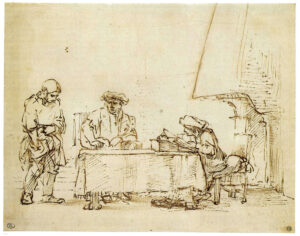 John, your parish secretary, puts together a mailing every week that he sends to the clergy who will be joining you as presiders and preachers. He includes in that mailing some of the material from an Augsburg Fortress publication called “Sundays and Seasons,” which is a great lectionary resource. The illuminations that your lectors read before each Bible reading giving a little introduction about the lesson come from “Sundays and Seasons.” I’ve been familiar with the publication for a long time, though I’ve never been a subscriber: I used to participate in a weekly ecumenical lectionary study group that included Presbyterian, Methodist, Lutheran, and Episcopal clergy and our Lutheran colleagues often brought something from “Sundays and Seasons” into our discussions.
 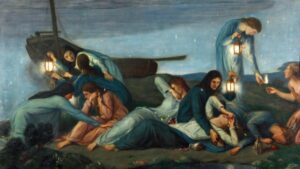 We have three intriguing lessons from scripture today. First we have a denunciation of Hebrew worship, which also interestingly contains a verse most famous in American politics for having been spoken on the steps of the Lincoln monument by Dr. Martin Luther King, Jr. Some people who dislike liturgy, or some aspect of liturgy, like incense, or vestments or music, ignoring that sentence about justice flowing like streams, have used this text to prove that God also dislikes, liturgy, or incense, or vestments, or whatever. However, that’s not what this lesson is about and I’ll get back to that in just a moment.

