 What is Lent all about?
Some say it’s a time when we are supposed to find the presence of God in everyday life. The Most Rev. Dr. Jonn Sentamu, Archbishop of York from 2005 to 2020, suggested as much in his 2015 Ash Wednesday meditation when he said, “Lent is a time to get to know God better.”[1] The metaphor of keeping Lent as being a journey during which we search for, find, and come to know more of God is so widespread and prevalent, one cannot find its origin.
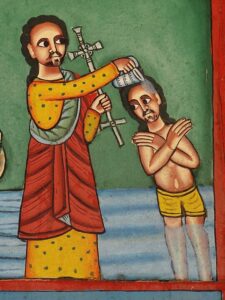
It seems to be the most common way to think about Lent. But that way isn’t working for me this year, especially as I contemplate Mark’s description of Jesus’ baptism and its aftermath. If in our Lenten discipline we are to be, in some way, doing what a Lenten hymn attributed to St. Gregory the Great says — “keep[ing] vigil with our heavenly lord in his temptation and his fast”[2] — then we should pay particular attention to what really was going on there and seek to do during Lent what seems to be going on with Jesus in the wilderness.
 Here we are at the end of the first period of what the church calls “ordinary time” during this liturgical year, the season of Sundays after the Feast of the Epiphany during which we have heard many gospel stories which reveal or manifest (the meaning of epiphany) something about Jesus. On this Sunday, the Sunday before Lent starts on Ash Wednesday, we always hear some version of the story of Jesus’ Transfiguration, a story so important that it is told in the three Synoptic Gospels, alluded to in John’s Gospel, and mentioned in the Second Letter of Peter.
 In the Episcopal Church, when we baptize a person, we pray that God will “give them an inquiring and discerning heart, the courage to will, and to persevere, a spirit to know, and love, [God], and the gift of joy, and wonder in all [God’s] works.”
 There’s a story about a pastor giving a children’s sermon. He decides to use a story about forest animals as his starting point, so he gathers the kids around him and begins by asking them a question. He says, “I’m going to describe someone to you and I want you to tell me who it is. This person prepares for winter by gathering nuts and hiding them in a safe place, like inside a hollow tree. Who might that be?” The kids all have a puzzled look on their faces and no one answers. So, the preacher continues, “Well, this person is kind of short. He has whiskers and a bushy tail, and he scampers along branches jumping from tree to tree.” More puzzled looks until, finally, Johnnie raises his hand. The preacher breathes a sigh of relief, and calls on Johnnie, who says, “I know the answer is supposed to be Jesus, but that sure sounds an awful lot like a squirrel to me.”
 When I find myself in times of trouble,
 On April 12, a little more than seven months ago, I was privileged to officiate and preach at a service of Choral Evensong at Trinity Episcopal Cathedral in Cleveland. Following the service, on our way home to Medina, my wife Evelyn and I stopped at a Lebanese restaurant in Middleburg Heights for a late dinner in celebration of our 43rd wedding anniversary, which that day was. After a lovely meal of hummus, baba ganoush, spicy beef kafta, and chicken shwarma, we went home to bed. A few hours later, around 2 a.m., I woke up with a horrendous case of heartburn. I took some antacid and went back to sleep sitting up in my favorite armchair. At 7 a.m. the next morning, I woke up knowing that I hadn’t had indigestion after all; I was having a heart attack.
 John, your parish secretary, puts together a mailing every week that he sends to the clergy who will be joining you as presiders and preachers. He includes in that mailing some of the material from an Augsburg Fortress publication called “Sundays and Seasons,” which is a great lectionary resource. The illuminations that your lectors read before each Bible reading giving a little introduction about the lesson come from “Sundays and Seasons.” I’ve been familiar with the publication for a long time, though I’ve never been a subscriber: I used to participate in a weekly ecumenical lectionary study group that included Presbyterian, Methodist, Lutheran, and Episcopal clergy and our Lutheran colleagues often brought something from “Sundays and Seasons” into our discussions.
  We have three intriguing lessons from scripture today. First we have a denunciation of Hebrew worship, which also interestingly contains a verse most famous in American politics for having been spoken on the steps of the Lincoln monument by Dr. Martin Luther King, Jr. Some people who dislike liturgy, or some aspect of liturgy, like incense, or vestments or music, ignoring that sentence about justice flowing like streams, have used this text to prove that God also dislikes, liturgy, or incense, or vestments, or whatever. However, that’s not what this lesson is about and I’ll get back to that in just a moment.
  What does it mean to say “Jesus is Lord”? The question arises because of today’s dialog between Jesus and some of the Pharisees about the relative importance of the Commandments. Jesus responds to a lawyer’s question about the greatest commandment and then follows his response with a question about the lordship of the Messiah, the anticipated “Son of David.”
  “The kingdom of heaven may be compared to a king . . . .”

