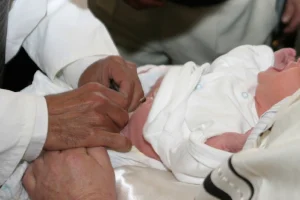
“Name this child.” That’s what I say to parents of infant baptismal candidates as I take their children from them. The words are not actually written in the baptismal service of The Book of Common Prayer as they are in some other traditions’ liturgies, but there is a rubric that says, “Each candidate is presented by name to the Celebrant . . . .”[1] so asking for the child’s name is a practical way of seeing that done. It’s practical, but it’s also a theological statement.
There is a common religious belief found in nearly all cultures that knowing the name of a thing or a person gives one power over that thing or person. One finds this belief among African and North American indigenous tribes, as well as in ancient Egyptian, Vedic, and Hindu traditions; it is also present in all three of the Abrahamic religions, Judaism, Christianity, and Islam.
The naming we do at baptism echoes the naming that takes place in Judaism when a male infant is circumcised on the eighth day after his birth. In that service, called the brit milah or bris, the officiating mohel prays, “Our God and God of our fathers, preserve this child for his father and mother, and his name in Israel shall be called ________”[2] and the prayer continues that, by his naming, the infant will be enrolled in the covenant of God with Israel. A similar thing is done when a girl is named in the ceremony called zeved habat or simchat bat, the “gift (or celebration) of the daughter” on the first sabbath following her birth.[3] With the name given at baptism, the church says to its newest member, “This is who you are: washed in the waters of baptism, sealed by the Holy Spirit, and marked as Christ’s own forever,”[4] a brother or sister in the church, a fellow member of the Body of Christ, an adopted child of God the Father.
Continue reading
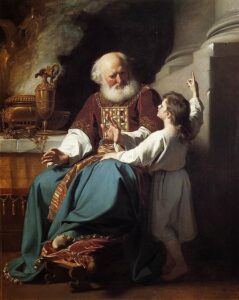 In the Episcopal Church, when we baptize a person, we pray that God will “give them an inquiring and discerning heart, the courage to will, and to persevere, a spirit to know, and love, [God], and the gift of joy, and wonder in all [God’s] works.”[1] Similarly, in the Evangelical Lutheran Church, the prayer is that the baptizee will receive “the spirit of wisdom and understanding, the spirit of counsel and might, the spirit of knowledge, and the fear of the Lord, [and] the spirit of joy in [God’s] presence.”[2]
 On April 12, a little more than seven months ago, I was privileged to officiate and preach at a service of Choral Evensong at Trinity Episcopal Cathedral in Cleveland. Following the service, on our way home to Medina, my wife Evelyn and I stopped at a Lebanese restaurant in Middleburg Heights for a late dinner in celebration of our 43rd wedding anniversary, which that day was. After a lovely meal of hummus, baba ganoush, spicy beef kafta, and chicken shwarma, we went home to bed. A few hours later, around 2 a.m., I woke up with a horrendous case of heartburn. I took some antacid and went back to sleep sitting up in my favorite armchair. At 7 a.m. the next morning, I woke up knowing that I hadn’t had indigestion after all; I was having a heart attack.
 What does it mean to say “Jesus is Lord”? The question arises because of today’s dialog between Jesus and some of the Pharisees about the relative importance of the Commandments. Jesus responds to a lawyer’s question about the greatest commandment and then follows his response with a question about the lordship of the Messiah, the anticipated “Son of David.”
 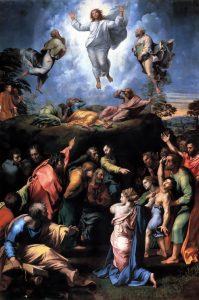 Today, in the normal course of the Lectionary, would have been the 10th Sunday after Pentecost on which, this year, we would have read the lessons known as “Proper 13” in which the gospel lesson is Matthew’s story of the feeding of the 5,000. However, since this is August 6, we don’t follow the normal course. We step away from the Lectionary to celebrate one of the feasts which, in the language of the Prayer Book, “take precedence of a Sunday,”
 When I was 19 years old, my parish priest, Fr. John Donaldson, died of cancer. I was privileged to be the acolyte and crucifer at his requiem and burial. It was a very formal, high-church affair. In all honesty, I remember very little of Fr. John’s funeral. I don’t remember Bishop Bloy’s homily at all, but I do remember the committal at the graveside. You see, it was my first experience of a burial using the liturgy of the Episcopal Church.
 This is an old and familiar story, a comfortable story if you will … the parable of the sower.
 Do any of you know the story of Tubby the Cocker Spaniel? Well . . . remember Tubby’s name. We’ll come back to him, but first let’s put today’s gospel lesson in perspective.
 “As Jesus was walking along, he saw a man called Matthew sitting at the tax booth; and he said to him, ‘Follow me.’ And he got up and followed him.”
 A book entitled Stories for the Heart was published a few years ago by inspirational speaker Alice Gray. It is a compilation of what Gray calls “stories to encourage your soul;” one of them is the following story, whose original author she says is unknown. It may not be true, but I (for one) hope it is:

