Occasional thoughts of an Anglican Episcopal priest

Category: Acts (Page 6 of 9)

Of Tombs and Siblings – From the Daily Office – August 14, 2014

From the Book of Acts:

[Stephen the Deacon answered the High Priest in the council and said:] “Joseph sent and invited his father Jacob and all his relatives to come to him, seventy-five in all; so Jacob went down to Egypt. He himself died there as well as our ancestors, and their bodies were brought back to Shechem and laid in the tomb that Abraham had bought for a sum of silver from the sons of Hamor in Shechem.”

(From the Daily Office Lectionary – Acts 7:14-16 (NRSV) – August 14, 2014)

Icon of the Martyrdom of St PhiloumenosShechem was known as Sychar in Jesus’ time. Near that land that Abraham had bought for use as a tomb, just a short walk south from the traditional location of Joseph’s tomb, is a well that belonged to Jacob. At that well, Jesus stopped to ask a Samaritan woman for a drink; part of the story of that meeting and Jesus’ conversation with the woman (the longest of all the conversations recorded in the Gospels) is today’s Gospel text (John 4:27-42).

Near Sychar the Romans built the Greek-named city of Flavia Neapolis which grew large and encompassed the ancient Jewish and Samaritan city. As the predominant local language changed to Arabic, the Greek name was retained but shortened and Arabicized, and now the modern city of Nablus is among the largest Arab cities in the Holy Land.

Over the site of Jacob’s Well stands the Greek Orthodox Church of St. Photini. The name Photini is given by Orthodox tradition to the Samaritan woman; it means “light bringer” in recognition of her bringing the light of Christ to the people of the city. The first church dedicated to her at the site was built in 311 AD.

There are two tombs at St. Photini Church. One inside houses the remains of Archimandrite Philoumenos, a priest who almost single-handedly restored the ancient church to its present modern condition. In 1979 a group of radical Zionists from a nearby Israeli settlement claimed Jacob’s Well, which is in a chapel inside the crypt of the church, as a Jewish holy place and demanded that crosses and icons be removed. A week later, on November 29, Fr. Philoumenos was hacked to death with an ax in the crypt and the church was desecrated. Although it is widely believed that the settlers were responsible, no one was ever convicted of the priest’s murder. Fr. Philoumenos was ranked among the Saints of the Church of Jerusalem on August 30, 2008, and his feast day set on November 29, the anniversary of his martyrdom.

Fr Justinus's TombThe second tomb is that of Fr. Justinus, the priest who took over the church from St. Philoumenos and continued his work of restoration. An accomplished artist, Fr. Justinus wrote all of the icons which now decorate the nave, sanctuary, and crypt, including an icon of the martyrdom of St. Philoumenos. Fr. Justinus’s tomb is empty because he is still alive. He built his tomb himself and it is placed just outside the front door of the church; he walks past it everyday coming from his residence in the neighboring monastery to the church. It is a daily reminder of his (and our) mortality and of the dangers he (and many) face in the on-going violence or threat of violence that characterizes the Holy Land today.

If we were to read further in Acts (and we will tomorrow and the day after) we would read of the martyrdom of Stephen. His address to the Sanhedrin (perhaps one would best characterize it as a polemical sermon) so enraged his hearers that “they dragged him out of the city and began to stone him” (Acts 7:58) which resulted in his death. We are told that “devout men buried Stephen and made loud lamentation over him” (8:2) but we are not told where his burial place may have been, though surely it is in or near Jerusalem.

Nonetheless, his sermon about Jesus at Jacob’s Well in Shechem-Sychar-Nablus, the well’s location near Joseph’s Tomb and its intimate connection to the martyrdom of St. Philoumenos, and the eventual outcome of Stephen’s address are stark reminders that the Good News of God (whether that be the Covenant of the Old Testament or the Gospel of the New) is not the promise of an easy life. One would not be surprised to hear the Almighty singing the lyrics of that old country song:

I beg your pardon; I never promised you a rose garden.
Along with the sunshine, there’s gotta be a little rain sometime.
When you take you gotta give so live and let live and let go.
I beg your pardon, I never promised you a rose garden.

In fact, Jesus did pretty much that when he disabused his disciples, “Do not think that I have come to bring peace to the earth; I have not come to bring peace, but a sword.” (Mat. 10:34)

The People of God are called to be risk-takers and, sometimes, to risk even death. Christians most surely must know that; we have only the example of our Lord to prove it. But it is also true of all the children of Abraham, not only Christians but also Jews and Muslims. What is sad is that Abraham’s descendants cannot live peaceably among themselves, that it is often our Abrahamic “siblings” from whom we face the greatest danger (sometimes even more so from our brothers and sisters within the same faith group). I believe that this breaks God’s heart!

As he died, Stephen the Deacon “knelt down and cried out in a loud voice, ‘Lord, do not hold this sin against them.’” (Acts 7:60) So should we all pray for those who persecute us, and let us pray especially for all who are the spiritual descendants of Abraham, that there may be peace among Jews, Muslims, and Christians.

(Note: The icon of the martyrdom of St. Philoumenos may be photographed by pilgrims and tourists, and those photographs are to be found widely posted on the internet, the Israeli Government and the Palestinian Authority will not permit the Greek Orthodox Patriarchate of Jerusalem nor the parish church or monastery to reproduce the icon. It is considered politically inflammatory and is therefore censored.)

====================

A request to my readers: I’m trying to build the readership of this blog and I’d very much appreciate your help in doing so. If you find something here that is of value, please share it with others. If you are on Facebook, “like” the posts on your page so others can see them. If you are following me on Twitter, please “retweet” the notices of these meditations. If you have a blog of your own, please include mine in your links (a favor I will gladly reciprocate). Many thanks!

====================

Father Funston is the rector of St. Paul’s Episcopal Church, Medina, Ohio.

Most Definitely – From the Daily Office – August 13, 2014

From the Book of Acts:

Now during those days, when the disciples were increasing in number, the Hellenists complained against the Hebrews because their widows were being neglected in the daily distribution of food. And the twelve called together the whole community of the disciples and said, “It is not right that we should neglect the word of God in order to wait at tables. Therefore, friends, select from among yourselves seven men of good standing, full of the Spirit and of wisdom, whom we may appoint to this task, while we, for our part, will devote ourselves to prayer and to serving the word.” What they said pleased the whole community, and they chose Stephen, a man full of faith and the Holy Spirit, together with Philip, Prochorus, Nicanor, Timon, Parmenas, and Nicolaus, a proselyte of Antioch. They had these men stand before the apostles, who prayed and laid their hands on them.

(From the Daily Office Lectionary – Acts 6:1-6 (NRSV) – August 13, 2014)

Coptic Pope Selected by a ChildMy wife refuses to use the word “coincidence.” She claims there are no such things. The concurrence in time of apparently unrelated but complementary and mutually reinforcing events, she asserts, is the intentional activity of the Holy Spirit. Nothing, “coincidental” (in the popular understanding of the word) about it.

Well, today one of these God-incidents, as she calls them, has occurred. When we are given this passage of scripture to read, we are also treated to the announcement of the Joint Nominating Committee for the Election of the Presiding Bishop (JNCPB) that it has issued a Call for Discernment and Profile for the election of the 27th Presiding Bishop of The Episcopal Church. (Notice all the “this is terribly important” capital letters in that announcement!) The “Call and Profile” can be found here: it is TWENTY pages long! The coincidence (Sorry, dear!) of this reading and this announcement seems instructive.

Luke (the author of Acts) doesn’t tell us how the apostles and the early Christian community actually called, profiled, [s]elected, and chose the first seven deacons, but I somehow doubt that they spent several months producing a twenty page document detailing the perceived needs, duties, qualifications, objectives, potential ministries, goals, and whatever-else-corporate-America-is-currently-buzzwording-for-CEOs of the job. Granted deacons are not presiding bishops. (Truth be told, I think deacons are more important than presiding bishops.) But diakonia is diakonia at whatever hierarchical level it may be performed.

I think the church has gotten lost. I hate to say that, but I think the church has truly gotten lost in the dark woods of corporate leadership process. We have followed the guidebook of the Harvard MBA and seem no longer to hear (or heed) the promptings of the Holy Spirit. As much as I value the democratic processes that make the Episcopal Church unique among Anglicans and the other branches of the Christian faith which preserve the Catholic Tradition, those processes do not and should not be permitted to make us a religious reflection of a for-profit corporation. What works (assuming it does work) for shareholders, directors, and managers of Wall-Street-traded business entities may not (probably does not) work for the church, but we seem to have adopted those processes and methods lock, stock, and barrel.

We use these methods now to select rectors of parishes, bishops of dioceses, and (now) the Presiding Bishop and Primate of the Episcopal Church. I ask, in all sincerity, have they worked? And my answer would be, “Sometimes.” Sometimes I believe the Holy Spirit uses our business methods and processes to do her work and help us select the best person. And sometimes I think our business processes and methods get in the way, and that the Holy Spirit just shrugs her shoulders, sits back, and waits for next time . . . .

When the Episcopal Cafe made note of the “Call and Profile” and posted that article on Facebook, I made this comment:

Put the names of all canonically eligible bishops in a large chalice then have my yet-to-be-born grandchild (who will be 9 months old and in attendance with his/her deputy parents) – or some other available innocent child – draw one name slip from the chalice. Make that person PB. Trust the Holy Spirit and stop all this corporate-America profiling-and-politicking nonsense.

This is a riff on the method the Coptic Orthodox Church uses to select its popes (as reported by NBC News). I believe it would work for us as well as, if not better than, all the profiling, job describing, nominating, and electing we go through; it is just as likely to be used and guided by the Holy Spirit, and maybe even more so. It was, basically, the method the apostles used to select a successor for Judas (Acts 1:15-26) and, in all honesty, I don’t think we’ve improved on it in nearly 2,000 years of adopting, changing, and monkeying with other methods.

My son is a clergy deputy to the upcoming General Convention (and his wife is a lay deputy). I asked if he thought Jr. Funston would be up to the task of selecting a name from a chalice. He replied, “Most definitely.”

====================

A request to my readers: I’m trying to build the readership of this blog and I’d very much appreciate your help in doing so. If you find something here that is of value, please share it with others. If you are on Facebook, “like” the posts on your page so others can see them. If you are following me on Twitter, please “retweet” the notices of these meditations. If you have a blog of your own, please include mine in your links (a favor I will gladly reciprocate). Many thanks!

====================

Father Funston is the rector of St. Paul’s Episcopal Church, Medina, Ohio.

All God’s Children: Day Four in Jerusalem – From the Daily Office – June 29, 2014

From the Acts of the Apostles:

Paul stood in front of the Areopagus and said, “Athenians, I see how extremely religious you are in every way. For as I went through the city and looked carefully at the objects of your worship, I found among them an altar with the inscription, ‘To an unknown god.’ What therefore you worship as unknown, this I proclaim to you. The God who made the world and everything in it, he who is Lord of heaven and earth, does not live in shrines made by human hands, nor is he served by human hands, as though he needed anything, since he himself gives to all mortals life and breath and all things. From one ancestor he made all nations to inhabit the whole earth, and he allotted the times of their existence and the boundaries of the places where they would live, so that they would search for God and perhaps grope for him and find him — though indeed he is not far from each one of us. For ‘In him we live and move and have our being;’ as even some of your own poets have said, ‘For we too are his offspring.’ “

(From the Daily Office Lectionary – Acts 17:22-28 (NRSV) – June 29, 2014)

Always one of my favorite stories of the Apostle Paul, this incident is depicted in the stained glass altar window of my church (St. Paul’s Episcopal Church in Medina, Ohio). I chose to use it as my focus scripture to introduce a summary of our Holy Land Pilgrimage activities today because Paul’s message of unity – that in God we all live and move and have our being, and that we are all God’s offspring – is one that needs badly to be heard in Israel and Palestine and, if the statistics we are hearing about Christian population in these countries are correct, it is one that won’t be heard very loudly or at all. Down from as high at 35% at the time of the British Mandate and the establishment of the state of Israel in 1948, the Christian population of Israel and Palestine today is less than 2%.

We began our day early with breakfast at 5:30 a.m. — to the usual assortment of olives, pickled eggplant, humus, labneh, yogurt, cheeses, and so forth was added a flaky, cheese-stuffed pastry, a sort of savory popover. Washed down with several cups of instant coffee (instant is all they serve here), this got us fortified for a morning of cultural fascination and disappointment.

First, we rode our bus to the Dung Gate of the old city, a pretty awful but ancient name for the southern gate in the city wall which derives from the refuse dumped here in ancient times; presumably, the prevailing winds would carry odors away. (“I went out by night by the Valley Gate past the Dragon’s Spring and to the Dung Gate, and I inspected the walls of Jerusalem that had been broken down and its gates that had been destroyed by fire.” Neh 2:13) This gate leads directly to the Western Wall and an archaeological park located at the south end of the Temple Mount.

We stood on line for nearly an hour waiting for Israeli security to open the gate that leads to the only access non-Muslims have to the top of the Temple Mount (which Muslims call “the Noble Sanctuary), the Al-Aqsah Mosque, and the Dome of the Rock. Above this gate is a sign reading, “According to Torah Law, entering the Temple Mount area is strictly forbidden due to the holiness of the site. [signed] The Chief Rabbinate of Israel” Both the Ashkenazi and Sephardi Chief Rabbis have signed this statement which was first issued by the Ashkenazi rabbi in 1935; both reiterated this prohibition in 2013.

Ignoring the Chief Rabbinate, a group of Israeli “settlers” stood in the line in front of us waiting to gain access to the Temple Mount.

Finally, security opened the gate and we were ushered through. The settlers were given a thorough search, however. From the covered wooden walkway from the security point to the actual gate of the Mount, we were able to take some good photographs of the crowd of Jews at the Wailing Wall. Directly under us, a large group of Jewish women were singing a hymn at the Wall. Directly in front of us, at the end of the covered walkway, Israeli security stored their heavy plexiglass riot shields, a visible sign to anyone entering that the police were prepared.

We entered the Noble Sanctuary and found a spot in the shade where Iyad could tell us about its history, ancient and modern. While he was talking some young adult tourists (American or Canadian college kids?) came onto the Mount and an old Muslim man began to berate them for being immodestly dressed. (We’d been told ahead of time that should wear long pants and long- or short-sleeve shirts, no tank tops; women should be in dresses or pants to the ankle, long-sleeved blouses, and scarves or veils. Why their guide hadn’t done the same, I have no idea.) An argument erupted between the old man and the Israeli police guards about who had authority to tell tourists whether they could enter and what the should wear. Eventually the college kids got themselves properly attired (using towels and large scarves) and walked on, but I know they took away an image of Muslim intractability.

Shortly after that, the settlers we’d seen at the security gate entered, to boos, hoots, catcalls, and other shouts of protest (or of “Allah hu akbar” – God is great) from the Muslims. They either offered a prayer or held a short conversation just inside the gate, then made a bee-line for an exit (passing us and wishing us “Shalom” as they did so). They had no reason to be there, other than to be provocative.

We spent some time walking through the area and seeing its sights. Unfortunately, since September 2000 when Israeli prime minister Ariel Sharon “visited” the Temple Mount, an act scene by many as provoking the second Intifada, no non-Muslim has been permitted to enter the Al Aq-sah Mosque or the Dome of the Rock, so we could not see in the insides of the buildings.

After that we left the Noble Sanctuary by another gate (one can leave by any of the twelve gates, but non-Muslims can enter by only the one). We made our way to St. Anne’s Church at the Pools of Bethesda. A short visit to the pools and archeological site was followed by our entering the church and, as a group, singing Seek Ye First before the altar. The church, which is a crusader construction of limestone, has marvelous accoustics and we really sounded good. (The church is well preserved because it was turned into a Muslim school at one point. This is why it has no windows; those were replaced by the Muslims with plaster filigree. It also has a verse from the Qur’an carved in the stone over the front door.) After that, we made our way back to the bus which took us back to St. George’s Cathedral.

We gathered in a rather full church for the Eucharist, celebrated in both English and Arabic — and interesting experience reciting the creed and other parts of the canon in English while others were doing so in Arabic. Bishop Suheil Dawani presided; Canon Naim Atik preached. The canon focused on Jesus’ reference to rewards in the reading from Matthew’s Gospel and tied it to the recent vote by the Presbyterian Church USA to divest itself of stock in companies doing business in occupied Palestine, which he praised. I really didn’t follow the connection, however.

A short coffee hour (the coffee was “Turkish” or Arabic coffee – strong and sweet in tiny cups) and then a conversation with the bishop. He told us about his diocese’s ministries (education and health care) carried on by 30 diocesan institutions in five countries; the diocese covers Israel, Palestine, Lebanon, Syria, and Jordan! He also told us about the shrinking of the Christian community in the Holy Land: the cathedral had been full, but that fullness was made up of two pilgrimage groups – ours and a larger group from Canada – and one group of scholars at St. George’s College. The indigenous members of the congregation this morning numbered only about twelve! He pleaded with us to support the work of the church in Jerusalem and beyond.

Lunch followed, after which we went to the Israel Museum to see a scale model of what Second Temple (First Century) Jerusalem is believed to have been, and an exhibit of the Dead Sea Scrolls. Both were very impressive. More impressive was the unfortunate and unnecessary way in which Iyad was hastled by the guards at the museum’s entrance. He was clearly made to feel unwelcome.

On our return to the Guest House we had some free time and then had a conversation with a Jewish scholar who described himself as a “Jewish Zionist Leftist who sympathizes with the Palestinians and believes they have a right to self-determination.” He laid out for us in very a honest and nuanced way the differing Jewish perceptions of the difficulties in Israel and Palestine. He personalized the struggle in this land by telling us stories of the ways in which he, his wife, and his children had been accosted by Muslims, among whom they live! He teared up telling us of an incident involving his 9-year-old son, and yet he still urged us to not take sides and he still takes the view that the Palestinian Arabs have an equal right to a homeland.

He advised us to “not take the conflict home with you” and to support Christians in this country. Noting that they are (as stated above) down to less than 2% of the population, he opined that their absence would be tragic for the country. They are a force for peace, he said, and without them the possibility of armed conflict increases. Asked what we could do, his answer was the same as the bishops – support the Christians.

A tasty dinner of spiced beef and then Compline finished the day.

Take away from this day – Paul is correct; we are all the children of one God and those of us of the Abrahamic faiths ought to be able to demonstrate that to the rest of the world. But, for whatever reasons, we seem unable to do that. Everywhere we go in this country we find Israeli Jews provoking Palestinian Muslims; clearly it is a minority doing so blatantly, but the government seems to do so as well in more subtle ways. We find Palestinians, both Muslims and Christians, angry at the Israelis. We find Christians unable to work together (even though their bishops, Bishop Dawani told us, meet together frequently for mutual support and consultation). We hear Arabs talk of “peace and justice” and Jews talk of “peace with security,” but there is very little talk of reconciliation. There are some beginnings of grass-roots efforts at reconciliation, but it is not happening in the secular political world nor in the religious hierarchies. “Pray for the peace of Jerusalem: ‘May they prosper who love you. Peace be within your walls and quietness within your towers.’ ” (Ps 122:6-7)

====================

A request to my readers: I’m trying to build the readership of this blog and I’d very much appreciate your help in doing so. If you find something here that is of value, please share it with others. If you are on Facebook, “like” the posts on your page so others can see them. If you are following me on Twitter, please “retweet” the notices of these meditations. If you have a blog of your own, please include mine in your links (a favor I will gladly reciprocate). Many thanks!

====================

Father Funston is the rector of St. Paul’s Episcopal Church, Medina, Ohio.

Rise! Rise! Rise! – Sermon for Easter 7 (Ascension Sunday) – RCL Year A – June 1, 2014

====================

On the Seventh Sunday of Easter: the Sunday after the Ascension, June 1, 2014, this sermon was offered to the people of St. Paul’s Episcopal Church, Medina, Ohio, where Fr. Funston is rector.

(The lessons for the day were: Acts 1:6-14; Psalm 68:1-10, 33-36; 1 Peter 4:12-14, 5:6-11; and John 17:1-11. These lessons can be read at The Lectionary Page.)

====================
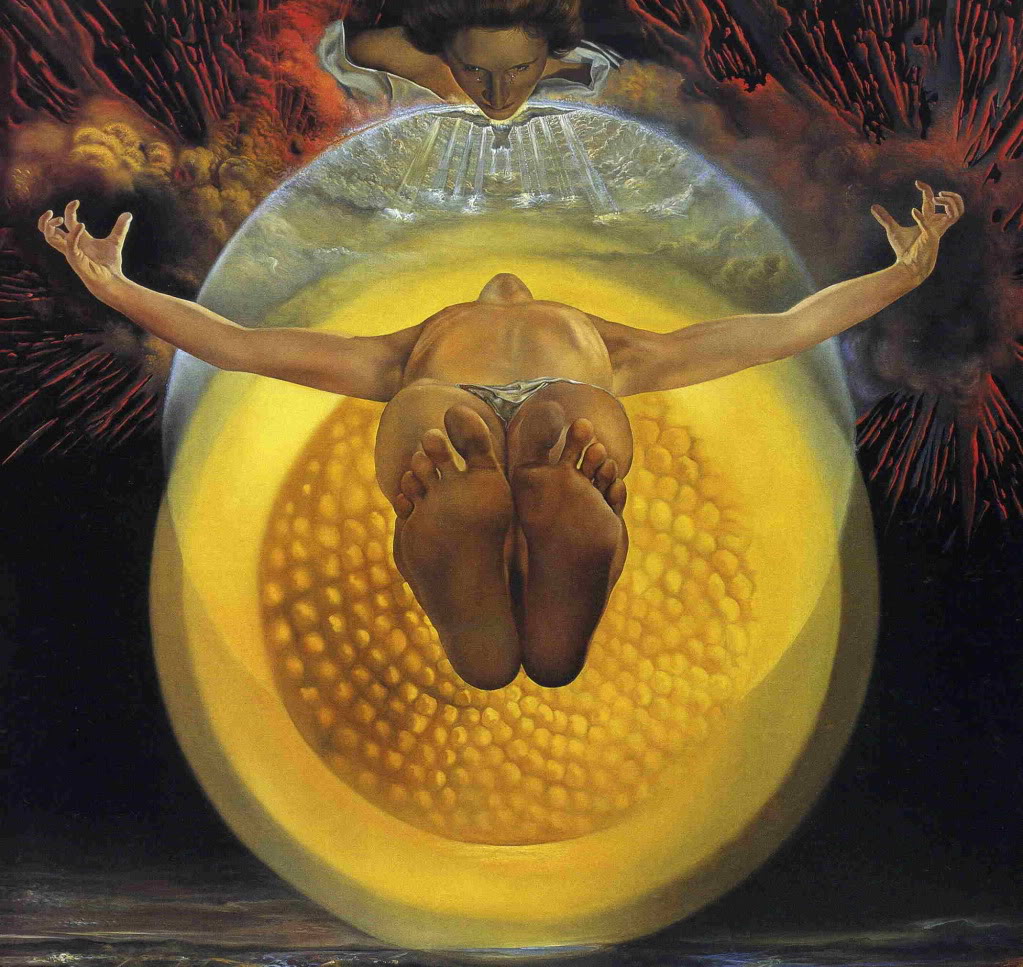
Ascension of Christ by Salvadore Dali

You may write me down in history
With your bitter, twisted lies,
You may trod me in the very dirt
But still, like dust, I’ll rise.

Does my sassiness upset you?
Why are you beset with gloom?
‘Cause I walk like I’ve got oil wells
Pumping in my living room.

Just like moons and like suns,
With the certainty of tides,
Just like hopes springing high,
Still I’ll rise.

Did you want to see me broken?
Bowed head and lowered eyes?
Shoulders falling down like teardrops,
Weakened by my soulful cries?

Does my haughtiness offend you?
Don’t you take it awful hard
‘Cause I laugh like I’ve got gold mines
Diggin’ in my own backyard.

You may shoot me with your words,
You may cut me with your eyes,
You may kill me with your hatefulness,
But still, like air, I’ll rise.

Does my sexiness upset you?
Does it come as a surprise
That I dance like I’ve got diamonds
At the meeting of my thighs?

Out of the huts of history’s shame
I rise
Up from a past that’s rooted in pain
I rise
I’m a black ocean, leaping and wide,
Welling and swelling I bear in the tide.

Leaving behind nights of terror and fear
I rise
Into a daybreak that’s wondrously clear
I rise
Bringing the gifts that my ancestors gave,
I am the dream and the hope of the slave.
I rise
I rise
I rise.

(From And Still I Rise,Maya Angelou, Random House:1978.
Note — The verse beginning “Does my sexiness upset you?” was not read in church.)

The late Dr. Maya Angelou, who died this week and was (in my opinion) one of the greatest of contemporary English-language poets, wrote that poem (entitled Still I Rise) in 1978. Though it speaks out of her experience as a black woman growing up in the segregated South of the mid-20th Century, I believe it also speaks to us in our context today, celebrating the Ascension of Christ into heaven and, also, honoring our five newly minted high school graduates.

The Feast of the Ascension was Thursday. You may have missed it, however; it is a feast largely ignored by the Church. It passes by and we seldom, if ever, give any thought to it. In the Sunday rota it is noted only as the day after which the Seventh Sunday of Easter comes: that’s exactly how today’s collect is titled in The Book of Common Prayer, Seventh Sunday of Easter: The Sunday after Ascension Day. Kind of sad, because the Ascension really is the last event of the Incarnation, the last scene of the last act of the great drama which is “the Christ event.” Fortunately, this year (Year A of the Revised Common Lectionary) we have actually heard the story of the Ascension from the Book of Acts. This is not the case in the other two years of the rotation; in years B and C the Ascension isn’t even mentioned in any of the Sunday readings.

The story of Christ’s Ascension is told not only in Acts, which we heard this morning, it is also found in the Gospels of Mark and Luke. Mark’s account is brief, a single verse: “So then the Lord Jesus, after he had spoken to them, was taken up into heaven and sat down at the right hand of God.” (Mk 16:19) Luke’s is also short: “He led them out as far as Bethany, and, lifting up his hands, he blessed them. While he was blessing them, he withdrew from them and was carried up into heaven.” (Lk 24:50-51).

Although neither Matthew’s Gospel nor John’s mention the Ascension event itself, both include prophetic references to it. According to Matthew, in his trial before the High Priest just before his Crucifixion, Jesus said, “I tell you, from now on you will see the Son of Man seated at the right hand of Power and coming on the clouds of heaven.” (Mt 26:64) In John’s Gospel, after the Resurrected Jesus tells Mary Magdalene not to cling to him, he gives her a message for the Apostles: “Go to my brothers and say to them, ‘I am ascending to my Father and your Father, to my God and your God.'” (Jn 20:17) So the fact of Jesus’ Ascension is well attested by Christian Scripture.

This Jesus, whom the powers of his age had (to use Dr. Angelou’s poetic language) tried to “write down in their history with bitter, twisted lies,” had tried to “tread in the very dirt” — this Jesus rose, not only from the grave into a new earthly existence, but into heaven. This Jesus, whom they “wanted to see broken, with bowed head and lowered eyes, with shoulders falling down like teardrops, weakened by his soulful cries” — this Jesus rose into very center of the Godhead. This Jesus, whom they “killed with their hatefulness” rose “out of the huts of the Hebrews’ history of shame,” from Israel’s past, a past “rooted in pain,” “bringing the gifts that his ancestors gave;” he is “the dream and the hope” of every human being enslaved to sin and death. He is our hope and he rose. He ascended into heaven taking our humanity into the very presence of God Almighty.

If the Incarnation (meaning the whole of Jesus’ earthly being, the entire time of God’s being in the flesh on earth) were viewed as a stage play, the drama of salvation would be seen in this way:

Act One — In the Nativity, God becomes a human being offering great promise to humankind.
Act Two — In the life of Jesus, God fully enters human existence in all its aspects making clearer the meaning of the promise.
Act Three — In the death and resurrection of Jesus, God defeats death and opens the way of eternal life to all human beings setting the scene for fulfillment of the promise.
Act Four — In the Ascension, the story comes full circle as a human being becomes God bringing the promise of the Nativity to fruition.
(Pentecost and all that follows it are the epilogue, just as the story of Israel and the words and works of the Prophets are the prologue.)

The Ascension is the denouement of the entire story but, unfortunately, most of the audience, thinking the play concluded, left after Act Three; some may even have left in the middle of that act. The climax of the drama played out on Thursday to a largely empty theater.

One of the Episcopal Church’s collects for today says: “We believe your only-begotten Son our Lord Jesus Christ to have ascended into heaven, so we may also in heart and mind there ascend.” (BCP 1979, page 226) I think this prayer gets it slightly wrong. Our ascension with Jesus is not a future thing that we “may” later attain. Rather, in Jesus’ Ascension we all have already ascended. It is not only Christ’s humanity but our humanity that ascended into heaven. God has already seated us in the heavenly places in Christ Jesus; our ascension is not so much an experience to be attained, but a reality to be experienced. As St. Athanasius famously put it, “God became man that man might become God.” This is known theologically as the theosis or deification of humanity, and in the Ascension of Jesus it has already happened.

So here we are, deified human beings capable, as Jesus told us, of doing the very works that he did and, in fact, of doing greater works because he has ascended to the Father and he will do whatever we ask in his name — at least that’s what he promised in the Gospel lesson from John we heard in church two weeks ago (Jn 14:12-13) — but do we actually do them? Do we do the works of power and witness to the truth of the Gospel? Let’s be honest and admit that we usually don’t.

We don’t because we’re a lot like the eleven guys standing on that hilltop in Bethany “gazing up toward heaven.” Like them, as Prof. James Holbert of the Perkins School of Theology has written, “We are too enamored of the ascending Jesus, our necks strained as we peer upward, hoping for a further sign, for a magic act, for a cloud spelling out ‘I love you.'”
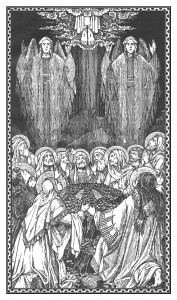
Ascension WoodcutIt’s my favorite part of the story, really, because it demonstrates just how human the Apostles really were, how much like us. It’s this part of the story that is depicted in the woodcut on the cover of our bulletins. There they are looking up, Jesus’ feet just disappearing, when the “two men” (probably angels) appear and ask them why they are staring into space. In our modern vernacular, the two angels tell them, “Don’t just stand there. Do something!”

Prof. Holbert paraphrases and analyzes what the angels say in this way:

“Why do you stand looking into heaven?” Did you not pay attention to him just a few moments ago? He said, ‘Go,’ and you are rooted on this spot, looking longingly for some further word from him. He will come back in the same way that he went, but you need ask no further questions about when, they imply. “When” is simply not the right question to ask.

Why in heaven’s name (I mean that quite literally!) do so many Christians then spend vast amounts of time, inordinate amounts of energy, immoderate amounts of speculation, asking precisely that very question? We have been asked to be “his witnesses” to the world, not his calculators for his return. It remains a thorough mystery to me why this is so, and has been so throughout Christian history.

But I suppose I do know the answer. It is far safer, far less demanding, to be a speculator than a witness. Speculators write books of calculations, hold seminars that attract thousands, rake in untold piles of loot, while prognosticating a certain time for Jesus’ return. Witnesses, on the other hand, just witness to the truth of the gospel: the truth of justice for the whole world, the love of enemies, and the care for the marginalized and outcast. As Acts 1 makes so clear, the world needs far fewer speculators and far more witnesses. (Speculators or Witnesses)

Which brings me to our five high school graduates . . . . You have finished that part of your education which society has made mandatory. Whatever you do from now on is up to you. You may, if you and your families decide, continue your education at college or university; you may continue it in trade or vocational school; you may continue it as an apprentice in a skilled trade. You may, alternatively, decide to enter the work force immediately and skip any further formal education and training, opting instead for what is known as “on the job training.” And you could, although no one here would recommend it or be happy if you did so, opt to do none of these things and, instead, become a bum, a grifter, a burden on society, in which case you will learn the hard and dangerous lessons of the streets.

Whatever you choose to do, you may have noted that every path means continuing to learn. I hope, as I’m sure everyone here and your parents hope, that you will learn the lessons of faith, hope, and love.

We hope that you will learn the lessons that Dr. Angelou learned and tried to teach us through her poetry — if people tell lies about you, rise above it; if people try to tread you in the dirt, rise above it; if they want to see you broken and weeping, disappoint them and rise above it; if they try to shoot you with their words, cut you with their eyes, or kill you with their hatefulness, rise above it.

We hope that you will learn to be, as Prof. Holbert said, witnesses “to the truth of the gospel: the truth of justice for the whole world, the love of enemies, and the care for the marginalized and outcast,” that you will learn to be (as the Letter of James puts it) “doers of the word, and not merely hearers.” (James 1:22)

That is our hope for you and our prayer.

And now I have a word for the parents of our graduates. I’ve been where you are now, twice. When our eldest, our son Patrick, entered college he went away to the University of the South in Sewanee, Tennessee. We drove him down to Sewanee and, with other freshman parents, we attended a meeting with the school’s president while our children took part in orientation activities. At the end of our meeting, the president was quite blunt: he basically said, “Go away. Get off campus. Let go of your sons and daughters.” Like Mary Magdalene, we were being told not to cling, not to hold on. So we left that meeting, found our son, and said good-bye. After he hugged us both, he turned and walked down the street toward to his dormitory, and he never looked back.

I stood there watching him go and, like those guys on the Mount of Olives, I wanted him to look back; I was “hoping for a further sign, for a magic act, for a cloud spelling out ‘I love you.'” Like them, I didn’t get it. I suppose the Apostles realized at some point as they stared into the sky that their friend, their rabbi, was no longer the man they thought they knew; he was something more. He was, and is, God. Standing on that campus lane at Sewanee, I knew that this young man was no longer the child I thought I knew; he was something more. He was, and is, an adult.

Both of our children, Patrick and Caitlin, are adults. So are yours. I’m proud to say that both of ours are college graduates and, though Caitlin is not working in her chosen field (yet), both are fully employed, productive members of society. So will yours be.

So don’t cling to them and don’t just stand there watching them go away, fading into the distance. You have things to do because, like them, like those eleven guys on that hillside in Bethany, like everyone of us, you too are called to be witnesses “to the truth of the gospel: the truth of justice for the whole world, the love of enemies, and the care for the marginalized and outcast,” to be “doers of the word.”

So graduates, parents of graduates, everyone . . . Remember the implication of the angels at the Ascension.

Don’t just stand there. Do something!

Experience the reality of the Ascension. Christ’s Ascension, our Ascension, your Ascension!

Rise!

Rise!

Rise!

Amen.

====================

A request to my readers: I’m trying to build the readership of this blog and I’d very much appreciate your help in doing so. If you find something here that is of value, please share it with others. If you are on Facebook, “like” the posts on your page so others can see them. If you are following me on Twitter, please “retweet” the notices of these meditations. If you have a blog of your own, please include mine in your links (a favor I will gladly reciprocate). Many thanks!

====================

Father Funston is the rector of St. Paul’s Episcopal Church, Medina, Ohio.

Playing to an Empty Theater – From the Daily Office – May 28, 2014

From the Letter to the Hebrews:

God did not subject the coming world, about which we are speaking, to angels. But someone has testified somewhere,
“What are human beings that you are mindful of them,
or mortals, that you care for them?
You have made them for a little while lower than the angels;
you have crowned them with glory and honor,
subjecting all things under their feet.”

(From the Daily Office Lectionary – Hebrews 2:5-8a – May 29, 2014 – Ascension Day)

Empty TheaterI cannot read these verses of Hebrews (nor the verses of Psalm 8 which the author quotes) without thinking of Hamlet:

What a piece of work is a man! How noble in reason! how infinite in faculty! in form, in moving, how express and admirable! in action how like an angel! in apprehension how like a god! the beauty of the world! the paragon of animals! And yet, to me, what is this quintessence of dust? man delights not me; no, nor woman neither . . . . (Hamlet, Prince of Denmark, Act II. Scene II)

Hamlet may not have delighted in humankind, but the story of Jesus and the witness of Scripture (Old and New) assure us that God does. With all our flaws and foibles, God loves the human race. (There are days when I wonder what that says about God, but the Feast of the Ascension is not one of them.) On this feast, we are assured that God loves us so much that God “crowns us with glory and honor.” We read not only this assurance in the Letter to the Hebrews, but also in the vision recorded in the Book of Daniel:

As I watched in the night visions,
I saw one like a human being
coming with the clouds of heaven.
And he came to the Ancient One
and was presented before him.
To him was given dominion
and glory and kingship,
that all peoples, nations, and languages
should serve him.
His dominion is an everlasting dominion
that shall not pass away,
and his kingship is one
that shall never be destroyed.
(Dan 7:13-14)

As I read today’s lessons I am saddened that this Feast is so ignored by the Church. It passes by and our members never even think about it, if they even know of it. In the Sunday rota it is noted only as the day after which the Seventh Sunday of Easter comes: that’s how next Sunday’s collect is titled in The Book of Common Prayer, “Seventh Sunday of Easter: The Sunday after Ascension Day.” Kind of sad, because the Ascension really is the last event, the last scene of the last act of the great drama which is “the Christ event.” Fortunately, this year (Year A of the Revised Common Lectionary) we will hear the story of the Ascension from the Book of Acts on Sunday morning; this is not the case in the other two years of the rotation.

If the Incarnation (meaning the whole of Jesus’ earthly being) were viewed as a stage play, the drama of salvation would be seen in this way: Act One — In the Nativity, God becomes a human being offering great promise to humankind. Act Two — In the life of Jesus, God fully enters human existence in all its aspects making clearer the meaning of the promise. Act Three — In the death and resurrection of Jesus, God defeats death and opens the way of eternal life to all human beings setting the scene for fulfillment of the promise. Act Four — In the Ascension, a human being becomes God bringing the promise of the Nativity revealed Act One to fruition. (Pentecost and all that follows it are the epilogue, just as the story of Israel and the words and works of the Prophets are the prologue.)

The Ascension is the denouement of the entire story but, unfortunately, most of the audience, thinking the play concluded, left after Act Three; some may even have left in the middle of that act. The climax of the drama plays out to a largely empty theater.

One of the Episcopal Church’s collects for today says: “We believe your only-begotten Son our Lord Jesus Christ to have ascended into heaven, so we may also in heart and mind there ascend.” (BCP 1979, page 226) I think this prayer gets it slightly wrong. Our ascension with Jesus, I believe, is not a future thing that we “may” later attain. Rather, in Jesus’ Ascension we all have already ascended. God has already seated us in the heavenly places in Christ Jesus; our ascension is not so much an experience to be attained, but a reality to be experienced. As St. Athanasius famously put it, “God became man that man might become God.” In the Ascension of Jesus, this theosis (deification) has already happened.

What a piece of work is humankind! Crowned with glory and honor. Given dominion and glory and kingship that shall not pass away. It’s sad that on the feast day that acknowledges this the theater is largely empty; the climax of the drama of redemption passes by largely unnoticed.

====================

A request to my readers: I’m trying to build the readership of this blog and I’d very much appreciate your help in doing so. If you find something here that is of value, please share it with others. If you are on Facebook, “like” the posts on your page so others can see them. If you are following me on Twitter, please “retweet” the notices of these meditations. If you have a blog of your own, please include mine in your links (a favor I will gladly reciprocate). Many thanks!

====================

Father Funston is the rector of St. Paul’s Episcopal Church, Medina, Ohio.

Memorial Day at Church – Sermon for the Sixth Sunday of Easter (May 26, 2014)

====================

On the Sixth Sunday of Easter, May 25, 2014, this sermon was offered to the people of St. Paul’s Episcopal Church, Medina, Ohio, where Fr. Funston is rector.

(The lessons for the day were: Acts 17:22-31; Psalm 66:7-18; 1 Peter 3:13-22; and John 14:15-21. These lessons can be read at The Lectionary Page.)

====================

Memorial Day Cemetery FlagsI’m going to do something I have never done before! I’m going to read someone else’s sermon. While I was pondering these lessons, doing the usual research, and thinking about what to say, I came upon a superb sermon preached on Memorial Day weekend three years ago when, as today, the lesson from Acts was the story of St. Paul preaching at the Areopagus. The preacher was the Rev. Kurt Wiesner who is the rector of All Saints Episcopal Church in Littleton, New Hampshire, and whom many of us remember from his tenure as curate at our own Trinity Cathedral. This is what Kurt had to say and I earnestly commend his thoughts to you:
[The sermon as originally posted on the internet can be found on Fr. Wiesner’s blog One Step Closer: Religion & Popular Culture.]

Memorial Day in Church — (A sermon preached Sunday of Memorial Day Weekend, 5/29/2011)

Contrary to the assumptions of many, Memorial Day is not officially a celebration of the church. Unlike Independence Day and Thanksgiving Day (both which I have talked about in the past), it is not on our church calendar, and there is no prayer in our Prayerbook to mark this day. It did not come from the church, nor was it formally adopted by it.

Robert Bellah writes that sociologists have suggested that America has a secular “civil religion” –- one with no association with any religious denomination or viewpoint –- that has incorporated Memorial Day as a sacred event. Our American tradition includes an obligation to honor the sacrifices made by our nation to earn our freedom. With the Civil War, a new theme of death, sacrifice and rebirth enters the civil religion. Memorial Day gave ritual expression to these themes, integrating the local community into a sense of nationalism. The American civil religion in contrast to that of France was never anticlerical or militantly secular; in contrast to Britain it was not tied to a specific denomination like the Church of England. Instead, Americans borrowed selectively from different religious traditions in such a way that the average American saw no conflict between the two, thus mobilizing deep levels of personal motivation for the attainment of national goals. (Civil Religion in America, by Robert Bellah, 1967. Used by Wikipedia)

This cannot completely explain why the church has not officially adopted Memorial Day: after all, the church has taken and adapted plenty of public events and celebrations in the past. Perhaps it’s only a matter of time. Then again, one could argue that every day is a Memorial Day in the church.
Regardless, this morning I want to share with you some Memorial Day history, which comes mostly from the Wikipedia Memorial Day entry:

Our tradition of Memorial Day comes from the time after the Civil War, honoring the soldiers who had died by decorating their graves with flags or flowers. By 1865 the practice of decorating soldiers’ graves had become widespread in the North. The first known observance was in Boalsburg, Pennsylvania, on October, 1864, and each year thereafter. Similar events followed around the northern states on various scales.

In Charleston, South Carolina, in 1865, freed enslaved Africans celebrated at the Washington Race Course, today the location of Hampton Park. The site had been used as a temporary Confederate prison camp for captured Union soldiers in 1865, as well as a mass grave for Union soldiers who died there. Immediately after the cessation of hostilities, freedmen exhumed the bodies from the mass grave and reinterred them in individual graves. They built a fence around the graveyard with an entry arch and declared it a Union graveyard. On May 1, 1865, a crowd of up to ten thousand, mainly black residents, including 2800 children, proceeded to the location for events that included sermons, singing, and a picnic on the ground.

Beginning in 1866 the southern states had their own Memorial Days. The earliest Confederate Memorial Day celebrations were simple, somber occasions for veterans and their families to honor the day and attend to local cemeteries.

General John A. Logan may be most responsible for growth of a particular holiday. On May 5, 1868, in his capacity as commander-in-chief of the Grand Army of the Republic -– the organization for Northern Civil War veterans -– Logan issued a proclamation that “Decoration Day” should be observed nationwide. It was observed for the first time on May 30 of the same year; the date was chosen because it was not the anniversary of a battle.

There were events in 183 cemeteries in 27 states in 1868, and 336 in 1869. The northern states quickly adopted the holiday; Michigan made “Decoration Day” an official state holiday in 1871 and by 1890 every northern state followed suit. The ceremonies were sponsored by the Women’s Relief Corps, which had 100,000 members.

The Decoration Day speech became an occasion for veterans, politicians and ministers to commemorate the war -– and at first to recall the atrocities of the enemy. They mixed religion and celebratory nationalism and provided a means for the people to make sense of their history in terms of sacrifice for a better nation, one closer to their God. People of all religious beliefs joined together, and the point was often made that the German and Irish soldiers had become true Americans in the “baptism of blood” on the battlefield.

By the end of the 1870s the rancor was gone and the speeches praised the soldiers of both the Union and Confederacy. In 1882, the name of Decoration Day was formally changed to Memorial Day in “memory” and ‘honor” of those who gave their lives fighting for a common cause, America.

This name, however, did not become more common until after World War II and was not declared the official name by Federal law until 1967.

Many Americans observe Memorial Day by visiting cemeteries and memorials. A national moment of remembrance takes place at 3 p.m. local time. Another tradition is to fly the flag of the United States at half-staff from dawn until noon local time. The half-staff position remembers the more than one million men and women who gave their lives in service of their country. At noon their memory is raised by the living, who resolve not to let their sacrifice be in vain, but to rise up in their stead and continue the fight for liberty and justice for all. The National Memorial Day Concert takes place on the west lawn of the United States Capitol the Sunday before Memorial Day. The concert is broadcast on PBS and NPR. Music is performed, and respect is paid to the men and women who died in war.

There have, however, been a number of the historical problems concerning Memorial Day. Many of the celebrations have included a demonization of whatever is the perceived other side: not just concerning the Civil War, but the world conflicts that have followed. Certain ideologies have upended Memorial Day at different times. Continuing from Wikipedia:

In many southern locations in the 1890s from the consolatory emphasis of honoring soldiers to public commemoration of the Confederate “Lost Cause”. Changes in the ceremony’s hymns and speeches reflect an evolution of the ritual into a symbol of cultural renewal and conservatism in the South.
By the 1950s, the theme of Memorial Day had become more geared towards American exceptionalism and understood duty to uphold freedom in the world.

There have also been challenges beyond nationalism. The tradition has become permanently linked to sporting events. One of the longest-standing traditions is the running of the Indianapolis 500, the auto race has been held in conjunction with Memorial Day since 1911, run on the Sunday preceding the Memorial Day holiday. The Coca-Cola 600 stock car race has been held later the same day since 1961. The Memorial Tournament golf event has been held on or close to the Memorial Day weekend since 1976.

On June 28, 1968, the Congress passed the Uniform Holidays Bill which moved three holidays from their traditional dates to a specified Monday in order to create a convenient three-day weekend. The holidays included Washington’s Birthday, Veterans Day, and Memorial Day. The change moved Memorial Day from its traditional May 30 date to the last Monday in May. The law took effect at the federal level in 1971. This change is still controversial. The VFW stated in a 2002 Memorial Day Address:

Changing the date merely to create three-day weekends has undermined the very meaning of the day. No doubt, this has contributed a lot to the general public’s nonchalant observance of Memorial Day. (David Mechant, April 28, 2007, “Memorial Day History”, in the Wikipedia entry)

While the actual significance of the original date is debatable, it is pretty clear that Memorial Day Weekend’s role as the unofficial start of summer has come to dominate the observance. And I don’t think it’s a stretch to say that, in the vocabulary of many, the phrase “Memorial Day” include the word “sale.”

As I said at the beginning, Memorial Day is not officially a day marked by the Episcopal Church. Certainly remembering those who have given their lives in service is appropriate for church communities to do, and explains why plenty of individual churches celebrate the day.

Perhaps some of what the church has to offer Memorial Day can be found in Paul’s insightful preaching in the Book of Acts this morning (Acts 17:22-31). Paul observes the many religious practices of the Athenians. He does not spend it time condemning what is wrong with their practice. Instead, he lifts up the Athenians pursuit of religious understanding, and building on their creativity and passion, preaches about God “…in whom we live and move and have our being”. (Acts 17:28)

Perhaps it is the role of the church to not only help remember what is good in Memorial Day … honoring those who died in service to their country … but to also lift up the day as something more: articulating a vision of a world that so values peoples’ lives as dwelling in God, that violence towards others becomes unacceptable.

Perhaps this is why I find the [hymn from the United Methodist Hymnal], A Song of Peace, so appropriate:

This is my song, O God of all the nations,
A song of peace for lands afar and mine;
This is my home, the country where my heart is;
Here are my hopes, my dreams, my holy shrine:
But other hearts in other lands are beating
With hopes and dreams as true and high as mine.

My country’s skies are bluer than the ocean,
And sunlight beams on clover leaf and pine;
But other lands have sunlight too, and clover,
And skies are everywhere as blue as mine;
O, hear my song, Thou God of all the nations,
A song of peace for their land and for mine.

This is my song, O God of all the nations,
A song of peace for (people) in every place;
And yet I pray for my beloved country
The reassurance of continued grace:
Lord, help us find our oneness in the Savior,
In spite of differences of age and race.
[From the United Methodist Hymnal (Stanzas 1 & 2 by Lloyd Stone, Stanza 3 by Georgia Harkness)]

========================

That is Kurt’s sermon…. to which I want to add just a brief postscript, beginning with a personal story:

From 1972 to 1974, I was the youth minister at St. Peter’s Episcopal Church in Del Mar, California, where Fr. Tally Jarrett, a former military chaplain who had served in Germany, was the rector. Fr. Tally had absolutely no musical talent or skill, and seldom used hymns in his sermons, so (unlike me) he did not select the hymns for worship; he left that up to the Choir Director. (I select the hymns, but I leave the selection of preludes, postludes, voluntaries, and anthems up to Bertie.)

One Sunday we had a guest preacher, the local Reformed Jewish rabbi, and I was on the schedule as the chalice bearer for the service. As we lined up in the back of the church for the procession, the organist struck the opening notes of the first hymn, Glorious Things of Thee Are Spoken. The words were written by John Newman, the same man who wrote Amazing Grace, but the hymn is set to the tune Austria by Franz Joseph Haydn. That tune is also the music for Das Lied der Deutschen, the German national anthem. Fr. Tally heard that tune start up, looked at the rabbi, and turned beet red with embarrassment; the rabbi just laughed and said, “Don’t worry about it! It’s a lovely tune.”

Thursday evening I was here in the church and heard the choir practicing their anthem . . . which turns out to be a choral arrangement of that hymn. I chuckled remembering that Sunday morning back in Del Mar and it occurred to me how similar to that event the singing of that tune, the melody of the national anthem of our sworn World War II enemy, on Memorial Day is. Some of us who fought against Germany in WW2 ourselves or whose fathers fought in that theatre, as did mine, might find it odd to do so. I find it particularly appropriate; a reminder that we have gotten past that conflict and that our former enemy is now our ally.

I would ask you to pay particular attention to the final verse that the choir will sing:

Savior, since of Zion’s city
I through grace a member am,
Let the world deride or pity,
I will glory in your name.
Fading are the worldlings’ pleasures
All their boasted pomp and show;
Solid joys and lasting treasures
None but Zion’s children know.

This, as Fr. Wiesner suggested, is what the church can lift up and articulate on Memorial Day, a “vision of a world that so values peoples’ lives as dwelling in God, that violence towards others becomes unacceptable,” a vision of a world in which all can enjoy the “solid joys and lasting treasures” of peace and good will.

Let us pray:

O Judge of the nations, we remember before you with grateful hearts the men and women of our country who in the day of decision ventured much for the liberties we now enjoy. Grant that we may not rest until all the people of this and every land share the benefits of true freedom and gladly accept its disciplines. This we ask in the Name of Jesus Christ our Lord. Amen.

====================

A request to my readers: I’m trying to build the readership of this blog and I’d very much appreciate your help in doing so. If you find something here that is of value, please share it with others. If you are on Facebook, “like” the posts on your page so others can see them. If you are following me on Twitter, please “retweet” the notices of these meditations. If you have a blog of your own, please include mine in your links (a favor I will gladly reciprocate). Many thanks!

====================

Father Funston is the rector of St. Paul’s Episcopal Church, Medina, Ohio.

So Many Martyrs – Sermon for the Fifth Sunday of Easter, RCL Year A – May 18, 2014

====================

This sermon was preached on the Fifth Sunday of Easter, May 18, 2014, at St. Paul’s Episcopal Church, Medina, Ohio, where Fr. Funston is rector.

(The lessons for the day were: Acts 7:55-60; Psalm 31:1-5,15-16; 1 Peter 2:2-10; and John 14:1-14 . These lessons can be read at The Lectionary Page.)

====================

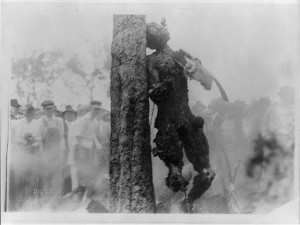
Lynching of Jesse WashingtonDoes the name “Jesse Washington” mean anything to you? It’s unlikely that it does. If I tell you that Jesse Washington died in 1916 in Waco, Texas, would that spark any memory? Have you ever been taught about the incident in which Washington was killed? Have you ever heard of what came to be called “The Waco Horror?”

Probably not. It’s not one of the incidents of American history that gets regularly taught in our schools. If I hadn’t taken a course in African American history when I was a college sophomore in 1970, I wouldn’t know anything about the death of Jesse Washington on May 15, 1916. It’s not the sort of story that makes a white person comfortable. But I do know about it, and the fact that its anniversary falls during the week when I was preparing a sermon on, among other passages from Scripture, Luke’s description of the martyrdom of Stephen in the Book of Acts struck me as significant. Both Stephen and Jesse Washington were murdered by mobs because they were different.

Jesse Washington was a 17-year-old African American farmhand. On May 8, 1916, he was accused of raping and murdering Lucy Fryer, the wife of his white employer in Robinson, Texas, not far from Waco. Jesse and his entire family (his parents and a brother) were questioned; the others were released, but Jesse was not. He was taken to Dallas, where he eventually signed a confession which some legal historians believed was coerced. There was little, if any, evidence that he was actually guilty.

Washington was tried for murder in Waco, in a courtroom filled with locals who had been provoked by local newspaper reports which included lurid, and demonstrably false, details about the crime. His defense counsel entered a guilty plea and Washington was quickly sentenced to death, but he had no opportunity to appeal.

After his sentence was pronounced, the teenager was dragged out of the courtroom and lynched in front of city hall. Over 10,000 spectators, including city officials and police, gathered to watch. Members of the mob castrated the boy, cut off his fingers, and hung him (still alive) over a bonfire. He was repeatedly lowered into the fire and raised again to prolong his agony and death. After he finally succumbed, the fire was extinguished and Jesse Washington’s charred torso was dragged through the town; parts of his body were actually sold as souvenirs. A professional photographer took pictures as the lynching progressed; these were printed and sold as postcards in Waco.

As a Christian society, we remember Stephen as the first Christian martyr and as a hero of our faith; his is a unique story told in the Book of Acts. As a Christian society, we don’t remember Jesse Washington, at all; he’s just one of thousands who were lynched. Historical reports indicate that between 1882 and 1968 there were over 4,700 lynchings in the United States. One history text estimates that between 1882 and 1930 in America at least one black person was lynched every week. (Tolnay, S., & E.M. Beck, A Festival of Violence, University of Illinois Press, 1992, p. ix) We know the numbers, but we don’t know their names.

We Americans, however, aren’t even in the minor leagues when it comes to martyring people for being different. Writing about Stephen’s death, Professor Daniel Clendenin reminds us that there have been so many more martyrs, that martyrdom is not ancient history. It is a very contemporary and present reality:

Millions more have been martyred for reasons other than religion — for their ethnicity (Jews, Armenians, Tutsis), for economic ideology (farmers, land holders), social prejudice (intellectuals, artists), race (American blacks), and gender (women around the world like the inspirational Malala Yousafzai of Pakistan).

Christians are just one group among many that honors their martyrs. Very few times, places or peoples have been spared mass murder.
If you can bear to read it, I recommend the book by Daniel Jonah Goldhagen, Worse Than War; Genocide, Eliminationism, and the Ongoing Assault on Humanity (2009). Goldhagen estimates that between 127–175 million people were “eliminated” in the last century.

These people came from all regions of the world, and from all social, economic and political groups. The vast majority of these victims were killed in their own countries, by their fellow citizens, by willing and non-coerced murderers, and almost never with any substantial dissent. Eliminationism is thus “worse than war.”

The numbers are mind-numbing, and therein lies our challenge. They bring to mind the infamous remark by [Joseph] Stalin in 1947 about the famine in Ukraine that was killing millions: “If only one man dies of hunger, that is a tragedy. If millions die, that’s only statistics.” (The Stoning of Stephen)

Clendenin concludes, “The martyrdom of Stephen disabuses us of a sentimental gospel. It roots us in the real world of industrial scale slaughter. The one man Stephen helps us to remember the individual humanity of the millions of people we might otherwise forget.”

Now I want to draw our attention away from mass murder and martyrdom, and focus instead, for a moment, on one another. I’d like you for just a few seconds to look around the room, and just take note of who and what you see here. (A short, silent pause)

What did you see? A bunch of living stones? The members of a holy priesthood? A chosen race? A royal priesthood? A people chosen and named by God? This is what Peter says we should see, the building material for a spiritual house, eternal in the heavens, not made with hands, that mansion in which there are many rooms where Jesus assures his disciples there is a place for all of us. But is that how we see one another?

Philip asked Jesus to show them the Father and Jesus replied, “Have I been with you all this time, Philip, and you still do not know me? Whoever has seen me has seen the Father. How can you say, ‘Show us the Father’?” I sometimes wonder if Jesus’ answer would perhaps have been different if Philip had asked, “Show us God.”

In the creation story in the first chapter of Genesis we are told, “God created humankind in his image, in the image of God he created them; male and female he created them.” (Gen 1:27) If Philip had asked Jesus, “Show us God,” might Jesus not have said, “Look around you, Philip.” Archbishop Desmond Tutu is fond of reminding people of those words from Genesis and suggesting that we should genuflect to one another! In a paper entitled Religious Human Rights and the Bible, he wrote:

The life of every human person is inviolable as a gift from God. And since this person is created in the image of God and is a God carrier a second consequence would be that we should not just respect such a person but that we should have a deep reverence for that person. The New Testament claims that the Christian person becomes a sanctuary, a temple of the Holy Spirit, someone who is indwelt by the most holy and blessed Trinity. We would want to assert this of all human beings. We should not just greet one another. We should strictly genuflect before such an august and precious creature. The Buddhist is correct in bowing profoundly before another human as the God in me acknowledges and greets the God in you. This preciousness, this infinite worth is intrinsic to who we all are and is inalienable as a gift from God to be acknowledged as an inalienable right of all human persons. (Emory International Law Review, Vol. 10 (1996): 63-68)

Which brings me back to Stephen and Jesse Washington, and to a strange little short story by the author Shirley Hardie Jackson entitled The Lottery that was first published in The New Yorker in June, 1948.

Set in a small, contemporary American town, a small village of about 300 residents, the story concerns an annual ritual known as “the lottery” which is practiced to ensure a good harvest; one character quotes an old proverb, “Lottery in June, corn be heavy soon.” As the story opens, the locals are excited but a bit anxious on the eve of the lottery. Children are gathering stones as Mr. Summers and Mr. Graves make the paper slips for the drawing and draw up a list of all the families in town.

When they finish the slips and the list, the men put them into a black box, which is locked up in the safe at a local coal company. The next morning the townspeople gather at 10 a.m. in order to have everything done in time for lunch. First, the eldest male of each family in town draws a slip; there’s one for every household. Bill Hutchinson gets the one slip with a black spot, meaning that his family has been chosen. In the next round, each member of the Hutchinson family draws a slip, and Bill’s wife Tessie gets the black spot. Each villager then picks up a stone and they surround Tessie, and the story ends as Mrs. Hutchinson is stoned to death while the paper slips are allowed to fly off in the wind.

Shortly after it was published, Ms. Jackson said of her story that she had hoped that by setting the particularly brutal ancient rite of stoning (the same thing that was done to Stephen) in the present she would shock her readers with “a graphic dramatization of the pointless violence and general inhumanity in [our] own lives.” (San Francisco Chronicle, July 22, 1948.) Her story suggests that we human beings are more capable of honoring our rituals and our preconceptions than we are of honoring one another.

I think the true stories of Stephen of Jerusalem, of Jesse Washington of Waco, Texas, and of those millions of martyrs who have been “eliminated” amply demonstrate that she was right. Not only are we more capable of honoring our rituals and prejudices that we of honoring one another, we are demonstrably willing to murder one another to protect them.

We are because when we look around at our fellow human beings we do not see one another as divine; we do not see living stones; we do not see members of a royal priesthood. Blinded, or perhaps just numbed, by familiar ritual, by preconception, by the simple human need to conform, we do not appreciate one another as fellow citizens of a holy nation, “chosen and precious in God’s sight,” as bearing the image of God.

“Have I been with you all this time, Philip, and you still do not know me?” Jesus asked. I’m not the least bit surprised in Philip, however; we human beings, made in the image of God, have been with each other for a long, long time, and we still do not know each other. Dr. Clendenin suggested that the martyrdom of Stephen helps us to remember the individual humanity of the millions of unnamed martyrs we might otherwise forget; may it also help us to remember the divinity of each of them and of each other.

Let us pray:

O God, you made us in your own image and redeemed us through Jesus your Son: Look with compassion on the whole human family; take away the arrogance and hatred which infect our hearts; break down the walls that separate us; unite us in bonds of love; and work through our struggle and confusion to accomplish your purposes on earth; that, in your good time, all nations and races may serve you in harmony around your heavenly throne; through Jesus Christ our Lord. Amen. (For the Human Family, Book of Common Prayer, Episcopal Church, 1979, page 815)

====================

A request to my readers: I’m trying to build the readership of this blog and I’d very much appreciate your help in doing so. If you find something here that is of value, please share it with others. If you are on Facebook, “like” the posts on your page so others can see them. If you are following me on Twitter, please “retweet” the notices of these meditations. If you have a blog of your own, please include mine in your links (a favor I will gladly reciprocate). Many thanks!

====================

Father Funston is the rector of St. Paul’s Episcopal Church, Medina, Ohio.

Jesus the Jedi – Sermon for the 3rd Sunday of Easter (Year A) – May 4, 2014

====================

This sermon was preached on the Third Sunday of Easter, May 4, 2014, at St. Paul’s Episcopal Church, Medina, Ohio, where Fr. Funston is rector.

(The lessons for the day were: Acts 2:14a,36-41; Psalm 116:1-3,10-17; 1 Peter 1:17-23; and Luke 24:13-35. These lessons can be read at The Lectionary Page.)

====================

Broken BreadSince the early 1970s this day, on the Episcopal Church calendar, this day on which we hear the story of Jesus’ appearance to the two disciples on the road to Emmaus has been known as Star Wars Sunday. It’s because Jesus is very much like a Jedi in this story. I mean, think about it . . .

In the Star Wars movies, Luke Skywalker is mentored first by Obiwan Kenobi, who dies, then by Yoda, who also dies. But both Obiwan and Yoda come back! They appear to Luke and others after their deaths, continue to teach and give sage counsel, and disappear. That’s what happens with Jesus in the story Luke tells us this morning.

It’s still Easter Sunday. (For us, we’re three weeks down the road, but for them it’s the afternoon of the same day on which Mary Magdalene and the others found the empty tomb.) Two disciples, one named Cleopas and the other unnamed (let’s call him “Bob” — although some feminists scholars suggest that the reason this disciple is not named is because she is a woman, so it might be “Bobbie”) are on their way to a village called Emmaus. Luke tells us this village is seven miles from Jerusalem; that’s a long walk — two or three hours. Sometime during this long afternoon journey, they are joined by a stranger whom they do not recognize; the stranger, Luke reveals, is Jesus but Cleopas and Bob can’t recognize him. They have a long talk with him about all the thing that have happened in Jerusalem in recent days, and he gives them sage counsel about the meaning of scripture, particularly the messianic prophecies. They arrive in Emmaus early in the evening and encourage their traveling companion to join them at dinner.

They sit down at an inn for the evening meal and the stranger takes the lead. He takes the bread served by the innkeeper, offers a blessing, and breaks the bread. Now, Cleopas and Bob realize who this is. As he does the same thing he had done with his followers just a few days before, their memory is tweaked and their eyes are opened (which suggests that Cleopas and Bob were in the upper room in Jerusalem on Thursday evening). That’s when they recognize him; that’s when they think they’ve figure out who he is — he’s Jesus the Jedi. And that’s when Jesus vanishes.

Why do you suppose that is? Why does Jesus disappear?

Well . . . let me remind you of what happened earlier in the day as the story is told by John. Mary Magdalene came to the tomb early in the morning, found it empty, and told Simon Peter. Peter and the disciple whom Jesus loved (another unnamed follower!) also found it empty, and then returned to their home to tell the others. Mary, however, hung behind and encountered Jesus but, like Cleopas and Bob on the road to Emmaus, she did not recognize him; she thought he was the gardener. Only when he addressed her by name (perhaps because of the tone of his voice) was something in her memory triggered and she realized who he was. She called him “Rabbouni” (which means teacher) and apparently fell at his feet and grabbed hold of them, for Jesus says to her, “Don’t hold on to me.” I think he did so for the same reason he disappeared from the table at the Emmaus inn.

Similarly, remember what happened before they arrived in Jerusalem, when Jesus took Peter and James and John up the mount of the Transfiguration. While they were on the holy mountain, the three disciples witnessed Jesus in conversation with Elijah and Moses. Peter wanted to memorialize the event by building booths, monuments to concretize the moment. Jesus said, “No. We’re not going to do that.” Again, I think for the same reason he disappeared in Emmaus.

That reason is that we cannot pin Jesus down. Jesus cannot be contained; he will not fit neatly into our boxes. When we think we have him figured out, we find out we are wrong. Jesus . . . God is bigger than any notion of him we may have; God is bigger than our conceptions, bigger than our doctrines, bigger than our creeds. And every encounter with Jesus is singular and unique. We cannot hold onto him; we cannot concretize and cast the moment in stone.

We just sang as our sequence hymn the old chestnut In the Garden, and that hymn makes this very point. We, the singer, say that we would like to stay there in that garden, but Jesus will not allow that:

I’d stay in the garden with Him,
Though the night around me be falling,
But He bids me go; through the voice of woe
His voice to me is calling.

We cannot pin him down! We cannot cast the moment in stone. When we think we’ve got hold of him, we find we are wrong; he disappears and what we are left with are our own notions, our own ideas, our own doctrines, our boxes. Our boxes, however, are too small; God is too big for them.

And the chorus of the hymn reminds us of the singularity and uniqueness of every meeting with our Lord:

And the joy we share as we tarry there,
None other has ever known.

Every time we encounter Jesus, the experience is unique; none other (not even our earlier selves) has ever had that experience before.

I think that is why it is significant that Cleopas and Bob recognized Jesus as he broke bread. Every loaf of bread is unique, similar perhaps to other loaves but never, ever identical. And every occasion on which bread is share is singular and unique. It may be a family meal or a celebration of the Eucharist; it may be a formal banquet or just friends having a bite. Whatever the circumstances, the situation is one unto itself, not like any other, never to be repeated.

A couple of Christmases ago, Evelyn gave me a set of books about the elements of the Eucharist. One volume is entitled The Spirituality of Wine; the other, which I have here, is The Spirituality of Bread by Donna Sinclair. The author is a Christian (in fact, I think she is an Anglican). I’d like to read you some of what she has to say about the symbolism of bread. About bread and community, she writes:

Jesus may have been lent significance by his association with other gods of bread. But that doesn’t acount for the power of his celebration, which persists daily around the world.

Everywhere, the words are similar: “He took a loaf of bread and after blessing it he broke it, gave it to them and said, ‘Take, this is my body.'” And, everywhere, people line up, blue-jean clad or robed, young or old, to receive bits of bread; or they sit in pews and pass tiny chunks on a plate; or they stand in a circle and murmur a blessing as a broken loaf moves from hand to hand.

Sometimes they gather around a sickbed.

Once, I sat in a circle of friends, in a smoky cabin in the bush, after a weekend of tending a woodstove and talking about dreams. We passed the bread around as gently as if it were the heart of the other, which it was.

The ritual has power. I get uneasy if I think I might be left out. Once, reporting on an event, I slipped up to take a photo of Archbishop Desmond Tutu serving Communion, and then paused anxiously. He winked and held out the bread.

Perhaps inclusion is this ceremony’s strength. This bread offers an enormous community, a family that stretches around the world and through the centuries. We don’t want to be left out.

We don’t want to be left out because we don’t want to miss the opportunity for that unique and singular encounter with Christ. Every celebration of Eucharist, like every sharing of bread and every meeting with Jesus, is a moment unto itself never to be repeated, never to be duplicated. We realize that in some way, that this encounter with Christ in the breaking of the bread will never happen again, and we don’t want to be left out.

With regard to bread and sacrifice, Ms. Sinclair writes:

The celebration of Communion is also a powerful experience of metaphor. Bread as body. Wine as blood. Love as sacrifice.

In the Jesus story, it is clear that love has great requirements. There is a price to pay, in an oppressive era, for feeding the unwanted.

It may help to see another story, that of the Celtic Earth goddess Tailtiu, queen of the Fir Bolg, one of the ancient peoples of pre-Christian Ireland.

When Tailtiu saw that her people were starving after an insufficient grain harvest, she took up an axe and, for a solid year, cleared a forest: “the reclaiming of meadowland from even wood by Tailtiu, daughter of Magmor,” is the way it is reported by the anonymous bard of The Dindsenchas, poems about Irish place names.

After the trees had been cut down, “roots and all, out of the ground,” the land became “a plain blossoming with clove,” presumably suitable for planting grain. But the cost was appalling. Tailtiu’s heart “burst in her body from the strain beneath her royal vest,” the bard says. The Celts loved their sacred groves, and the destruction to the enchanted richness of her forest must have broken Tailtiu’s heart.

Aware that she is dying, her courtiers gather around, and Tailtiu whispers her last command. She wants funeral games to be held in her honour each year, just before the harvest. And they are to be peaceful, she says, “without sin, without fraud, without reproach, without insult, without contention, without seizure, without theft.”

Thanks to her faithful foster-child Lugh (later associated with a bountiful harvest), Tailtiu’s wish came to pass. There was always an “unbroken truce” at her fair, and “men went in and came out without any rude hostility. Corn and milk in every stead, peace and fair weather for its sake, were granted to the heathen tribes of the Greeks for maintaining of justice.”

Tailtiu had given up her beloved forest and her life for a vision not too different from that of Archbishop Oscar Romero or of Mondawmin, who brought corn to the Ojibway. “Unbroken truce” and “corn and milk in ever stead,” represent the commonwealth of peace, the kingdom Jesus told his friends was close by. New parents get a glimpse of this kingdom looking at their tiny baby. Their sudden understanding that they would do anything to keep this child safe is the closest we can come, perhaps, to understanding the sacrifice that is part of love’s potential.

Perhaps that’s the power of Communion bread. Some say that it commemorates Jesus offering himself as a sacrifice for our sins, but I don’t think so. I would be appalled by a god who asked for the death of his child, or any child. But like any parent, I believe I would die for my children’s lives, even as absurdly grown-up as they are now.

Perhaps this bread simply expresses our wish to live little closer to the ideal of Tailtiu, Jesus, or Mondawmin, who died to give their people enough to eat. None of us can stand up to greed or selfishness as strongly as we wish. But eating this ceremonial bread with others, who also want to be just and loving, makes us brave enough to try.

Maybe that’s why I am sometimes overwhelmed at these ceremonies. Maybe I am simply terrified by the high sacrifices love assumes. Certainly the part most touching to me in the story of my own bread-god, Jesus, is not his death, but his constant focus on compassion. “Love one another as I have loved you,” he commands. “Love your enemies.”

Every encounter with this God who commands us to love, every encounter with love is unique and singular. Every encounter with this God who commands us to love, every encounter with love is larger than we can describe. We cannot constrain love in our boxes. Whatever our notions, our doctrines, our creeds, our understandings . . . they are too small to contain love, to pin love down, to hold onto and control love. When we try, love disappears, and that is why Jesus disappeared from the dinner table in that inn in Emmaus.

Now . . . I have to confess that, on the church’s calendar, this really isn’t Star Wars Sunday. But as every Star Wars aficionado knows, today is Star Wars Day: “May the Fourth be with you.”

But may Jesus the Jedi . . . Jesus, known in the breaking of the bread . . . Jesus, whom we cannot hold onto and pin down . . . Jesus, unique and singular . . . may Jesus be with you. Amen.

====================

A request to my readers: I’m trying to build the readership of this blog and I’d very much appreciate your help in doing so. If you find something here that is of value, please share it with others. If you are on Facebook, “like” the posts on your page so others can see them. If you are following me on Twitter, please “retweet” the notices of these meditations. If you have a blog of your own, please include mine in your links (a favor I will gladly reciprocate). Many thanks!

====================

Father Funston is the rector of St. Paul’s Episcopal Church, Medina, Ohio.

Flesh and Blood – From the Daily Office – April 24, 2014

From the First Letter to the Corinthians:

What I am saying, brothers and sisters, is this: flesh and blood cannot inherit the kingdom of God, nor does the perishable inherit the imperishable.

(From the Daily Office Lectionary – 1 Corinthians 15:50 (NRSV) – April 24, 2014.)

Human BodyI think I know what Paul is trying to say here, but I don’t like the way he’s saying it. I mean, I really have a theological issue with the assertion that “flesh and blood cannot inherit the kingdom of God.” I think the statement is just plain wrong. It states a dualism that relegates the material, specifically the human body, to realm of the damned, the unclean, the unworthy. In light of a creation story in which the Creator “saw everything that he had made [including that human flesh and blood], and indeed, it was very good,” I cannot accept the condemnation of our material being.
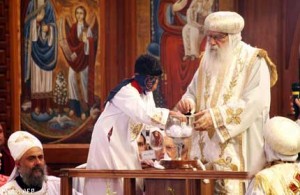
We have in our scriptural tradition an understanding that there have been human beings bodily “ascended” into the spiritual realms. “Elijah, because of great zeal for the law, was taken up into heaven,” says the First Book of Maccabees (1 Mac 2:58), and that is what Second Book of Kings describes: “Elijah ascended in a whirlwind into heaven.” Elisha watched it happen and kept staring up until he could no longer see his master. (2 Kg 2:11-12) And then there is Enoch who “walked with God; then he was no more, because God took him,” (Gen 5:24) a statement which has always been understood to mean that he was taken, flesh and blood, into God’s eternal Presence.

Of even greater significance is the Ascension of Christ! As the Apostles stood “watching, he was lifted up, and a cloud took him out of their sight,” and then a couple of angels assured them that he had “been taken up from you into heaven.” (Acts 1:9,11) This was Jesus in the same body that had been executed! That body still bore the wounds of crucifixion; he had invited Thomas, “Put your finger here and see my hands. Reach out your hand and put it in my side.” (Jn 20:27) That flesh-and-blood body which ascended had sat at table with his friends; after his Resurrection, that same flesh-and-blood body had eaten a piece of honey and shared some grilled fish. Paul goes on and on about earthly bodies and heavenly bodies, physical bodies and spiritual bodies, perishable bodies and imperishable bodies . . . but Jesus lived, died, rose, and ascended in one and same body!

I’m rather fond of the body I’ve lived in. It’s fat and out of shape and, truth be told, I wish it were better looking! But I’ve done a lot of stuff with this body and, like Henry Higgins with regard to Eliza Dolittle’s face, I’ve grown accustomed to it. It has been useful — it’s climbed holy mountains and visited sacred places; it’s lifted babies from their cribs and cuddled them; it’s hugged my wife and children; it’s helped old people into and out of bed; it’s held the hands of dying parents; it’s fed the hungry and built shelters for the homeless; it’s stood at the altar of God and ministered the Flesh and Blood of Christ. This flesh and blood has done some holy things. If I’m going to be gifted with life eternal, I’ll be happy to do so in this flesh and blood that has served me well, and with which I have done my best to serve God and God’s people.

I think I know what Paul was trying to say, but I wish he’d found a different way to say it because I think what he said is just wrong. Flesh and blood can inherit the kingdom of God. Indeed, I believe that flesh and blood have already inherited the kingdom of God. Here and now.

====================

A request to my readers: I’m trying to build the readership of this blog and I’d very much appreciate your help in doing so. If you find something here that is of value, please share it with others. If you are on Facebook, “like” the posts on your page so others can see them. If you are following me on Twitter, please “retweet” the notices of these meditations. If you have a blog of your own, please include mine in your links (a favor I will gladly reciprocate). Many thanks!

====================

Father Funston is the rector of St. Paul’s Episcopal Church, Medina, Ohio.

Testing Spirits, Drawing Lots – From the Daily Office – February 24, 2014

From the First Letter of John:

Beloved, do not believe every spirit, but test the spirits to see whether they are from God; for many false prophets have gone out into the world.

(From the Daily Office Lectionary – 1 John 4:1 (NRSV) – February 24, 2014.)

Coptic Pope Selection by LotHow does one “test the spirits”? How does one divine the promptings of the spirit or determine the will of God? That’s always the question we must face. In the ancient tabernacle, the high priest’s vestments included a breastplate in which he kept a couple of stones called the urim and the thummim (Exodus 28:30). What those were is a subject of much speculation, but one theory is that they were sort of like dice. The belief is that the high priest cast these dice to determine God’s guidance, to “test the spirit” when faced with a difficult decision.

Today is the feast of St. Matthias, who was selected by the eleven remaining apostles to replace Judas and restore their number to 12. Why they believed this was necessary would be an interesting subject of speculation, but what’s on my mind this morning is the method of selection. To “test the spirit,” to gain God’s guidance, they drew lots, much like casting dice:

They proposed two, Joseph called Barsabbas, who was also known as Justus, and Matthias. Then they prayed and said, “Lord, you know everyone’s heart. Show us which one of these two you have chosen to take the place in this ministry and apostleship from which Judas turned aside to go to his own place.” And they cast lots for them, and the lot fell on Matthias; and he was added to the eleven apostles. (Acts 1:23-26)

In the Episcopal Church, we use a rather lengthier process to select the successors of the apostles. Our method of choosing bishops includes appointment of nominating or screening committees, reception of nominations and applications, interviews, “meet-and-greet” tours (some refer to these as “dog-and-pony shows”), electing conventions, and finally approvals by other dioceses’ Standing Committees and bishops.

I’m told that in some Oriental Orthodox churches the method is more like that used by the eleven in today’s story from acts. The names of all clergy eligible to be bishop are written on slips of paper and placed in a chalice. A young child (sometimes blindfolded) is then asked to draw out a slip, and the named clergy person becomes the bishop. This is the manner in which the pope of the Coptic Orthodox Church is selected.

Does our lengthy (some might suggest inordinately long) process produce better apostles, better bishops than the drawing of lots? Does it “test the spirits” any more accurately than the casting of dice? One cannot say, but it’s a question to ponder on this feast of Matthias.

====================

Father Funston is the rector of St. Paul’s Episcopal Church, Medina, Ohio.

« Older posts Newer posts »