 Five weeks ago we began our month long journey through the world of bread with what Presbyterian scholar Choon-Leon Seow called the “remarkably mundane” story of food for the hungry, the feeding of the 5,000.[1] In the context of that story, we considered the need for budgets and plans, the need to be sure that one has enough bread to the crowd, enough materials to build a tower, enough resources to fight go to war or fight a battle. The metaphor of bread reminds us of the need to plan ahead.
The next Sunday, as Jesus launched into the long discourse on bread which is the sixth chapter of the Gospel of John, we looked at the origins of the metaphor in our faith tradition with the unleavened bread of the Passover and the gift of manna, the bread from heaven given in the desert of Sinai, and how in the faith of the Hebrew people the bread of affliction, the bread of slavery in Egypt, was transformed into the bread of justice. We heard Jesus extend this metaphor with the graphic, almost disgusting, image not merely of eating symbolic bread but of eating his flesh and drinking his blood. How, we wondered, can we work with this disturbing metaphor in our modern world?
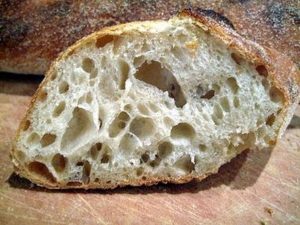 We have come to week four of our five week exploration of the metaphor of bread, the flesh of Jesus, the bread of life, the bread from heaven, the bread that gives life to the world. “I am the living bread that came down from heaven. Whoever eats of this bread will live forever; and the bread that I will give for the life of the world is my flesh,” says Jesus. “Just as the living Father sent me, and I live because of the Father, so whoever eats me will live because of me.”
 Children, as those of us who have had or who have been children know, grow in their ability to communicate. Vocabularies grow. Grammars develop. They move from simple one- or two-syllable concepts – such as “Mama” or “Dada” or “NO!” – to more complex ideas.
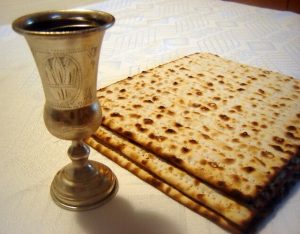 At the end of our gospel lesson this morning, Jesus said to the crowd, “It is my Father who gives you the true bread from heaven. For the bread of God is that which comes down from heaven and gives life to the world.” They said to him, “Sir, give us this bread always.” Jesus answered, “I am the bread of life. Whoever comes to me will never be hungry, and whoever believes in me will never be thirsty.”
 In 2014, Evie and I were privileged to join a group of other pilgrims from Ohio and Michigan and spend not quite three weeks in Palestine and Israel visiting many of the sites we hear about in the Bible, especially the Christian holy places of the Gospel stories. One of those was a hilly place overlooking the Sea of Galilee called Tabgha. Until 1948, when the Israelis uprooted its residents, a village had been there for centuries; now it is simply an agricultural area and a place of religious pilgrimage.
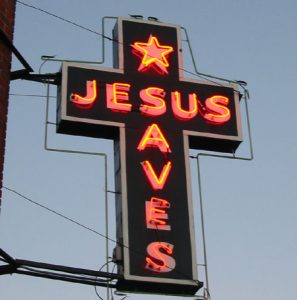 Our kids this week have been “Shipwrecked,” but they’ve also been “rescued by Jesus.”
 Some of you may have heard of Brooks’s law, which has to do with the time it takes to complete a software project. It’s similar to the general law of diminishing returns in economics. Professor Fred Brooks of the University of North Carolina first proposed the law in 1975; it holds that “adding manpower to a late software project makes it later.”
 What do you suppose it was like in Jerusalem on that Pentecost morning so long ago?
 Our gospel lesson today is from John’s story of the last supper. This is part of a long after-dinner speech that Jesus gives including a section known as the “high priestly prayer.” In it, among other petitions, Jesus asks God the Father to look after his disciples. He prays:
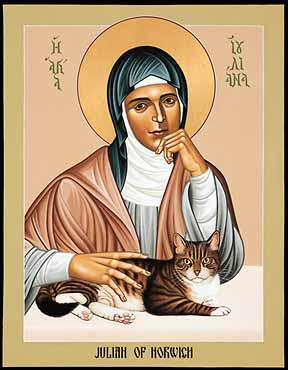 Today we are welcoming Reed C_____ F_____ into the Household of God through the Sacrament of Holy Baptism. We are also commemorating Dame Julian of Norwich, one of the medieval saints of English Christianity. Twenty-eight years ago I was ordained a deacon on Julian’s feast day which is actually on Tuesday, May 8. So the lessons we heard this morning, and the second of the two collect I offered after the Gloria in Excelsis, were from the propers for Dame Julian’s celebration. But I would like to read you also the brief Gospel lesson appointed for the Sixth Sunday of Easter, which is also from John’s Gospel

