 In 2011 a young man in New York City named Gabriel went to a party. While there, he drank some of the alcoholic punch being served. Unknown to the young man, the punch had been spiked with a drug called Gamma-Hydroxybutyric Acid, commonly called GHB. Prescribed as Xyrem and also called by a variety of “street names,” it is known as a “date rape” or rave drug. It comes as a liquid or as a white powder that is dissolved in water, juice, or alcohol. In most people it produces euphoria, drowsiness, decreased anxiety, excited behavior, and occasionally hallucinations. For Gabriel, however, who suffered from medication-controlled epilepsy, it caused a seizure. Apparently interacting with his regularly prescribed medication, the GHB he had unknowingly consumed caused a fatal convulsion.
Category: John (Page 6 of 25)
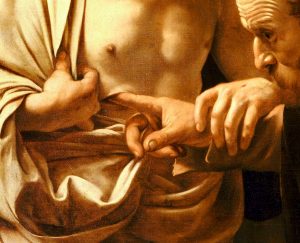 Every year, for as long as any of us can remember, on the Second Sunday of Easter the church has told the story of Thomas, Thomas the Doubter, “Doubting Thomas” who wouldn’t believe that Jesus had risen, the poster child for those who are uncertain. But, believe me, Thomas gets a bad rap! He was no worse a doubter or disbeliever than any of the others, including Peter!
Consider this from the end of Mark’s Gospel:
Now after he rose early on the first day of the week, he appeared first to Mary Magdalene, from whom he had cast out seven demons. She went out and told those who had been with him, while they were mourning and weeping. But when they heard that he was alive and had been seen by her, they would not believe it. After this he appeared in another form to two of them, as they were walking into the country. And they went back and told the rest, but they did not believe them. Later he appeared to the eleven themselves as they were sitting at the table; and he upbraided them for their lack of faith and stubbornness, because they had not believed those who saw him after he had risen.[1]
 Before coming to Ohio, my wife and I lived in the Kansas City metroplex. For reasons that still remain mysterious, I was somehow added to the mailing list for the newspaper of the Roman Catholic Archdiocese of Kansas City, Kansas, which is called The Leaven. When we moved here, I expected that that would stop, but somehow they got my change of address, so I still get The Leaven. I suppose I could have asked to be taken off, but I enjoy reading some of the articles, especially a column written by the paper’s editor-in-chief Father Mark Goldasich. Fr. Goldasich often relates stories of people from around the archdiocese; some are funny, some are touching, and some, like this recently offered story, bring tears to your eyes:
One day a young man was shopping in a supermarket when he noticed an elderly lady who seemed to be following him. Whatever aisle he turned down, she turned down. Whenever he stopped, she stopped. He also had the distinct impression that she was staring at him.
As the man reached the checkout, sure enough, the lady was right there. Politely, he motioned for the woman to go ahead of him.
Turning around, the elderly lady said, “I hope I haven’t made you feel uncomfortable. It’s just that you look so much like my late son.”
Touched, the young man said, “Oh, no, that’s OK.”
“I know that it’s silly,” continued the lady, “but could I ask you to do something for me? Could you call out, ‘Goodbye, Mom,’ as I leave the store? It would make me feel so happy.”
The young man was glad to oblige. After the lady went through the checkout and was on her way out of the store, he called out, “Goodbye, Mom!”
The lady turned back, smiled and waved.
 Sometimes I find myself at a loss for words. It doesn’t happen often, but once in a while I simply don’t know what to say about a person or an event or a spiritual feeling. On Good Friday, is one of the times when this happens. I don’t know what I want to say about Jesus or his crucifixion or the salvation we enjoy because of his death and resurrection.
When these speechless times happen, I find that turning to poets helps. I find that others have expressed that with which I am having such difficulty. So, today, I want to share three poems with you, actually part of an epic poem, a hymn, and a complete short poem. These aren’t specifically about Good Friday, but they give us some insight into this event, the Passion, death, and resurrection of Jesus Christ, and what it might mean for us.
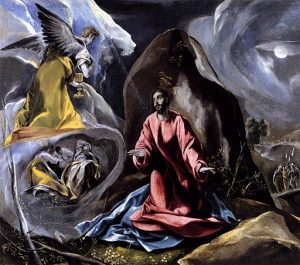 Across the Kidron valley from Jerusalem, at the foot of the Mount of Olives, is a small grove of olive trees. In the midst of it is a church called “The Church of All Nations” and in the center of that church, surrounded by a low wrought iron fence sculpted to resemble brambles and thorns, is a large, rough, flat rock. It is called “the stone of agony” and tradition tells us it is the place where Jesus prayed on the night before he died.
Our gospel lesson for this evening, for Maundy Thursday, does not mention that olive grove, that stone, or Jesus’ prayers. Our gospel lesson on this day is always the same from year to year. We rehearse John’s story of Jesus washing his disciples’ feet. John’s Jesus is self-assured and in control. He “knew that his hour had come to depart from this world and go to the Father.”[1] He knew “that the Father had given all things into his hands.”[2] “He knew who was to betray him.”[3] He gives his friends a “new commandment” (which, as a colleague of mine noted in our on-line bible study, isn’t really all that new): “Love one another.”[4]

This is such a great set up! Here are these Greeks (whether gentiles or Greek-speaking Jews of the Diaspora is unclear) who want to meet Jesus. John tells us in today’s gospel lesson:
Now among those who went up to worship at the festival were some Greeks. They came to Philip, who was from Bethsaida in Galilee, and said to him, “Sir, we wish to see Jesus.” Philip went and told Andrew; then Andrew and Philip went and told Jesus.[1]
So the Greeks come to Philip (who apparently speaks Greek) and make their request. He goes to Andrew (another unclear thing: does he take the Greeks with him?) The two of them go see Jesus (with the Greeks?)
Now, how will Jesus respond?
 I’m a great fan of Sesame Street. The generation after mine in the Funston family, my niece Saskia, my nephew York, and my own children, Patrick and Caitlin, grew up with that show and it taught them a lot of good things. The show taught my kids literacy, counting, simple logic, and social skills. It did so using a rapid-fire mix of puppetry, animation, and short films. Created in 1969, “it was designed to deliberately mimic the fast pace and style of TV advertising in order to ‘sell’ learning to kids: An Aesop-friendly story featuring the recurring characters on the Street would be intercut with rapid-fire ‘commercials’ for that day’s ‘sponsors’ (‘Sesame Street has been brought to you today by the letters A and S, and the number 7…’).”[1]
Always, it was sponsored by two letters and a number. I thought about starting this sermon that way: “Today’s sermon is brought to you by the letters A and R, and the number 15.” But if I did that, you’d think I was going to, again, preach about guns and mass murder and the killing of children.
Well, you wouldn’t be wrong . . . but you wouldn’t be right, either.
 You all know the truth of the statement, “You can’t take it with you.” What you may not know is that that sentiment is straight out of the New Testament! St. Paul, writing to the young new bishop Timothy, says, “We brought nothing into the world – it is certain that we can take nothing out of it.”[1] Once upon a time a man who died was given a dispensation from this truth. Before his death he was given a very special suitcase into which he could put one thing to bring with him to heaven. He gave it a lot of thought and over a period of years, as he led a successful life, he made his final decision and loaded up his suitcase. He put it under his bed waiting for that last day. When he finally died, he showed up at the Pearly Gates carrying his special suitcase with his one important thing. Word spread through heaven and all the angels gathered around him wanting to know what he had brought. So he knelt down and, with great flourish, opened the valise to reveal bright shining bricks of gold. The angels were stunned; they just stood there, staring silently at the man and at his suitcase. Finally, Michael Archangel, the commander of God’s army and spokesman for the angels, in a disappointed and incredulous tone of voice asked, “Pavement? You brought pavement?”
 Introductory Comment:
Before I offer my homily this morning, I want to say something about a verse I have chosen not to address. Nathanael asks, “Can anything good come from Nazareth?” Many of my clergy colleagues this week have made note of the question the president has been quoted as asking about Haiti and other countries, and they have chosen to focus their sermons this morning on issues of immigration. I have not; I had already chosen my focus verse for today and decided not to make any change. Nonetheless, I want join my colleagues in pointing out that in the First Century, the hometown of our Lord and Savior was regarded in much the same way that Mr. Trump is said to have considered the countries of the Caribbean, of Latin America, and of Africa. Can anything good come from such places? I encourage you in your prayerful meditations on the Gospel, regardless of how you may feel about the president, about his immigration policies, or his alleged remarks, to remember Nathanael’s question and the answer that has echoed through the centuries.
 Why do we do this? Why do we gather when a loved one dies and hold assemblies like this? Most human beings believe that death is not the end of the person who has passed away. Except for the few human beings who really strongly subscribe to an atheist philosophy, and they truly are a minority of our race, everyone on earth belongs to some faith group which teaches that we continue on, whether it is by reincarnation or in the Elysian Fields or the happy hunting grounds, as a guiding ancestral spirit or at rest in the presence of our Lord. So why do we do this?


