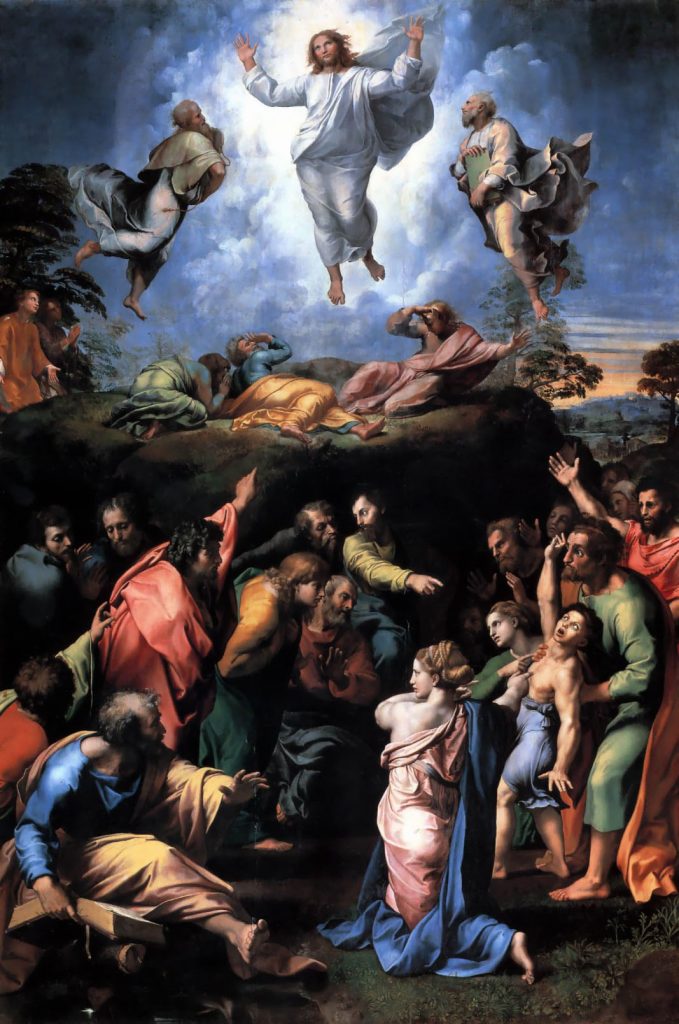
 Preachers often focus on Peter’s unthinking outburst offering to make three dwellings for Jesus, Elijah, and Moses on the mountain of the Transfiguration. Such booths would concretize his all-to-human desire to experience continually the radiance of God. Life, however, is not like that; it’s not all mountaintop highs. Life is full of ups and downs, both high mountaintops and low valleys.
My favorite artistic depiction of the Transfiguration is that by the High Renaissance painter Raphael. The top of Raphael’s painting portrays the glory and radiance described by the Evangelists Mark, Matthew, and Luke on the mountaintop, while the bottom shows what’s happening down below, what our lectionary reading leaves out. If we read further in Mark’s Gospel we find (as Paul Harvey might have said) the rest of the story:

 You all know the truth of the statement, “You can’t take it with you.” What you may not know is that that sentiment is straight out of the New Testament! St. Paul, writing to the young new bishop Timothy, says, “We brought nothing into the world – it is certain that we can take nothing out of it.”
 “The Lord your God will raise up for you a prophet like me from among your own people; you shall heed such a prophet.”
 A couple of months ago, I was part of a conversation among several parishioners about the set-up for our celebrations of the Nativity. We looking at our plans for Christmas services, and a member of our altar guild exclaimed, “That’s the problem! Things are always changing around here!”
 Introductory Comment:
 Christmas is now done. It ended Friday on Twelfth Night. I am sure than none of you, good Anglican traditionalists that we all are, put away any of your decorations before then, but have by now put them all away.
  “In the beginning was the Word . . . .” The Prologue of John’s Gospel echoes the opening words of the Bibe, “In the beginning God said . . . .” Our God is a god who communicates, who speaks, whose Word creates.
  One of the commentaries I read this week about our gospel lesson was written by a Lutheran serminary professor named Jan Schnell Rippentrop. She noted three things about John the Baptizer’s self-description in the Fourth Gospel:

