From the Letter to the Hebrews:
Since, then, we have a great high priest who has passed through the heavens, Jesus, the Son of God, let us hold fast to our confession. For we do not have a high priest who is unable to sympathize with our weaknesses, but we have one who in every respect has been tested as we are, yet without sin. Let us therefore approach the throne of grace with boldness, so that we may receive mercy and find grace to help in time of need.
(From the Daily Office Lectionary – Hebrews 4:14-16 (NRSV) – February 22, 2013.)
“Let us approach the throne of grace with boldness”! These are among my favorite words in all of Scripture.
 Some years ago, my wife and I were members of a congregation in Southern California where the assistant priest was a military chaplain originally from Georgia. He was normally rather soft-spoken, but when he would introduce the traditional (Jacobean English) version of the Lord’s Prayer using the words from The Book of Common Prayer he would emphasize one word: “And now, as our Savior Christ has taught us, we are BO-WULD to say . . . .”
When I read these words from the Letter to the Hebrews, I find myself reading them with his voice and his inflection, “Let us approach . . . with BO-WULDness!” And I actually believe that the author of this letter would approve of that.
Over the years I’ve read a lot of commentaries on this letter and on this particular passage, and it seems to me that when most commentators read verse 16 they lose their focus. A lot of what I have read analyzes the term “throne of grace” and goes off on tangents about the relationship of this image to other depictions of God’s throne in the Hebrew and Christian scriptures. That’s all well and good, but the subject of this verse is “us”! It’s an admonition to “us” to come before God’s throne (whatever it may be called) with confidence, with self-assurance, maybe even with a little brashness, with some chutzpah!
About twenty years ago, when I was just starting in my first independent pastorate in a tiny country church (after a two-year curacy in a major metropolitan parish), I read a business management book entitled Built to Last: Successful Habits of Visionary Companies. The authors, James Collins and Jerry Porras, postulated that what made companies truly successful was their adoption of a long-term vision of their future, a vision that is “clear and compelling, serves as a unifying focal point of effort, and acts as a clear catalyst for team spirit.” They called this vision a “BHAG” (pronounced “BEE-hag”) or “Big Hairy Audacious Goal.” The book made sense to me and to the members of my vestry, and we engaged in a visioning process that established a BHAG for the congregation. It worked, for a while . . . we grew the church from an average attendance of 35 to nearly 150 on a Sunday; our Sunday School attendance increased five-fold; we added a larger parish hall, a couple of offices, and some classrooms to the church building. Sometimes, though, timidity can rear its head and advances can be lost.
In any event, when I read the Letter to the Hebrews telling us to approach God’s thrown with chutzpah I think of BHAGs; let us approach the Lord with big hairy audacious visions, with big hair audacious prayers. While I love the old hymn Before thy throne, O God, we kneel, I think its sentiment of pain and shame is exactly not what this epistle champions. This letter says, “Stand up on your feet! Hold your head high! Take your best shot with God!” In fact, when I read this letter, I think of a song by the rock group Styx:
You’re fooling yourself if you don’t believe it.
You’re kidding yourself if you don’t believe it.
Get up, get back on your feet;
You’re the one they can’t beat and you know it!
Come on, let’s see what you’ve got!
Just take your best shot and don’t blow it!
So then I ask myself, “Why is this epistle in the Lectionary for this time of year? Is this a Lenten sentiment?” Lent is a season in which we take time to rediscover just how much we are loved by God. Knowing that we are loved gives us confidence; it gives us courage for self-reflection and honest self-appraisal. We have the courage to change our minds, to change our hearts. This change, in Greek called metanoia, literally “change of mind” but theologically “repentance”, works an interior change in us to gain freedom from the things that bind us and the actions that diminish us. True repentance gives us the capacity and the confidence to boldly approach the throne of God where we receive what the Father wants to give us – grace and mercy to help in time of need. So, yes, this is a Lenten sentiment.
Approach the throne of grace, take your best shot, and don’t blow it!
====================
A request to my readers: I’m trying to build the readership of this blog and I’d very much appreciate your help in doing so. If you find something here that is of value, please share it with others. If you are on Facebook, “like” the posts on your page so others can see them. If you are following me on Twitter, please “retweet” the notices of these meditations. If you have a blog of your own, please include mine in your links (a favor I will gladly reciprocate). Many thanks!
====================
Father Funston is the rector of St. Paul’s Episcopal Church, Medina, Ohio.
 Every time I recite Psalm 19 with its words of praise for the Law, I am caught up short by verse 12. In verses 7-11 we read that the Law is perfect and just, that it provides wisdom and rejoicing, that it is more desirable than gold or honey, and that in keeping it there is enlightenment and reward. Then comes the kicker, “Who can tell how often he offends? Cleanse me from my secret faults.” In other words, despite all the grandeur and wonder of the Law, no one can actually keep it!
 Day before yesterday, I had a pretty good day in my ministry as rector of my parish. An Episcopal Church Women event went very well; we all had fun in what we were doing. I got home in the late afternoon and took care of a couple of personal matters, called my wife about the possibility of a “date night,” and when she said “Yes” I made reservations for dinner. I took the dog for a walk and, after my wife got home from work, we went out to dinner at our favorite local restaurant. When we returned home, I turned on my computer, checked my email, took a look at Facebook . . . and learned that Deb, a long time friend, a singer of great skill, and an occasionally very funny woman had passed away. It more than ruined the day.
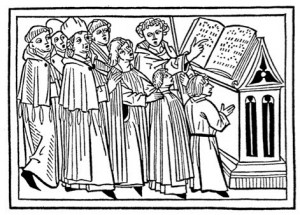 Chapter 50 of Ben Sira’s book is a description of a temple liturgy led by “the high priest, Simon son of Onias.” (v. 1) It is filled with poured-out wine, sumptuous vestments, the shouting of priests, the blowing of trumpets, the people falling on their faces. Not the sort of ho-hum run-of-the-mill worship service one finds in most Christian churches these days.
 The collect for today from The Book of Common Prayer:
 I love this Psalm – it’s about liturgy and worship, something dear to my heart!
 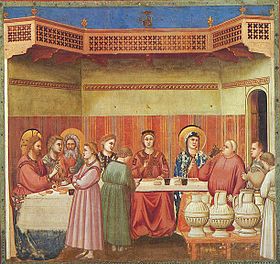 A year ago I was in Ireland, camped out in a cottage outside of the village of Banagher, County Offaly, on sabbatical. As my study project, I was translating old Irish hymns into metrical, rhyming English such that they could be sung to the music of the original. The hymns were published in the early 20th Century in a collection titled Dánta Dé Idir Sean agus Nuadh compiled by Uná ní Ógáin. Dánta Dé includes a communion hymn which elaborates on John’s story of the wedding feast; it is entitled The Blessed Wedding at Cana and is attributed to Maighréad ní Annagáin. I found I could not directly translate the hymn, so instead I wrote a poem of my own. Reading this story today, I recall working on that piece and offer it again.
 Reading these oh-so-familiar words in the introduction to John’s Gospel, I remember other words I read on another blog yesterday:

