Occasional thoughts of an Anglican Episcopal priest

Category: Sermons (Page 30 of 40)

What’s the Point? – Sermon for Midnight Mass, Christmas Eve – December 24, 2013

====================

This sermon was preached at Christmas Eve Midnight Mass, December 24, 2013, at St. Paul’s Episcopal Church, Medina, Ohio, where Fr. Funston is rector.

(The Revised Common Lectionary, Christmas II: Isaiah 62:6-12; Psalm 97; Titus 3:4-7; and Luke 2:1-20. These lessons can be read at The Lectionary Page.)

====================

Charlie Brown Christmas DollA few weeks ago, I was shopping at Giant Eagle and I wondered down the seasonal products aisle, which had been rapidly cycling through Halloween, then Thanksgiving, and now Christmas. On one shelf, I spotted something that pulled me up short; I had to have it and I knew that it would influence my Christmas Eve sermon. It was this Charlie Brown Christmas doll.

That same day, a ministry colleague who runs a tongue-in-cheek Facebook group entitled “The Society for the Prevention of Tacky Vestments” posted a picture of a clergy stole — this one — covered with pictures of the Peanuts gang opening presents around a Christmas tree. I knew I had to have it! I asked her where she’d found it and she directed me to an eBay page where I ordered it. It is truly tacky! It’s got all the wrong colors — it’s mostly red, the color of martyrdom — and sends all the wrong messages — it’s crassly commercial; it’s all about the worst of the secular observance of Christmas; it’s got nothing religious on it at all. (It made me sort of wonder: if your Christmas fabric has nothing about Jesus on it, what’s the point of making a stole out of it?) Nonetheless, I had to have it and I knew that, together with Charlie Brown here, it would influence this Christmas Eve sermon. Let me tell you why . . . .

When I was seven years old, about a month or so into the first semester of Second Grade, my mother decided that we (she and I) would take an extended Thanksgiving-through-Christmas holiday with her parents in Long Beach, California. At the time, we were still living in my hometown, Las Vegas, Nevada. My father had died a year and a half before; my older brother was living with our other grandparents in Kansas. So, it was just the two of us.

I guess she had made arrangements with her employer to take an extended leave, and with my school because I was going to have to do reading and arithmetic assignments while we were gone, but that was OK with me. At least I wouldn’t have to go to school and endure the daily routine with Mrs. Dougherty!

So for a little more than a month encompassing those two major holidays, we shared my grandparents’ second floor walk-up a block from the beach and the Nu-Pike amusement park in Long Beach. On the ground floor of the building where they lived were two businesses: a dentist’s office and my grandfather’s barbershop. For some reason, the barbershop was closed! My grandfather had packed up his tools (they were now in a case in the front hall closet of the apartment) and put the business up for sale.

I was later to learn that he had done so because he was suffering with late-stage colon cancer; he was struggling to wrap up his affairs and make sure my grandmother would be provided for after his anticipated death, which came just a few months later in March of the next year. What was an extended holiday vacation for me, was anything but for my mother. She was there to spend a last Christmas with her father, and to help him deal with all the messy reality at the end of human life.

Sometime during the week before Christmas, my grandmother and my mother went off to do some shopping, and my grandfather got it into his head that my hair was too long. (I had hair in those days and it was sort of longish.) So he set a stool in the bathtub, told me to sit on it, draped me with one of his barber’s capes, got his tools from the front hall closet, and went to work. The reason he could no longer barber became painfully obvious as the haircut progressed.

He suffered from recurrent stabbing gut pain because of the cancer, and while he was cutting my hair one of these occurred. He flinched and made a mis-cut with his electric barber sheers. He didn’t cut me, but he did shave a 2-inch stripe up the back of my neck and across the top of my head! There was nothing to be done for it but to shave the rest of my head . . . . so that I ended up looking pretty much the way I look now, without the beard, of course.

A few days later, my brother joined us for the holidays and his first words on seeing me were, “You look just like Charlie Brown!” referring to this character from the Peanuts comic strip which had been our late father’s favorite. For the rest of that holiday week, that’s what he (and everyone else) called me.

Eventually my hair grew back and the haircut was forgotten. But that name stuck, and for the rest of my childhood and youth, my family nickname was “Charlie Brown.” So when I saw these Peanuts-related Christmas things, I knew I had to have them; and I knew that I would preach about them tonight.

The Peanuts franchise proved to be even more durable than my nickname. In 1965 it was the source of one of the most memorable and still best-loved Christmas specials on TV, A Charlie Brown Christmas; in fact, it was rebroadcast by ABC just last Thursday. 48 years after its debut and 13 years after the death of its creator, Charles Schulz, that cartoon Christmas special continues to touch hearts. In part because of its endurance, TV Guide has ranked Peanuts as the 4th greatest television cartoon of all time. (The top three are The Simpsons, The Flintstones, and the original Looney Toons series.)

If you’ve seen the Peanuts Christmas special, you know that there is a point in the story — which revolves around the kids putting on a Christmas play with a subplot involving Charlie Brown’s forlorn-looking little Christmas tree — there is a point in the story when Charlie cries out, “Isn’t there anyone who knows what Christmas is all about?” Linus replies, “Sure, Charlie Brown, I can tell you what Christmas is all about,” and walks out onto the stage where the play is to be performed. He calls for a spot light, and then begins to recite St. Luke’s nativity narrative, the same Gospel story we just heard. He ends with the message of the angels, “Glory to God in the highest and, on earth, peace, goodwill towards men.” As he walks back over to Charlie Brown, he says, “That’s what Christmas is all about, Charlie Brown.”

David Michaelis, in his biography of Charles Schulz entitled Schulz and Peanuts, tells the story behind this. During development meetings early in the production of the special, Schulz “proudly announced” that there would be “one whole minute” of Linus reciting the Gospel. The producer, Bill Melendez, tried to talk him out of it. But Schulz, who was an active “lay preacher” in the Church of God, insisted, “We can’t avoid it — we have to get the passage of St. Luke in there somehow. Bill, if we don’t do it, who will?” Schulz was asking, as I had asked about my Peanuts-inspired stole, “If Jesus isn’t in Christmas, what’s the point?”
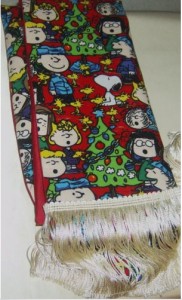
Peanuts StoleAnd it seems to me that that question, raised by Peanuts and Charlie Brown, by this doll and that special, by this silly stole that I will never wear again, is one we really need to think about: If Jesus isn’t in Christmas, what’s the point?

Now, I’m not a proponent of the nonsense that Bill O’Reilly and others put out about some mythical “war on Christmas.” There isn’t one. A war on Christmas might actually be a good thing: the history of the church throughout the world, from its founding by the Apostles to the present day, demonstrates that where the church is actively persecuted, where there is a war against the church and its message, the faith is strong and grows. The 2nd Century Church Father Tertullian wrote that “the blood of martyrs is the seed of the Church.” A real war on Christmas would be a good thing! But there isn’t one.

What there is, I think, is not so much a war on Christmas, as an indifference towards Jesus! There’s plenty of holiday music on the radio and in the stores, but precious little of it mentions Jesus! There are yard displays galore, although there are a lot more Santas, Frosties, Grinches, and elves than baby Jesuses and Holy Families! There are scores of people attending parties, concerts, and special programs, many more at those venues then there are in churches like this. The winter solstice is being celebrated all over the place and the world around us is calling it “Christmas,” while exhibiting a gross indifference to Jesus . . . but if Jesus isn’t in Christmas, what’s the point?

Christmas, as Linus told Charlie Brown and reminded us, ought to be about Jesus being born in a stable in Bethlehem. Born there because the emperor had declared a census, a crucial element in the Roman empire’s system of taxation. In the ancient world, taxes were profoundly oppressive, especially in an economic system filled, as our own increasingly is, with individuals living at the very edge of survival. In a world full of working poor with very little to spare, the insatiable appetites of Roman military might and power, like the insatiable appetites of today’s government-subsidized corporations, cost ordinary people a great deal.

From his very first breath, Jesus’ life was shaped by oppressive power. His very existence was threatened by distant rulers, by Herod who would try to kill him as an infant, and by the Roman empire which would one day work his death, a death he would conquer and in conquering give meaning to his birth and his life.

In a very real sense, Jesus was born homeless. If Jesus were to be born today, he would likely be found in a tent city, under a turnpike overpass, in a city-center shelter, not in the safety of a maternity ward. If Jesus were to be born today, he would be found among those who suffer most but hope for much better, with those who rely on the kindness of strangers, on the goodness of the society around them to survive.

Jesus’ birth, as Linus told Charlie Brown and reminded us, was announced to shepherds. The announcement did not ring in the throne room of Caesar, nor that of Herod, nor even in the city council chambers of Bethlehem. The good news was first heard by powerless, anonymous people in a dirty camp watching their sheep and yearning for something better.

The world around us is indifferent to these realities of Jesus’ birth. The world around us, filled with those who are desperately poor, encourages us to ignore them, to make merry with an abundance of glitz and glamor rather than exhibit a generosity of spirit. The world around us, filled with those who have nowhere to live, encourages us to disregard them, to celebrate consumption and excess rather than the sufficiency of family and faith. The world around us, filled with powerless people whose lives are a mess, encourages to take no notice, to revel in plastic perfection instead of the complicated, beautiful reality of untidy human life.

Sunday evening our Church School children performed their annual Christmas pageant. It was fun and funny. It was lovely and it was sweet. The kids did a good job and everyone had a good time, but as I watched it I was struck by how little of Jesus there was in it. In fact, when it was all over, one of the parents in the audience asked, “But where’s Jesus?” Joseph (who was a 15-year-old boy who stands about 6′ 3″) held up a small doll which had been tucked away out of sight in an over-sized manger crib. It was a funny moment, but it underscored our question: If Jesus isn’t in Christmas, what’s the point?

In Linus’s brief one-minute of Gospel recited in the middle of what was otherwise a cute children’s Christmas cartoon, the Peanuts Christmas special reminded us that Jesus is in Christmas and that at its core Christmas is not a holiday for children! The secular celebration of the winter solstice with its parties, with its gift giving (and receiving), with its glitz and glamor and plastic perfection — that is a holiday for children and for those who act like children. But the commemoration of the poor, homeless, messy birth of Jesus, given meaning by his poor, homeless, messy death, redeemed by his glorious and life-affirming resurrection, this Christmas is a holy day for grown-ups!

A little more than a decade ago, a priest of our church named Fleming Rutledge suggested that the idea that Christmas is entirely for children encourages spiritual immaturity. She wrote:

In these stress-filled times, virtually all of us, as we get older, will seek relief by visiting, in our imaginations, a childhood Christmas of impossible perfection. These longings are powerful and can easily deceive us into grasping for a new toy, new car, new house, new spouse to fill up the empty spaces where unconventional love belongs. Our longings are powerful, our needs bottomless, our cravings insatiable, our follies numberless. For those who cannot or will not look deeply into the human condition, sentiment and nostalgia can masquerade as strategies for coping quite successfully for a while — but because it is all based on illusion and unreality, it cannot be a lasting foundation for generations to come. (For Grown-Ups)

In other words, if Jesus isn’t in Christmas, what’s the point?

In the 4th Century, St. Augustine of Hippo wrote a prayer in his autobiographical Confessions. “You,” he wrote to God, “have made us for yourself, O Lord, and our hearts are restless until they rest in you.” If we are honest, we all have that deep longing — that sense of something missing in our lives. It comes with maturity and is a sort of nagging feeling that something about us is incomplete. We grown-ups, unlike children, are consciously aware of how fragile life is; we know how limited and unfinished we are. We know that if Jesus isn’t in Christmas, there is no point!

Samuel Wells, the dean of the chapel at Duke University, wrote an article a few years ago about his experience attending a Christmas pageant at a church in Delhi, India, where the parts were all played by adults. (Christmas Is Really for the Grown-Ups) His initial reaction, he said, was to be flabbergasted: “Everyone knows the unique charm of Christmas is lost if adults take it too seriously. I sat there in Delhi and thought, Don’t these people realize that Christmas is really for the children?” (Emphasis his.) But as the play went on his perception changed: “[W]hen you see a nativity play performed by adults in a country like India, . . . you see for a start that Christmas is about suffering people.”

“This is a story,” he wrote, “about political oppression, harsh taxes, displaced people, homelessness, unemployment, vulnerable refugees and asylum-seekers. That’s the danger of performing it in a place like Delhi and having it acted out by adults who themselves know the very real possibility of any or all of these realities. We might have to recognize what it’s really about.”

And there’s more. Making note of the biblical account of Elizabeth’s barrenness, Mary’s unplanned pregnancy, Joseph’s confusion and possible humiliation, Wells comments, “The Christmas story’s teeming with personal grief, unresolved longings, uncomfortable secrets, shabby compromises, intense fears, social humiliation, and aching hurts.”

“When you sit in a market square in Delhi and see adults performing the Christmas story in an open-air nativity play. . . . . You see that Christmas is about people struggling, not just politically, but personally. Everywhere you look in the Christmas story you see people clinging on with their fingertips to life, to sanity, to respectability, to hope.”

Then Wells considers the wise men scanning the heavens and making their pilgrimage to Bethlehem; he points to the shepherds shivering on the hillside and, later, to Anna and Simeon waiting in the Temple. “When you see adults performing a nativity play, not for their grandparents’ camera-shots but in order genuinely to inhabit the story and make it their own, you see people not just suffering, not just struggling, but also searching. . . . . The nativity story is full of people searching, people yearning, people wanting to believe there’s more than just appearances and surviving and making a living and staying cheerful.”

When we consider the Christmas narrative as a story for adults, says Wells, it “encourage[s] us to name and explore the edges of our own faith, and commitments, and convictions, and questions.” Christmas as a story for grown ups encourages us to get in touch with the suffering in the story, the discrimination in our own culture, the political oppression in our own world. Christmas encourages us as adults to get in touch with the struggling in the story, the disappointment, distress, and despair in the lives of the Holy Family, the wise men, the shepherds, and all the others, and to recognize their struggle in our own lives and in the lives of those around us. Christmas encourages us grown-ups to get in touch with the searching in the story, with the nagging incompleteness of human life, the unresolved questions of faith, the yearning of people aching for truth, longing for meaning, waiting for hope, reaching out for God.

The adults acting out the Nativity play in India and the Peanuts gang (especially Linus) putting on their Christmas pageant in the television special both underscore the importance of our question: if Jesus isn’t in Christmas, what’s the point?

Christmas is not a holiday entirely for children, but it is a holiday entirely about a Child, the child Jesus who is God Incarnate, the Son of God who chose to become as limited, as fragile, as human as we are.

Charlie Brown’s question, “What’s it all about?” is our question, and Jesus, the Child born in the stable, is our answer. Our lives, with all their nagging incompleteness, are in the hands of a God who became human, who was born poor and homeless, who joined us in all the messiness of human life. The God who comforts us and lifts us up when we can’t lift ourselves up became Jesus, the Child born in a stable and laid in a manger, an infant who could not lift himself up, who needed to be comforted and lifted up by others, and thus inspires us to comfort and lift up others — the ones he would call members of his family: the poor, the homeless, the suffering, the struggling, the searching, the ones who live in the messiness and incompleteness of our world.

Without Jesus in Christmas, there is no point, because Jesus is the point! In the end Jesus is the good news of Christmas: that God, made fully known in Jesus, is with us, in all our suffering, in all our struggling, in all our searching, in all the messy incomplete reality of grown-up human existence.

Linus answering Charlie Brown by reciting that one-minute of Gospel in the middle of what is otherwise simply a cute children’s Christmas cartoon reminds us that Christmas really isn’t for children. It’s for adults.

It’s for you.

====================

A request to my readers: I’m trying to build the readership of this blog and I’d very much appreciate your help in doing so. If you find something here that is of value, please share it with others. If you are on Facebook, “like” the posts on your page so others can see them. If you are following me on Twitter, please “retweet” the notices of these meditations. If you have a blog of your own, please include mine in your links (a favor I will gladly reciprocate). Many thanks!

====================

Father Funston is the rector of St. Paul’s Episcopal Church, Medina, Ohio.

Saying “Yes” – Sermon for Advent 4: December 22, 2013 – Revised Common Lectionary, Year A

====================

This sermon was preached on the Fourth Sunday of Advent, December 22, 2013, at St. Paul’s Episcopal Church, Medina, Ohio, where Fr. Funston is rector.

(The Revised Common Lectionary, Advent 4A: Isaiah 7:10-16; Romans 1:1-7; Psalm 80:1-7,16-18; and Matthew 1:18-25. These lessons can be read at The Lectionary Page.)

====================

Maria TheotokosA couple of weeks ago our choir and the brass quartet offered a really lovely service of Advent Lessons and Carols on the evening of Second Advent. We had things set up a little differently than you usually see our chancel and I hear later that someone had asked, “What’s all that Catholic stuff doing on the altar?” I was confused by the question because we always have “Catholic stuff” on the altar!
We have seasonally colored frontals. We have this pure white “fair linen” and this smaller piece of linen with a funny Latin name on which we set the Bread and Wine of the Eucharist. We have a chalice and a patten and a colored veil. We have candles! All of that is “Catholic stuff” and we always have it here on the altar, so I was confused by the question.

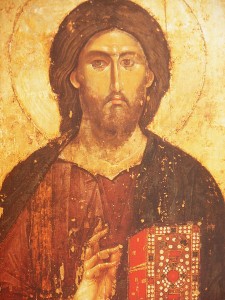
Then I realized that what the questioner was asking about were these . . . the icons that we place on the altar during our services of Compline on the last Sunday evening of each month and that I had thought would make a nice addition to the prayerful atmosphere of lessons and carols. This one is a representation of the Madonna and Child known in Greek as Maria Theotokos — which means “Mary the God-Bearer.” The other is called the Christus Pantokrator (the words mean “Christ All-Mighty”) and depicts Christ as a teacher or as the stern-but-merciful, all-powerful judge of humanity. They are actually not so much Catholic as Orthodox. In the Eastern Orthodox tradition, icons are an aid to prayer; they are called “windows into heaven.”

Christus PantokratorFor that reason, icons are typically not realistic; they are very “wooden,” very simple, almost cartoonish. Much is left to the viewer’s, the prayer’s imagination. I love to pray with icons and with other “visual aids,” with paintings, photographs, candles, flowers, all that “Catholic” stuff. It is one of the beauties of our Anglican tradition that we understand worship and prayer to be an activity of the whole person, to engage all of our senses. “Taste and see that the Lord is good,” the Psalmist wrote. (Psalm 34:8) We take those words seriously and so we don’t exclude any form of prayer or spirituality; we don’t distinguish between what is catholic or what is protestant. If it’s helpful in prayer, if it offers an aid to our understanding or our relationship with God, we thinks it’s fine. We draw on the catholic tradition, on the protestant traditions, on the orthodox tradition, even on non-Christian traditions. We’re willing to say “Yes” to anything that aids our connection to God.

But it’s so much easier to say “No,” isn’t it? I have a suspicion that the person who asked, “What’s all that Catholic stuff doing on the altar?” was also thinking something the along the lines of “We’ve never done that before.” That’s what we mean when we say “No.” “No” means we can keep with the status quo; we don’t have to face and deal with something we’ve never done before. That’s what Ahaz, the king of Judah, tries to do in the reading from the prophet Isaiah this morning. The prophet tells the king to ask God for a sign, but Ahaz declines to lest he be thought to put God to the test and be guilty of what Scripture elsewhere denounces as spiritual presumption. He knows that doing so can cause trouble for the asker, so he prefers to the status quo. He says, “No!” God gives him a sign anyway: “Look! A virgin will bear a son and name him ‘Emmanuel’.”

We’re all a bit like Ahaz; we prefer to stick with the way things are. The status quo may not be comfortable, but it is familiar. We know how to deal with it; we may not know how to handle something we’ve never encountered before.

“Yes” opens the future. It opens us to the unknown; it opens us to what we’ve never done before. Saying “Yes” is pregnant with possibility. But saying “No” is so much easier, so much safer!

The icons came to mind today because of the Gospel story.

On the Fourth Sunday of Advent, we like to say that we honor Mary and, to an extent, that’s true. Usually, in two of the three years of the lectionary cycle, we hear about the Annunciation when the angel Gabriel informed Mary that she had been chosen to bear God’s Son. But this year, we hear the other story, the annunciation to Joseph when an angel, not named by Matthew but often also portrayed as Gabriel, appeared to Joseph in a dream and explained Mary’s condition to him. They were betrothed, almost but not quite married, when it was discovered that Mary was pregnant. Joseph knew he wasn’t the father, but he didn’t want to embarrass this young girl, so he planned to divorce her (in a sense) in a quiet, private way. The angel visits him to convince him otherwise.

The icons came to mind today because when I contemplate Bible stories, when I pray about these tales, I like to use art, to look at the way these stories of the faith have been portrayed by painters and sculptors. There are two paintings, in particular, of this story that I like, and one of the Annunciation to Mary that is absolutely my favorite painting of a biblical tale.

The Annunciation by Sandro BotticelliThe Mary painting is by Sandro Botticelli, a Renaissance Florentine painter of the late 15th Century. In his painting, Mary is a Medici princess! She’s all decked out in these Renaissance robes, standing in a beautiful palace in front of window looking out over a lovely formal garden. Not very a very realistic depiction, of course, since she was a 1st Century Palestinian peasant girl! In any event, what is important is not how she’s dressed, but the emotions the painting conveys, and not only hers but also the angel Gabriel’s.
As Mary is depicted, she seems to be flinching away from the angel, holding her hands out as if fending him off. The expression on her face is nearly unreadable, but it is certainly not one of acceptance. Gabriel, also decked out as if he were a Medici courtier but these lovely, golden, semi-transparent wings billowing behind him, is kneeling before her. His hands are reaching out as if pleading. The expression on his face is one of apprehension. You can almost hear him thinking, “Oh, no! She’s going to say, ‘No!’ I’m going to have to go tell God that I blew it!” Of course, she didn’t say, “No.” But . . . what if she had?

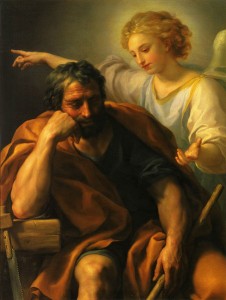
St Joseph's Dream by Raphael MengsThe paintings of Joseph are, first, a painting by an 18th Century German Bohemian painter named Raphael Mengs. Other than this painting, I don’t know this painter, but I did see this painting in the Kunsthistorisches Museum in Vienna. It is notable, first of all, for it’s depiction of Joseph as a relatively young man. Usually in art, Joseph is portrayed as an old man because of a legend that he was very old, had been previously married, had other children (who are those identified in the Bible as Jesus’ brothers and sisters), and passed away early in Jesus’ life. Scholars generally disagree with that: most now believe that Mary was probably only 13 or 14 years of age, Joseph perhaps 16 to 20.

In Mengs painting Joseph is perhaps a bit older than that but still a young man. He is fit and muscular, clearly a hard working man; Joseph, of course, was a carpenter. He has fallen asleep at his workbench, and the angel is speaking to him from behind, sort of over his shoulder. Joseph’s sleeping face is somewhat shrouded in shadow and hard to read. Sometimes when I look at this painting, he looks puzzled or confused; sometimes he looks angry; sometimes, simply uncaring. He does not look like someone who is going to readily agree to whatever the angel is telling him.

The Dream of St Joseph by Georges de la TourThe second painting of Joseph is by another 18th Century painter, the Frenchman Georges de la Tour. De la Tour is more conventional. He portrays Joseph as an elderly man, bald with a bushy beard. He appears to be in bed and to have fallen asleep while reading; a book is in his hand. The angel stands next to him; the scene is lighted by a single candle standing on a bedside table between them. We cannot see the candle, but only its light on the angel’s face and on Joseph’s. Joseph appears to be waking up, but not quite awake. He seems to be in that in-between, liminal stage — not quite asleep but not quite awake. I don’t know about you, but if someone tries to get me to do something when I’m just waking up like that, they’re going to get a resounding “No!”
Again, just like Mary, we know that Joseph did not say, “No.” He did not divorce Mary; he carried through with the marriage. Jesus was born and Joseph reared him as his own son. This is terribly important to Matthew, who traces Jesus’ lineage to King David through Joseph; as the acknowledged foster-adoptive son of Joseph, who is a blood descendent of David (the angel addresses him as “son of David”), Jesus also is “of the house and lineage of David.” This, for Matthew, legitimizes the claim that Jesus is the Davidic Messiah predicted by the prophets.

Think, for a moment, what might have happened if either of these young people had said, “No.” If Mary had declined to bear the Son of God, there would have been no Jesus. Oh, surely, God would have worked the plan of salvation in a different way, but it wouldn’t have been the way we know; there wouldn’t have been a Jesus Christ, a Christian church, the history of the world as we know it. We cannot imagine what it would have been, but it wouldn’t have been this!

If Mary had agreed but then Joseph refused, what might the childhood of the Son of God have been like. As it was, he was reared in a typical 1st Century Jewish family. He learned his lessons, worked with his foster father, learned the craft of carpentry, went to school at the local synagogue, learned the Scriptures and the traditions of his faith, obtained all the knowledge that was the necessary foundation of his life and ministry. But if he had been not the son of a merchant craftsman? What if he’d been the illegitimate son of an unwed mother? Again, we can be sure that God would have worked with that, but the story of salvation would have been radically different!

We have made it nearly all the way through Advent, this introspective season of preparation for the Feast of the Nativity, the celebration of the Incarnation of God in the birth of Jesus of Nazareth. But it is more than that; Advent bids us prepare not only to celebrate Christmas, but to get ready for what we call “the Second Coming,” the Messiah’s return at the end of time. Christmas (which technically hasn’t even started yet) will be over soon. As a church season, it lasts only twelve days starting Tuesday night. For many of us, it will be shorter than that. The tree will be taken down, the gift wrap thrown away, many of the gifts returned to stores and other gifts already broken long before Twelfth Night! But there’s still that unknown and unpredictable “last great day” when Christ will return to “judge the quick and the dead.”

Between now and then, we will have many opportunities to say “Yes” or “No.” We will have many opportunities to open the future. Will we do so? Will we say “Yes” and embrace the unknown pregnant with possibility? Will we play it safe, maintain the status quo, say “No?”

As we come to the end of Advent, give that some thought, give some thought to Mary’s “Yes,” to Joseph’s “Yes,” and prepare yourself again. Get ready! Keep awake! Be alert! When the opportunity comes remember Mary and Joseph, and say “Yes!” Open the future!

Amen!

====================

A request to my readers: I’m trying to build the readership of this blog and I’d very much appreciate your help in doing so. If you find something here that is of value, please share it with others. If you are on Facebook, “like” the posts on your page so others can see them. If you are following me on Twitter, please “retweet” the notices of these meditations. If you have a blog of your own, please include mine in your links (a favor I will gladly reciprocate). Many thanks!

====================

Father Funston is the rector of St. Paul’s Episcopal Church, Medina, Ohio.

Bird Brained – From the Daily Office – December 21, 2013

From the Gospel according to Matthew:

When the Son of Man comes in his glory, and all the angels with him, then he will sit on the throne of his glory. All the nations will be gathered before him, and he will separate people one from another as a shepherd separates the sheep from the goats, and he will put the sheep at his right hand and the goats at the left.

(From the Daily Office Lectionary – Matt. 25:31-33 (NRSV) – December 21, 2013.)

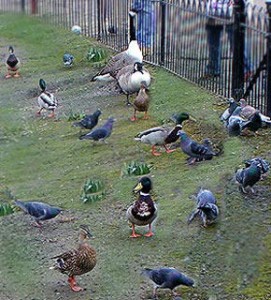
Ducks Geese and PigeonsI ought to be thinking “purer thoughts” or something . . . .

But I’ve been pondering this gospel bit all day, and although there are many things I could say about it, what keeps coming back to my mind is that (given the Phil Robertson, Duck Dynasty, A&E kerfluffle of the past several days) I’m glad that Jesus chose to make his point by separating sheep from goats, not geese from ducks.

I must be punchy (or maybe bird-brained) from Christmas preparations and sermon writing.

====================

A request to my readers: I’m trying to build the readership of this blog and I’d very much appreciate your help in doing so. If you find something here that is of value, please share it with others. If you are on Facebook, “like” the posts on your page so others can see them. If you are following me on Twitter, please “retweet” the notices of these meditations. If you have a blog of your own, please include mine in your links (a favor I will gladly reciprocate). Many thanks!

====================

Father Funston is the rector of St. Paul’s Episcopal Church, Medina, Ohio.

Broken Hearts – From the Daily Office – December 20, 2013

From the Psalter:

Open my lips, O Lord,
and my mouth shall proclaim your praise.
Had you desired it, I would have offered sacrifice;
but you take no delight in burnt-offerings.
The sacrifice of God is a troubled spirit;
a broken and contrite heart, O God, you will not despise.

(From the Daily Office Lectionary – Psalm 51:16-18 (BCP Version) – December 20, 2013.)

Broken Heart_by_eReSaWThe Episcopal Church includes Psalm 51 in its liturgy of Ash Wednesday. After ashes are imposed on the faithful and just before the recitation of a litany of penitence, the psalm is recited in its entirety. It’s a perfect piece of scripture for that use with its plea for forgiveness — “Have mercy on me, O God, according to your loving-kindness” (v. 1) — its acknowledgement of sinfulness — “For I know my transgressions, and my sin is ever before me” (v. 3) — and its petition for amendment of life — “Create in me a clean heart, O God, and renew a right spirit within me (v. 11).


I am so familiar with it in that Lenten liturgical setting that when it rolls around in the Daily Office cycle it always surprises me and usually seems oddly inappropriate for whatever other time of year it is appointed. Today, however, these ending verses strike me as particularly apposite.

In planning my Advent and pre-Christmas activities, I had set aside today for the preparation of my sermons for Advent IV (often the story of the Annunciation, but this year the tale of Joseph’s dream about Mary’s pregnancy) and Christmas. It was not a good decision; I should have started earlier, but I know myself well and usually do just fine “working to deadline.”

It was not a good decision for two reasons, one I knew about well ahead of time and one just occurred. The first is that tomorrow is the 14th anniversary of my mother’s death. I thought that it had been long enough (more than a decade, for pity’s sake!) that I could overlook that residual sadness, and probably I could have but for the second reason. Yesterday morning I received word (via Facebook) that an old friend, a colleague in ordained ministry, had passed away this week.

This is the week our Sunday School children have been rehearsing for Sunday’s annual pageant. This is the week our choir has held its annual Christmas party and dinner. This is the week our new Gallery addition to the Parish Hall has become nearly finished and is gorgeous beyond expectations. This is the week when Christmas cards are pouring in from friends old and new, from family, from colleagues, from people we haven’t seen in years but whom we remember with fondness. This is a week in which one’s cup should be overflowing with all the joys of the holidays!

Then that news and with it the old sorrow of missing Mom. The wisdom of Book of Proverbs is shown once again: “Even in laughter the heart is sad, and the end of joy is grief.” (Prov. 14:13)

But this morning, I get to read Psalm 51 and to pray as every preacher surely does in one way or another, “Open my lips, O Lord, and my mouth shall proclaim your praise,” and to be reminded that “the sacrifice of God is a troubled spirit.” Writing out my sermon for Christmas will be no different than preparing any sermon! Sure, the crowd will likely be bigger than a Sunday morning congregation and it will include people I’ve never seen before and people I haven’t seen since Easter and people I haven’t seen since last Christmas, and a small piece of me wants to preach the zinger that will change their hearts and get them returning to corporate worship on a weekly basis . . . and a larger part of me scoffs at that idea! Sure, it’s a big, grand show we put on on Christmas Eve, and a small part of me wants to preach an eloquent and stirring homily that will be remembered as people head home (and beyond) . . . and a larger part of me reminds that small piece of me that people don’t go out humming the sermon. The larger part of me knows full well that writing this sermon is no different than preparing any sermon.

Every sermon a priest or pastor preaches, on the days it is conceived and researched, on the day it is written, on the day it is preached, must be larger than his or her peculiar situation, whether it is a Sunday sermon, a funeral homily, or the oration on a principal feast. Every preacher must set aside his or her personal concerns and issues, his or her griefs and sorrows, his or her individual joys. Every preacher must, I think, begin and continue the homiletic process with two biblical prayers: first, from John the Baptizer who said, “[Christ] must increase, but I must decrease” (John 3:30); second, from today’s psalm, “Open my lips, O Lord, and my mouth shall proclaim your praise.”

So today, as I prepare to write some sermons, I do so in the midst of personal sadness, but I am reminded that “a broken and contrite heart [the Lord] will not despise,” and a line from a favorite song occurs to me:

Ring the bells that still can ring
Forget your perfect offering
There is a crack in everything
That’s how the light gets in.
(Anthem by Leonard Cohen)

From the cracks in a preacher’s broken heart, the Light can and will get in!

I offer these thoughts to my colleagues in ministry with a prayer and an assurance that their Christmas homilies will touch the hearts, the broken hearts, of the people entrusted to their care.

====================

A request to my readers: I’m trying to build the readership of this blog and I’d very much appreciate your help in doing so. If you find something here that is of value, please share it with others. If you are on Facebook, “like” the posts on your page so others can see them. If you are following me on Twitter, please “retweet” the notices of these meditations. If you have a blog of your own, please include mine in your links (a favor I will gladly reciprocate). Many thanks!

====================

Father Funston is the rector of St. Paul’s Episcopal Church, Medina, Ohio.

The Highway of Salvation – Sermon for Advent 3, RCL Year A – December 15, 2013

====================

This sermon was preached on the Third Sunday of Advent, December 15, 2013, at St. Paul’s Episcopal Church, Medina, Ohio, where Fr. Funston is rector.

(The Revised Common Lectionary, Advent 3A: Isaiah 35:1-10; Canticle 15 (The Song of Mary, Luke 1:46-55); James 5:7-10; and Matthew 11:2-11. These lessons can be read at The Lectionary Page.)

====================

Highway though Blooming Desert

There are some numbers that made the news this week: 194 and 11,507. They are important numbers, numbers which represent an unpleasant reality of the world in which we live. I’ll return to them in a moment. but first let’s explore the Scriptures assigned to this, the Third Sunday of Advent, the second week in a row the Gospel focuses on John the Baptizer.

Last week we heard from John himself, this week we have Jesus asking people why they paid attention to John: “What did you go out into the wilderness to look at?” he asks them. “A prophet,” would be the correct answer, but more than a prophet – the forerunner of the kingdom of God. Jesus draws on the tradition of the prophet Malachi through whom God had said, “See, I am sending my messenger to prepare the way before me . . . . ” (Mal. 3:1) It was Malachi who predicted that the Messiah would be heralded by the return of Elijah: “I will send you the prophet Elijah before the great and terrible day of the Lord comes.” (Mal. 4:5) This was and remains in Judaism a traditional expectation known to all Jews. By equating John with Elijah, Jesus was announcing to one and all that, in himself, the reign of heaven had begun, that salvation was at hand. Some who heard him took this testimony seriously, but many others rejected. We take it seriously and because we do, we are preparing once again to celebrate Jesus’ birth.

We take it seriously that salvation is at hand, but what do we really mean when we use that word, “salvation”?

I know that many will say that salvation is a personal thing. “If you confess with your lips that Jesus is Lord and believe in your heart that God raised him from the dead, you will be saved,” wrote Paul to the Romans. Many people believe that what this means is that, doing those two things, each person will get into heaven when he or she dies.

On the other hand, we have the witness of the prophet Isaiah in today’s reading from the Old Testament that salvation is more communal than personal. God “will come and save you,” he says: “Then the eyes of the blind shall be opened, and the ears of the deaf unstopped; then the lame shall leap like a deer, and the tongue of the speechless sing for joy.” Hands that are weak will be strengthened, knees that are feeble will be made firm, and those who are fearful of heart will be made strong. Salvation is something that happens for the whole human community.

And not only is salvation communal, it is universal! Not only is salvation for the human community, it is for the whole of creation! “Waters shall break forth in the wilderness” and “the burning sand shall become a pool.” “The desert shall rejoice and blossom; . . . it shall blossom abundantly.”

Isaiah makes it clear that salvation is so much more than personal; it is so much more than simply getting into heaven when we die. Salvation is for everyone; it is for everything; and it is for the here-and-now. Jesus affirms this when John sends word to Jesus and asks, “Are you the one?” Jesus replies: “Tell John what you hear and see: the blind receive their sight, the lame walk, the lepers are cleansed, the deaf hear, the dead are raised, and the poor have good news brought to them.” Notice that everything Jesus says is present tense! It’s here! It’s now! It’s not “will be;” it’s not “might be;” it’s not sometime in the future. It’s not in heaven when we die! It’s here and it’s now!

So why, then, if salvation is for everyone and everything in the here-and-now, are we told to wait “until the coming of the Lord?” Why in our Epistle Lesson does James tell us to “be patient [as] the farmer waits for the precious crop from the earth, being patient with it until it receives the early and the late rains?” That question haunted me during my prayers and my meditations this past week as I thought about what to say this morning. As I pondered the question, however, I came to realize that I was focusing on the wrong things. I was looking at and questioning the waiting and the patience, and I should have been fixing my attention on the farmer.

I grew up in a farming family. My nuclear family weren’t farmers, but my maternal great-grandfather, Hinrich Buss, homesteaded several thousand acres of Kansas farmland in the late 1800s and quite a few of my Buss cousins to this day run farms on that land. Some grow corn and soybeans; others run dairy farms. I know from family example that while farmers do a lot of waiting and have to be patient people, they are never idle. “Waiting with patience” doesn’t mean sitting around doing nothing; to wait and be patient as a farmer patiently waits is to be active, to be attentive, to take a hand in bringing about that for which one is waiting.

Salvation that transforms the human community, that enables all creation to sing together in present and eternal joy happens as people’s eyes are opened to see and their ears are unstopped to hear both the Good News of God in their own lives and the needs of others to know that Good News in their lives. When that happens, the desert wilderness blooms and becomes a verdant landscape.

Passing through that lush landscape, says Isaiah, there will be a highway. “It shall be called the Holy Way” and the redeemed shall walk upon it to Zion, singing and rejoicing as they go. How will that highway get there? In a few more chapters, Isaiah will answer that question by saying to the People of God, “In the wilderness prepare the way of the Lord, make straight in the desert a highway for our God.” That highway, the highway of salvation, will get there because the People of God will build it!

There is an old story about a time of economic depression in France. The government decided that it would put the unemployed to work building roads. Initially, this worked well: the workers received paychecks, their spirits were high, and the government was pleased with itself. But then some of the laborers began to ask where the roads were leading. The government had to admit that these roads were simply make-work; they were going nowhere, just out into a swamp or something. The workers became dispirited; they lost a sense of purpose in their work. In a very real sense, their eyes were shut and their ears were closed up because they had been robbed of the hope that they were making life better for others and for themselves.

Salvation happens, the highway in the wilderness gets built, when there is hope; hope is there when our eyes and ears are opened to perceive that God is in our midst and to know that amazing things are possible. People of God have known this in every generation and they have seen it in every generation. God “has mercy on those who fear him in every generation.” God shows “the strength of his arm” and “scatter[s] the proud in their conceit” in every generation. God “cast[s] down the mighty from their thrones” and “lift[s] up the lowly” in every generation. God “fill[s] the hungry with good things” and sends “the rich . . . away empty” in every generation.

God does these things through God’s People who in every generation have seen Isaiah’s vision of a God of infinite and unstoppable hope, who in every generation have wondered how to see it more clearly, how to believe it more firmly, and how, like the patiently waiting farmer, to actively and attentively take a hand in transforming the often unpleasant desert realities in which they live.

I mentioned some numbers earlier, numbers that I suggested represent an unpleasant reality of the world in which we live: 194 and 11,507. Yesterday was the one-year anniversary of the murder of 20 children and six adults at Sandy Hook Elementary School in Newtown, Connecticut. We were tragically reminded of that massacre by another shooting incident on Friday at Arapahoe High School in suburban Denver, Colorado. In our country during the year between those two incidents, 11,507 people have died from gunshots; 194 of them have been children 12 years of age or younger. It is an unpleasant reality of the wilderness in which we still live, where we are still called to build the highway of salvation.

Let us pray:

Almighty God our heavenly Father, you have promised to come and save us as the eyes of the blind are opened and the ears of the deaf unstopped: Open our eyes and unstop our ears that we may know that you are in our midst and may share your vision of infinite and unstoppable hope, that we may do the work of transforming unpleasant realities and building the highway of salvation for all; for the sake of him who was and is and is to come, your Son Jesus Christ our Lord. Amen.

====================

A request to my readers: I’m trying to build the readership of this blog and I’d very much appreciate your help in doing so. If you find something here that is of value, please share it with others. If you are on Facebook, “like” the posts on your page so others can see them. If you are following me on Twitter, please “retweet” the notices of these meditations. If you have a blog of your own, please include mine in your links (a favor I will gladly reciprocate). Many thanks!

====================

Father Funston is the rector of St. Paul’s Episcopal Church, Medina, Ohio.

The Advent Question – Sermon for Advent 1, RCL Year A – December 1, 2013

====================

This sermon was preached on the First Sunday of Advent, December 1, 2013, at St. Paul’s Episcopal Church, Medina, Ohio, where Fr. Funston is rector.

(The Revised Common Lectionary, Advent 1A: Isaiah 2:1-5; Psalm 122; Romans 13:11-14; and Matthew 24:36-44. These lessons can be read at The Lectionary Page.)

====================

Advent WreathFriday was a Holy Day in America! It was a day when all across the nation thousands, if not millions, of people breathed prayers of thanks. It was a day when all across the nation thousands, if not millions, improved the lives of many, many others. It was a day when news organizations from the smallest local radio station to international broadcast and cable conglomerates asked Americans across the nation, “How did you participate?” Yes, Friday was a Holy Day in America!

Wait! Did he say, “Friday?” Yes, he said, “Friday.” It was Black Friday. The day on which, we are told, retailers whose businesses have been operating at a loss all year long finally find themselves making a profit, when the ink on the ledger changes (in accounting tradition and terminology) from red to black. The thousands, possibly millions, uttering those thanksgivings were the managers, executives, Chief Executive Officers, financial officers, accountants, stockholders, and owners of retail concerns from smallest local boutique to the largest retail chains. Those thousands, possibly millions, who improved the lives of those retail owners and managers were the shoppers, the consumers, the buyers of bargains who . . .

In Odessa, Texas, trampled an 8-year-old boy and got themselves pepper-sprayed by store security in a mad rush to tear open a WalMart pallet of bargain-priced tablet computers.
* * *
In Las Vegas, Nevada, another shopper in the leg during a struggle over a bargain TV in a Black Friday sale at Target.
* * *
In incidents in Virginia and California, stabbed and slashed each other with knives in their efforts to get at sale-priced merchandise.

And they all did it in celebration of the birth of our Lord and Savior Jesus Christ. Or so those news organizations, from the smallest radio station to the international broadcast and cable conglomerates, tell us — this is all a part of “the Christmas Season.”

Somehow, though, I think we can be fairly sure that this isn’t what the Prophet Isaiah had in mind when he wrote:

Come, let us go up to the mountain of the LORD,
to the house of the God of Jacob;
that he may teach us his ways
and that we may walk in his paths.

Nor is it what St. Paul had in mind when he wrote:

Let us live honorably as in the day, not in reveling and drunkenness, not in debauchery and licentiousness, not in quarreling and jealousy.

Yes, the church has a rather different understanding of what we should be about during these days leading up to the celebration of the Messiah’s birth. Contrary to what the retail advertisers and the international news conglomerates tell us, this is not “the Christmas season.” This is the season of Advent. These four weeks or so leading up to Christmas Day are a time when the church bids us, as we make our preparations to celebrate the Messiah’s Birth, also to more consciously prepare for the his return. To ask ourselves a question . . .

But the question for Advent is not “When will Jesus come back?” Although the Scriptures continually remind us that one day God will, in Isaiah’s words, “judge between nations and shall arbitrate for many people,” Jesus reminds us that “about that day and hour no one knows.” So we must “keep awake” because we “do not know on what day [the] Lord is coming.” “The Son of Man is coming at an unexpected hour.” No, the question is not about when (or even if) the Messiah will return.

We all know that preparing to celebrate the birth of Christ is not a once-and-done thing. We do it again and again and again, every year. Sometimes we make mistakes doing it — We invite the wrong co-worker to our open house . . . next year we won’t do that again! We try using gorgonzola cheese in the stuffing . . . won’t do that again! Sometimes something new turns out to be something we want to do again — Apollo’s Fire’s Christmas vespers was lovely; we’ll take that in again next year. Going to church is great; let’s do that again soon! It’s not once-and-done; it’s something we do again and again and again.

Preparing for the Messiah’s return is also not a once-and-done thing. It’s something we have to work at and be ready at any time. This is what Jesus is saying when says that “two will be in the field; one will be taken and one will be left. Two women will be grinding meal together; one will be taken and one will be left,” or when he reminds us that “if the owner of the house had known in what part of the night the thief was coming, he would have stayed awake and would not have let his house be broken into.” It’s not that those things will happen at the end of time when he returns, but rather that they can happen at any time and, therefore, one must always be prepared. We must, in fact, always be preparing. We are to stay awake, to watch for signs of God’s activity in the world.

No, the question is not about when (or even if) the Messiah will return.

On the First Sunday in Advent, we are called upon to take our God and ourselves seriously. We are called upon to recognize that life can be changed, possibly even ended in an instant and to live our lives accordingly.

I was reminded earlier in the week by an old colleague from Kansas about something our bishop, the Rt. Rev. Bill Smalley, often said when we would gather as clergy. He liked to say that each order of the clergy, deacons, priests, and bishops, had a particular “iconic ministry.” Priests, in particular, he would say are the “icons of the story.” The role of the priest, in Bishop Smalley’s estimation, is to tell the story of God, the story of God’s People, the story of Jesus . . . to tell the story again and again and again. My colleague said, “Throughout the church year our worship tells the story over and over without much thought about how we live our lives, how we live in the Kingdom of God. We say we gather to praise God, but in truth we gather to tell the story, over and over. Our praise of God is in our lives.” And so, my old colleague suggested, a person who truly believes the story should ask him- or herself, “How does a person who believes this story live and praise God?”

That strikes me as a really good question to ask oneself during Advent, “How does a person who believes this story live?” Isaiah’s answer was, “they shall beat their swords into plowshares, and their spears into pruning hooks; nation shall not lift up sword against nation, neither shall they learn war any more.” St. Paul’s answer was, “Make no provision for the flesh, to gratify its desires.”

How does a person who believes this story live? It’s not a question that I can answer for you, but it is a question we can explore together and find answers that work for each of us, though our answers may not be exactly the same. And we may find answers that work for us today but won’t be right next year. It’s not a question with a once-and-done answer.

I was reading through a list of “things you can do for Advent,” things like read a chapter of Holy Scripture every morning, or reconnect with five old but not recently contacted friends, or reach out to a new charity. They were all good suggestions, but the one that particular rang a bell for me this year was to take five minutes every morning and make a list. Not a Christmas list of things to buy, or things to do, or things you want. Make an Advent list list of 24 blessings in your life, it could include the people you love, the people who love you in spite of yourself, the signs you recognize of God’s presence in your life. After you’ve made your list, each day in Advent pray a prayer of thanks for one of the things on the list.

That made sense to me this year because for me, this year, the answer to ” How does a person who believes this story live?” is “With gratitude.” And then my friend Mary Frances Schjonberg shared her sermon for this morning and in it introduced me to a poet new to me, Gunilla Norris. She is a psychotherapist who describes her work as “the practice of spiritual awareness in the most mundane and simple of circumstances.” In a poem called Polishing the Silver, she prays for the gift of gratitude:

As I polish let me remember
the fleeting time that I am here. Let me let go of
all silver. Let me enter this moment
and polish it bright. Let me not lose my life
in any slavery – from looking good
to preserving the past, to whatever idolatry
that keeps me from just this –
the grateful receiving of the next thing at hand.

Remember, it’s not Christmas yet. It’s Advent and Advent asks a question: “How does a person ‘keep awake’ because we ‘do not know on what day [the] Lord is coming?'” How does a person who believes this story live? Poet Norris suggests a pretty good answer to consider: By gratefully receiving the next thing at hand. Amen.

====================

A request to my readers: I’m trying to build the readership of this blog and I’d very much appreciate your help in doing so. If you find something here that is of value, please share it with others. If you are on Facebook, “like” the posts on your page so others can see them. If you are following me on Twitter, please “retweet” the notices of these meditations. If you have a blog of your own, please include mine in your links (a favor I will gladly reciprocate). Many thanks!

====================

Father Funston is the rector of St. Paul’s Episcopal Church, Medina, Ohio.

Drawing Water from the Springs of Salvation – Sermon for Pentecost 26, Proper 28C – November 17, 2013

====================

This sermon was preached on the 26th Sunday after Pentecost, November 17, 2013, at St. Paul’s Episcopal Church, Medina, Ohio, where Fr. Funston is rector.

(The Revised Common Lectionary, Proper 28C: Isaiah 65:17-25; Canticle 9 (Isaiah 12:2-6); 2 Thessalonians 3:6-13; and Luke 21:5-19. These lessons can be read at The Lectionary Page.)

====================

Illustration of Chinese Fifteen Buckets Idiom“You shall draw water with rejoicing from the springs of salvation.”

Their placement in the Book of Isaiah suggests that these words were written early in the career of the first prophet whose writings are collected into this book (there are three), a time when Judah had been conquered by and was a tributary-state of the Assyrian Empire. In the first eleven chapters of the book, Isaiah had prophesied against the Jewish people and the nation’s leaders, condemning their failure to follow God’s Law, their failure to take care of the widows, the orphans, the poor, the resident alien. He had even given his son a prophetic name, Maher-shalal-hash-baz — meaning “He has made haste to the plunder!” — to reflect God’s judgment against them. Isaiah prophesied of desolation and loss, and those prophecies seemed to have come true. It was a time such as Jesus describes in the Gospel today, a time when nation had risen against nation, kingdom against kingdom. Yet, in the midst of it, Isaiah offers this song of hope.

“You shall draw water with rejoicing from the springs of salvation.”

I once worked with a man who blew, as the saying goes, hot and cold. If you asked him, “How’s it going?” you’d get one of two responses. If things were OK, he’d say, “God’s in his heaven and all’s right with the world.” But on another day he’d answer, “The world’s going to Hell in a hand-basket!” There was no in-between with him, no shades of gray, no shades of anything! Either everything was great, or everything was awful. Isaiah’s message in our Gradual today is a message that even when everything is awful, even if the world is going to Hell in a hand-basket, God’s still in his heaven, God’s still in charge and eventually all will be right with the world.

“You shall draw water with rejoicing from the springs of salvation.”

One of the things we preachers do is look back to see if we said anything about a Biblical text the last time it came up on the lectionary rotation, so that is what I did. The last time we had the First Song of Isaiah as part of our Sunday worship, it was the Sunday following the Sandy Hook School shooting in Newtown, Connecticut. I didn’t preach on this particular text that Sunday, but it would have been a fitting text; it is a message of reassurance for the worst of times.

“You shall draw water with rejoicing from the springs of salvation.”

So . . . there are three themes or images in this one verse that I’d like to explore with you today: drawing water, rejoicing, and the springs of salvation. And I want to begin with the middle one because that is the way Isaiah begins.

Chapter 12 is only six verses long but, for some reason, when it is used liturgically as a canticle, the first verse is dropped off: we begin with Verse 2, “Surely, it is God who saves me . . . . ” But Isaiah began his song this way: “You will say in that day: I will give thanks to you, O Lord, for though you were angry with me, your anger turned away, and you comforted me.” (v 1) “I will give thanks to you, O Lord . . . .”

This is more than a polite “Thank You” note. This is a song of praise that describes, that would accompany a physical expression of gratitude. The Hebrew word here is yadah, which signifies the stretching out of one’s hands in thanks while singing.

It’s like . . . do you know the 1964 movie Zorba the Greek? It’s based on a novel of the same name by Nikos Kazantzakis. It is the story of Basil, a young English-Greek intellectual played by Alan Bates, and his encounter with a vibrant Greek peasant, Alexis Zorba, the title character; it is a story full of betrayal, death, and failure. But, at the end, as Basil is preparing to leave Crete (where the story is set) and return to Oxford, he asks Zorba to teach him to dance. What follows is this wonderful scene in which Anthony Quinn, who plays Zorba, lifts his hands and begins slowly to demonstrate the sirtaki. The music, by Mikis Theodorakis, builds as Quinn and Bates dance, with their hands raised, faster and faster, laughing, and overcoming all the darkness and tragedy that has gone before. That is yadah!

That theme is continued in this pivotal verse: “You shall draw water with rejoicing from the springs of salvation.” The word yadah is not repeated; here we have another word sawsone, which means “joyfulness,” or “mirth,” or even “giddiness,” translated in our Prayer Book text as “rejoicing.” Nonetheless, the meaning is the same: an exultant joy which requires physical expression.

“You shall draw water with rejoicing” — with dancing and singing and laughter and giddiness — “from the springs of salvation.”

The next image to consider is the drawing of water from a well. That’s not something many of us are familiar with, even if we live on farm properties with wells those wells are equipped with electric pumps and we get our water from a tap at the sink; we just turn a handle and the water comes out. Not so in Isaiah’s day or in Jesus’ time, nor even for some of our grandparents. In those days you took your bucket to the well and you lowered down, filled it, drew it up (not with a turn crank, by the way, but by brute strength), and then you carried it into the home, however far away that might be.

That day to day reality would most certainly have been in the minds of Isaiah’s first audience, but perhaps for them it would have been overshadowed by memories of an annual ritual. An important part of the celebration called Sukkoth or the Feast of Tabernacles was the “Festival of Water-drawing.” In this ritual, on each morning of the seven days of Sukkoth, a young priest would take a golden pitcher to the Pool of Siloam and fill it with water. He would then carry the water in a procession with lighted torches up to the Temple where the water was poured upon the altar, and the people broke out into jubilant song and dance.

The ritual of water-drawing was a reminder that God’s Presence is as fundamental and basic to human life as the water that falls from the sky or springs up from the earth. Life-giving water symbolizes God’s power. The image here is of water flowing with abundance, spilling over, and flowing out to the whole earth. In Isaiah’s song, the ritual of water-drawing leads directly to the proclamation of good news to all nations. The good news of God’s salvation cannot be contained; it must reach out to all the world.

Now something lost in the English translation is Isaiah’s use of singular and plural “yous,” his address is first to individuals and then to the community as a whole. In the ritual of water-drawing, it was the priest who drew the water as representative of the community, but in Isaiah’s song the “you” in this verse is addressed to each individual. “You shall draw water . . . .” — not the priest on your behalf — not the community of which you are a part — but you individually, you personally, you shall draw from the well of living water. Each of us goes to the well-spring individually . . . but what a mess it would be if we all showed up and tried to do that at the same time without any coordination!

As I thought about that, I remembered an old Chinese proverb I learned in Asian folklore course in college: Qi shang ba xia, literally, “seven up, eight down.” The full saying is, “My heart has fifteen buckets, seven up, eight down.” The image is from a folktale of fifteen people at a community well, all trying to draw water; seven with their buckets going up and eight going down, all clanging and banging against one another, spilling the water and achieving nothing. It refers to a person or a community faced with a time of uncertainty, fear, or turmoil. The English equivalent is “to be all sixes and sevens,” to be in a general state of confusion and disarray, possibly even a condition of irreconcilable conflict.

That certainly cannot be what Isaiah had in mind with his image of each of drawing out water individually! Surely there is here a lesson about working together in community! Remember that though each of us draws from the well we do so together, with yadah and sawsone, with that thankfulness and joy that expresses itself in dancing. Like Zorba and Basil dancing the sirtaki together, we work together so that our buckets are not “seven up, eight down,” not banging against one another and spilling their water uselessly, but all filled, drawn up, and poured out in proclamation of God’s good news. We never go to the well alone; we go together, and together we fill and draw out our buckets in a purposeful and concerted dance of joyful abundance.

“You” — each of you individually, but all of you together — “shall draw water with rejoicing” — with dancing and singing and laughter and giddiness — “from the springs of salvation.”

Which brings us to the last image of this verse: the springs of salvation.

While reviewing the commentaries and study guides about this text, I came across an alternative translation: “With great joy, you people will get water from the well of victory.” (CEV) At first blush, “well of victory” and “springs of salvation” seem like very different images! Salvation is something we receive, something that God gives us. Victory is something achieved, something that we do ourselves! But when I went to my Hebrew lexicon, I discovered that, indeed, the Hebrew word used here has been translated in other circumstances as “victory” (Psalm 20:5) and also as “prosperity” (e.g., Job 30:1) or as “deliverance” (e.g., Psalm 3:2). The well of God’s grace produces all of these things: deliverance, salvation, prosperity, victory.

In John’s Gospel we are told a story of Jesus meeting a Samaritan woman at the communal well in the city of Sychar. He asked her to draw him a drink from the well, and when she expressed surprise that a Jewish man would ask that of a Samaritan woman . . .

Jesus answered her, “If you knew the gift of God, and who it is that is saying to you, “Give me a drink,’ you would have asked him, and he would have given you living water.” The woman said to him, “Sir, you have no bucket, and the well is deep. Where do you get that living water? Are you greater than our ancestor Jacob, who gave us the well, and with his sons and his flocks drank from it?” Jesus said to her, “Everyone who drinks of this water will be thirsty again, but those who drink of the water that I will give them will never be thirsty. The water that I will give will become in them a spring of water gushing up to eternal life.” The woman said to him, “Sir, give me this water, so that I may never be thirsty or have to keep coming here to draw water.” (John 4:10-15)

The word used by the Prophet Isaiah, the word translated as “salvation,” as “victory,” as “prosperity,” as “deliverance,” is also a Name. The word is yeshu’ah; the name we translate as “Jesus.”

Even when the enemy (whoever or whatever that may be) has invaded and all seems to be desolation and loss . . . even when nations rise against nations and kingdoms against kingdoms . . . even when the world seems to be going to hell in a hand-basket . . . even in a time of unfathomable tragedy and grief, Isaiah’s words comfort and reassure us. They are a promise of “buoyant and determined hope that refuses to give in to debilitating present circumstances.” (Walter Brueggemann)

“You” — each of you, each of us individually, but all of us together —

“shall draw water” — living water —

“with rejoicing” — with dancing and singing and laughter and giddiness —

“from the springs of salvation” — from the wellspring who is Jesus.

Let us pray:

Lord Jesus, you promised that you would give to any who asked living water gushing up to eternal life: Make us thirsty for that living water that we may love God with our whole heart and soul and mind, that we may rejoice in your victory and salvation with dancing and singing and laughter, that we may fill our buckets with your abundant prosperity and may pour out your good news for all the world, that we may love our neighbor as ourselves; in your Holy Name we pray. Amen.

====================

A request to my readers: I’m trying to build the readership of this blog and I’d very much appreciate your help in doing so. If you find something here that is of value, please share it with others. If you are on Facebook, “like” the posts on your page so others can see them. If you are following me on Twitter, please “retweet” the notices of these meditations. If you have a blog of your own, please include mine in your links (a favor I will gladly reciprocate). Many thanks!

====================

Father Funston is the rector of St. Paul’s Episcopal Church, Medina, Ohio.

The Literature of Veterans Day — In Lieu of a Sermon for Pentecost 25C, November 10, 2013

====================

In lieu of a sermon on November 10, 2013, the 25th Sunday after Pentecost at St. Paul’s Episcopal Church, Medina, Ohio, where I am rector, I gave a report on the recently concluded 197th Diocesan Convention of the Diocese of Ohio.

In lieu of a sermon transcript, therefore, this week I offer two pieces of literature I read every Veterans Day.

====================

Veterans Day HonorBoth my father and my father-in-law were veterans of World War II. My father was gravely injured in France — while he was running from his position as a forward artillery spotter to convey information for the gunners (running because his radio had malfunctioned and he had vital data to convey), shrapnel entered the bottom of his right foot, exited, entered and exited his calf, then entered his thigh and damaged the bone. Wounded, he made it to a place where his information could be transmitted. He was eventually evacuated to England, underwent surgery, and was sent home to the States for therapy and convalescence. He was nearly always in pain from those injuries and frequently found relief in a bottle; it was that drinking that eventually killed him when he lost control of his car in a single-vehicle accident.

My father-in-law suffered no physical injuries. But he did witness friends and fellow soldiers die in horrible ways, and he was in the group of soldiers who liberated Ohrdruf and Buchenwald. He was never able to talk about his war experiences, but I know he suffered psychic and spiritual damage.

Every year on Veterans Day, I especially remember my father and (since my marriage) my father-in-law. In their honor, since being introduced to them in college as a student of English and American literature, I make it a practice to read two pieces of literature on this day. The American piece is a short story by Mark Twain, The War Prayer:

It was a time of great and exalting excitement. The country was up in arms, the war was on, in every breast burned the holy fire of patriotism; the drums were beating, the bands playing, the toy pistols popping, the bunched firecrackers hissing and spluttering; on every hand and far down the receding and fading spread of roofs and balconies a fulttering wilderness of flags flashed in the sun; daily the young volunteers marched down the wide avenue gay and fine in their new uniforms, the proud fathers and mothers and sisters and sweethearts cheering them with voices choked with happy emotion as they swung by; nightly the packed mass meetings listened, panting, to patriot oratory with stirred the deepest deeps of their hearts, and which they interrupted at briefest intervals with cyclones of applause, the tears running down their cheeks the while; in the churches the pastors preached devotion to flag and country, and invoked the God of Battles beseeching His aid in our good cause in outpourings of fervid eloquence which moved every listener.

It was indeed a glad and gracious time, and the half dozen rash spirits that ventured to disapprove of the war and cast a doubt upon its righteousness straightway got such a stern and angry warning that for their personal safety’s sake they quickly shrank out of sight and offended no more in that way.

Sunday morning came — next day the battalions would leave for the front; the church was filled; the volunteers were there, their young faces alight with martial dreams — visions of the stern advance, the gathering momentum, the rushing charge, the flashing sabers, the flight of the foe, the tumult, the enveloping smoke, the fierce pursuit, the surrender!

Then home from the war, bronzed heroes, welcomed, adored, submerged in golden seas of glory! With the volunteers sat their dear ones, proud, happy, and envied by the neighbors and friends who had no sons and brothers to send forth to the field of honor, there to win for the flag, or, failing, die the noblest of noble deaths. The service proceeded; a war chapter from the Old Testament was read; the first prayer was said; it was followed by an organ burst that shook the building, and with one impulse the house rose, with glowing eyes and beating hearts, and poured out that tremendous invocation:

God the all-terrible! Thou who ordainest,
Thunder thy clarion and lightning thy sword!

Then came the “long” prayer. None could remember the like of it for passionate pleading and moving and beautiful language. The burden of its supplication was, that an ever-merciful and benignant Father of us all would watch over our noble young soldiers, and aid, comfort, and encourage them in their patriotic work; bless them, shield them in the day of battle and the hour of peril, bear them in His mighty hand, make them strong and confident, invincible in the bloody onset; help them crush the foe, grant to them and to their flag and country imperishable honor and glory —

An aged stranger entered and moved with slow and noiseless step up the main aisle, his eyes fixed upon the minister, his long body clothed in a robe that reached to his feet, his head bare, his white hair descending in a frothy cataract to his shoulders, his seamy face unnaturally pale, pale even to ghastliness. With all eyes following him and wondering, he made his silent way; without pausing, he ascended to the preacher’s side and stood there waiting. With shut lids the preacher, unconscious of his presence, continued his moving prayer, and at last finished it with the words, uttered in fervent appeal, “Bless our arms, grant us the victory, O Lord and God, Father and Protector of our land and flag!”

The stranger touched his arm, motioned him to step aside — which the startled minister did — and took his place. During some moments he surveyed the spellbound audience with solemn eyes, in which burned an uncanny light; then in a deep voice he said:

“I come from the Throne — bearing a message from Almighty God!” The words smote the house with a shock; if the stranger perceived it he gave no attention. “He has heard the prayer of His servant your shepherd, and will grant it if such be your desire after I, His messenger, shall have explained to you its import — that is to say, its full import. For it is like unto many of the prayers of men, in that it asks for more than he who utters it is aware of — except he pause and think.

“God’s servant and yours has prayed his prayer. Has he paused and taken thought? Is it one prayer? No, it is two — one uttered, and the other not. Both have reached the ear of Him who heareth all supplications, the spoken and the unspoken. Ponder this — keep it in mind. If you would beseech a blessing upon yourself, beware! lest without intent you invoke a curse upon your neighbor at the same time. If you pray for the blessing of rain on your crop which needs it, by that act you are possibly praying for a curse on some neighbor’s crop which may not need rain and can be injured by it.

“You have heard your servant’s prayer — the uttered part of it. I am commissioned by God to put into words the other part of it — that part which the pastor — and also you in your hearts — fervently prayed silently. And ignorantly and unthinkingly? God grant that it was so! You heard the words ‘Grant us the victory, O Lord our God!’ That is sufficient. The whole of the uttered prayer is compact into those pregnant words. Elaborations were not necessary. When you have prayed for victory you have prayed for many unmentioned results which follow victory — must follow it, cannot help but follow it. Upon the listening spirit of God fell also the unspoken part of the prayer. He commandeth me to put it into words. Listen!

Lord our Father, our young patriots, idols of our hearts, go forth into battle — be Thou near them! With them — in spirit — we also go forth from the sweet peace of our beloved firesides to smite the foe. O Lord our God, help us tear their soldiers to bloody shreds with our shells; help us to cover their smiling fields with the pale forms of their patriot dead; help us to drown the thunder of the guns with the shrieks of their wounded, writhing in pain; help us to lay waste their humble homes with a hurricane of fire; help us to wring the hearts of their unoffending widows with unavailing grief; help us to turn them out roofless with their little children to wander unfriended in the wastes of their desolated land in rags and hunger and thirst, sports of the sun flames in summer and the icy winds of winter, broken in spirit, worn with travail, imploring thee for the refuge of the grave and denied it —

For our sakes who adore Thee, Lord, blast their hopes, blight their lives, protract their bitter pilgrimage, make heavy their steps, water their way with their tears, stain the white snow with the blood of their wounded feet!

We ask it, in the spirit of love, of Him Who is the Source of Love, and Who is the ever-faithful refuge and friend of all that are sore beset and seek His aid with humble and contrite hearts. Amen.

(After a pause.) “Ye have prayed it; if ye still desire it, speak! The messenger of the Most High waits.”

It was believed afterward that the man was a lunatic, because there was no sense in what he said.

The other, the English piece, is a poem from World War I by Wilfrid Owen, Dulce et Decorum Est. The title and last lines of the poem are the Latin for “It is sweet and proper to die for one’s country.” It is a line from one of the Roman poet Horace’s Odes. In that poetic setting, it has been translated, “What joy, for fatherland to die!”

Bent double, like old beggars under sacks,
Knock-kneed, coughing like hags, we cursed through sludge,
Till on the haunting flares we turned our backs
And towards our distant rest began to trudge.
Men marched asleep. Many had lost their boots
But limped on, blood-shod. All went lame; all blind;
Drunk with fatigue; deaf even to the hoots
Of disappointed shells that dropped behind.

GAS! Gas! Quick, boys! — An ecstasy of fumbling,
Fitting the clumsy helmets just in time;
But someone still was yelling out and stumbling
And floundering like a man in fire or lime…
Dim, through the misty panes and thick green light
As under a green sea, I saw him drowning.

In all my dreams, before my helpless sight,
He plunges at me, guttering, choking, drowning.

If in some smothering dreams you too could pace
Behind the wagon that we flung him in,
And watch the white eyes writhing in his face,
His hanging face, like a devil’s sick of sin;
If you could hear, at every jolt, the blood
Come gargling from the froth-corrupted lungs,
Obscene as cancer, bitter as the cud
Of vile, incurable sores on innocent tongues, —
My friend, you would not tell with such high zest
To children ardent for some desperate glory,
The old Lie: Dulce et decorum est
Pro patria mori.

I honor the sacrifices made by those who have served. I mourn the loss of those who died. I remember the wounds sustained by my father and father-in-law. May no one ever be asked by their country to do so again.

God, our refuge and strength, bring near the day when wars shall cease and poverty and pain shall end, that earth may know the peace of heaven through Jesus Christ our Lord. Amen. (Church of England, Common Worship, Collect for Remembrance Sunday)

====================

A request to my readers: I’m trying to build the readership of this blog and I’d very much appreciate your help in doing so. If you find something here that is of value, please share it with others. If you are on Facebook, “like” the posts on your page so others can see them. If you are following me on Twitter, please “retweet” the notices of these meditations. If you have a blog of your own, please include mine in your links (a favor I will gladly reciprocate). Many thanks!

====================

Father Funston is the rector of St. Paul’s Episcopal Church, Medina, Ohio.

Cleaning the Windshield — Sermon for All Saints Sunday, RCL Year C – November 3, 2013

====================

This sermon was preached on All Saints Sunday, November 3, 2013, at St. Paul’s Episcopal Church, Medina, Ohio, where Fr. Funston is rector.

(The Revised Common Lectionary, All Saints: Daniel 7:1-3,15-18; Psalm 149; Ephesians 1:11-23; and Luke 6:20-31. These lessons can be read at The Lectionary Page.)

[Note: The Revised Common Lectionary Old Testament reading for All Saints in Year C is an edited pericope; I had the reader at Mass read the entire thing, verses 1 through 18.]

====================

Windshield with BugsToday is the first Sunday in November which means that instead of the normal sequence of lessons for Ordinary Time, we are given the option of reading the lessons for All Saints Day, which falls every year on November 1. So today we heard a very strange reading from the Book of Daniel, a to-my-ear very troubling gradual psalm (in which we sing of wreaking vengeance on the nations and punishment on the peoples, of binding king in chains, and of inflicting judgment on the nobles bound in iron), a bit of Paul’s letter to the Church in Ephesus extolling the riches of the inheritance of the saints, and to Luke’s version of the Beatitudes in which Jesus not only blesses the poor, the hungry, and the weeping, he sighs woefully over the future plight people like ourselves – the comparatively wealthy, those whose bellies are full, and those in relatively good state of mind.

I asked our Old Testament reader this morning to read a somewhat longer lesson from Daniel than you find in your bulletin insert because the edited (or, more accurately, gutted) version there (which are the verses required for the day by the Revised Common Lectionary) includes only the introduction of a dream or vision experienced by Daniel and then skips immediately to the interpretation. We would have heard none of the apocalyptic imagery of the dream, but I think it important that we listen to and consider Daniel’s troubling vision of four strange beasts and the coming of one “like a son of man,” else how are we to understand the interpretation given by the “attendant.”

Early in my meditations and study for preaching today, I thought I would explore with you the meaning of the beasts and so on, but the more I thought about that, and especially as I began actually organizing my thoughts and writing out my sermon, I decided against doing so. It would I think be a distraction from the focus of the day. I was thinking that the reading as edited in the Lectionary presents us with a passage that makes little sense, but after reading and hearing again the full Daniel’s story of seeing a winged lion, a tusked bear, a four-headed leopard, and a ten-horned and iron-toothed monster, I guess that’s what we have in the longer reading, too! A lesson that distracts us, as so much in the Bible can do; so many people focus on these arcane details that they miss the bigger picture the Bible tries to show. As result, we get such non-Biblical nonsense as the various forms of “tribulationism” and the story of “the Rapture;” we get “one-issue Christians” who refuse to recognize as members of the same faith Christians who disagree with them. We get exactly the opposite of what the Feast of All the Saints is supposed to underscore.

So, instead of dealing with this troubling bit of the Bible right now, what I’d like you to do is come with me for a drive. Let’s just set the Bible aside and go get in our car and head off down the road. It’s a country road, a hard-pack dirt country road out in the farm country. We’re taking a country drive on a fine, beautiful spring day. It’s been raining, but it’s not raining now. Now the sun is shining and the birds are singing and insects of all sorts are buzzing and humming and chirping. In fact, there are loads of insects. It’s one of those days when the damsel flies are swarming, doing their brief romantic aerial ballets to attract mates and perpetuate their species. It’s one of those days when the grasshoppers are doing their best to eat everything in sight. It’s one of those days with yellow swallow-tails and monarchs and viceroys and white cabbage butterflies are flittering all over the place.

As we drive along, we’re traveling at a pretty good clip and, as you might expect with all those bugs around, the windshield is getting pretty messy. And since it just stopped raining and the dirt road is still a bit muddy, a lot of that has splashed up onto the windows and the windshield, as well. In fact, we can barely see through the windshield! We put the wipers on and twist the knob so the washer fluid sprays onto the glass, but the bug juice is sticky and there’s a lot of mud, so the washers only clear a little of the muck away, and the windshield is now not only covered with dead bugs and muck, it’s streaky, too!

Still, we peer through the streaks of bug blood and mud, and keep our eyes on the road ahead. Eventually we come to a filling station and we pull in. In a bygone era, a man in coveralls with a greasy rag tucked in his pocket would have run out and begun filling our tank with gas, and he would have checked under the hood, and he would have carried out a bucket of soapy water with a large sponge and a squee-gee, and he would have washed our bug-be-splattered, mud-streaked windshield and cleaned away all that distracting muck that was keeping us from seeing our way ahead.

A few days ago, I was reviewing a Vacation Bible School curriculum based on the story of Jonah and in the sales literature the publisher had written these words: “The Bible is a window that shows us God’s heart. In the stories, in the writings, and in the Gospels we see what God is like. The Bible reveals God to us, just like the windows in a car or in a building reveal what is going on outside.”

Isn’t that a great image for Holy Scripture: “The Bible is a window that shows us God’s heart.” Now I don’t know about you, but when I am driving in a car on a day like I described to you, a day when the windshield gets are splattered and messy with dead bugs and mud, I have a hard time looking beyond that cloudy window in front of me. I get distracted by the details on the window; I focus on them and not on the road out in front of me.

But so long as I focus on the window, the window is not serving its purpose. The window is not there to be the object of my attention; it is there to let me see what is happening on the other side. So it is with the Bible.

The Education for Ministry group that I have the privilege to mentor in this parish is made up of all first year students, so everyone in the group is working through study of the Old Testament. We are about six weeks into reading Genesis and Exodus now, and one of the things we’ve noticed is that the stories of the Patriarchs and the first Hebrews are not very pretty: Abraham is a liar; Jacob is a cheat; Joseph’s brothers are petulant bullies who nearly kill him; Moses whines a lot; and Aaron (Moses’ brother), although he is the first high priest, is the one who turns the people away from God and fashions the golden calf for them to worship! We are all, I think, finding it difficult to look past the peccadillos of the Patriarchs in order to see the God who is behind the stories; just like its difficult to look past the bugs and the mud on the windscreen!

And then today, along comes Daniel with his weird vision, the Palmist with his bloodthirsty delight in vengeance and revenge, and Jesus telling us that those of us who are fairly well off are destined to be hungry and in mourning! It’s hard to look past all of that understand where God is. As one commentator on Daniel noted, we who read this story in the Bible are “in the midst of bewildering events that affright and confuse.”

We find this all hard to accept and difficult to look through because we want the Bible to be clear! We want the Bible to be the answer book, to lay it all out for us in simple and easy-to-follow instructions; we want to be able to say, as our Sunday School children sang last week, “The B-I-B-L-E, that’s the book for me! I stand alone on the word of God, the B-I-B-L-E!” We just want it to be clear! But the Bible doesn’t exist to be the object of our devotion; the Bible doesn’t exist to be regarded on its own and for itself. The Bible is a window through which God is reveals Godself to us and, like any window, its got some distracting stuff we have to look past.

It does so because it is book (several books, actually) full of human stories, and human stories are messy. So we end up with stories of people who are sometimes liars and cheaters; people who can sometimes whine and be unfaithful. We end up with stories of weird hallucinations and frightful dreams. We end up with poetry by someone who’s been hurt so badly that vengeance and revenge can look like a gift of God. We end up with troubling warnings that we might, probably will, face hunger and grief. How do we look past that to see, as Paul encouraged the Ephesians, with the eyes of our hearts enlightened, so that we may know what is the hope to which God has called us?

Well, when we were on our drive through the countryside with our windshield spatted with bug goo and mud, we pulled into a gas station, and a mechanic came out and washed all of that away. Remember? Today is the day that we remember those who help clean away all of the distractions, the filling station attendants of the faith. Today we remember the saints who help to clear our vision of God. Broadly speaking, of course, the saints are all those who are baptized, who follow Jesus Christ, and who live their lives according to his teaching, which would include all of us here today. Church tradition, however, also uses the term more narrowly to refer to especially holy women and holy men who are heroes of the faith, who through lives of extraordinary virtue reveal the Presence of God to us, who clean that window through which we all look.

Cleaning a WindshieldThe saints whom we celebrate on this day (and the many who are given special days of individual recognition) were people who tried to live according to the Bible as they understood its teachings. Like us, they read it and encountered those troubling visions, those petulant patriarchs, those bloodthirsty psalms, and somehow looked past them and through them to see the God of faith, the God who Incarnate in Jesus said, “Love your enemies, do good to those who hate you, bless those who curse you, pray for those who abuse you.” We extoll the virtues of those saint and we celebrate their lives and their witness because they help us to do the same. By their lives and their examples, they clean the windshield for us; they clean away the bug blood and the mud, so that we no longer focus on the window, but on the God the window shows us.
This is not to suggest that we should not study nor seek to understand the murkiness and cloudiness that we find on the window, the questionable and troublesome visions of Daniel, the lying and cheating of the Patriarchs, the bloodthirstiness of the Psalmist, or the petulant pettiness of the Prophets. Certainly, we should for we can learn thereby of the graciousness of the God who overlooked and overcame those faults, who regarded and redeemed those men and women! But following the example of the saints before us, we should not let ourselves be distracted by them so that we fail to see and appreciate that same God.

Today we give thanks for the saints, the filling station attendants of the faith, who help us clean our windshields.

O God, the King of saints, we praise and glorify your holy Name for all your servants who have finished their course in your faith and fear: for the blessed Virgin Mary; for the holy patriarchs, prophets, apostles, and martyrs; and for all your other righteous servants, known to us and unknown; and we pray that, encouraged by their examples, aided by their prayers, and strengthened by their fellowship, we also may be partakers of the inheritance of the saints in light; through the merits of your Son Jesus Christ our Lord. Amen. (BCP 1979, Burial of the Dead, page 504)

====================

A request to my readers: I’m trying to build the readership of this blog and I’d very much appreciate your help in doing so. If you find something here that is of value, please share it with others. If you are on Facebook, “like” the posts on your page so others can see them. If you are following me on Twitter, please “retweet” the notices of these meditations. If you have a blog of your own, please include mine in your links (a favor I will gladly reciprocate). Many thanks!

====================

Father Funston is the rector of St. Paul’s Episcopal Church, Medina, Ohio.

Open to God — Sermon for the 23rd Sunday after Pentecost, Proper 25C – October 27, 2013

====================

This sermon was preached on the 23rd Sunday after Pentecost, October 27, 2013, at St. Paul’s Episcopal Church, Medina, Ohio, where Fr. Funston is rector.

(The Revised Common Lectionary, Proper 25C: Sirach 35:12-17; Psalm 84:1-6; 2 Timothy 4:6-8,16-18; and Luke 18:9-14. These lessons can be read at The Lectionary Page.)

====================

3rd Century Mural, Woman in Orans PositionWe are straying from our usual lectionary path today because it is one of our Children’s Sundays and we have some younger kids reading the lessons at the 10 a.m. service. So, instead of a long reading from the prophet Joel (RCL Year C, Track 1), we have a brief lesson from the Book of Ben Sira, which is sometimes called Ecclesiasticus. (RCL Year C, Track 2) We thought it would be easier for a child to read.

This is one of the books of the Apocrypha, those books recognized by the Roman and Eastern Orthodox churches as canonical, but rejected by Protestants. Anglicans steer a middle course and accept them for moral teaching, but not as the basis for religious doctrine. The text is a late example of what is called “wisdom literature,” instruction in ethics and proper social behavior for young men, especially those likely to take a role in governance.

Ben Sira was written early in the 2nd Century before Christ by a Jewish scribe named Shimon ben Yeshua ben Eliezer ben Sira of Jerusalem. The Jewish nation was then under domination of the Seleucid Empire, a Greek-speaking kingdom centered in modern day Syria. Society in Jerusalem was very polarized: powerful vs. weak; rich vs. poor; Jew vs. Gentile. Ben Sira sought to guide his students through socially ambivalent times.

Among the topics he addresses is the proper forms and attitudes of worship. The Seleucid governors had involved themselves in the affairs of the Temple and, therefore, many people (especially the precursors of the Pharisees) believed that Temple worship was comprised and invalid. Furthermore, for many of the city’s wealthy participation in Temple rituals was a matter of show to advance themselves and their agenda; they offered mere lip service to God while oppressing the poor and helpless.

In this social milieu, Ben Sira offered instruction on the nature of worship, sacrifice, and prayer in Chapters 34 and 35 of the book. In Chapter 34 he describes worship that is not acceptable to God:

The Most High is not pleased with the offerings of the ungodly, nor for a multitude of sacrifices does he forgive sins. Like one who kills a son before his father’s eyes is the person who offers a sacrifice from the property of the poor. The bread of the needy is the life of the poor; whoever deprives them of it is a murderer. To take away a neighbor’s living is to commit murder; to deprive an employee of wages is to shed blood. When one builds and another tears down, what do they gain but hard work? When one prays and another curses, to whose voice will the Lord listen? If one washes after touching a corpse, and touches it again, what has been gained by washing? So if one fasts for his sins, and goes again and does the same things, who will listen to his prayer? And what has he gained by humbling himself? (Ben Sira 34:23-31)

He follows this up with the advice we heard in our reading today: “Be generous when you worship the Lord, and do not stint the first fruits of your hands. With every gift show a cheerful face, and dedicate your tithe with gladness. Give to the Most High as he has given to you, and as generously as you can afford.” (Ben Sira 35:10-12)

Ben Sira’s wisdom would have been well known to the people of Jesus’ time. Portions of the book were found among the Dead Sea Scrolls, and a nearly complete scroll was discovered at Masada, the Jewish fortress destroyed by the Romans in 73 AD. In addition, there are numerous quotations of the book in the Talmud, and the Anglican scholar Henry Chadwick (1920-2008) cogently argued that Jesus quoted or paraphrased it on several occasions, including in the petitions of the Lord’s Prayer.

So when Jesus told the parable of two prayers, his original audience would have had Ben Sira’s advice as background; they would have known that Jesus was referring back to a concern about hypocritical worship, about worship that is merely for show, about worship that does not honor the commandments, a concern dating back many years. They would have known who Jesus was condemning, just like we do! They knew that Jesus was not talking about them, just like we know that Jesus is not talking about us! Thank God that we are not like the bad people who pray with self-righteousness and contempt for others . . . .

Oh . . . wait a minute! You see what Jesus has done? He’s trapped us! He’s tricked us into judging the Pharisee, to regarding him with contempt. And by judging the Pharisee we have become like the Pharisee; in order to get Jesus’ point we have to point to the Pharisee and his sin. By pointing to someone else, to “thieves, rogues, adulterers, or even . . . this tax collector,” and to their sins, the Pharisee condemns himself; by pointing to the Pharisee and his sin, we condemn ourselves.

Clever, sneaky preacher, that Jesus! How do we become more like the tax collector and less like the Pharisee? Ben Sira instructed his students to look worship with the eyes and understanding of God, with humility and without partiality.

So here’s an exercise . . . look at the other people all around you in church today. You know most of these people; some of them are in your family; some of them are your friends; you go to breakfast with some of them every Sunday. You may not know others; some are people you see here on Sunday but don’t otherwise socialize with; some may be people you don’t know at all. But about all of them, you do know two things. First, you know that God loves them; God loves every single person in this church today. God made them; God knows them; God loves them.

The second thing you know is that nobody in this church today is perfect. The religious way to say that is that every one of us is a sinner. Each one of us says and does things that hurt others; each one of us says and does things that hurt ourselves; each one of us says and does things that hurt God. Sometimes we do that intentionally; more often we do it negligently. But the simple truth is, whatever the reason for it may be, that we do it.

And here’s a third thing you know, and this you know about yourself . . . that the two things you know about all these people around you in church are also true of you. These are the two central truths of the Christian faith: that we are sinners and that God loves us anyway.

Now I’d like to ask you all to stand, as you may be able.

Raise your right hand, palm cupped up. Receive in that hand the truth that God loves you, that God loves all of us. Now raise your left hand, palm cupped up. Offer from that hand to God the truth that you are not perfect, that you are a sinner. See how your right hand is still holding the first truth; the second doesn’t change it at all. Not about you, not about anyone!

This, by the way, is called the orans position, the ancient position of prayer, standing with one’s hands up-raised, open to God; it has a rich tradition in Jewish and Christian practice, one’s body representing the spirit open to God’s grace.

The Pharisee in the parable failed to be fully open, fully honest with God or with himself. He was willing to raise the one hand to receive God’s blessing, but was unwilling to raise the other, unwilling to admit that he was imperfect, that he was like the thieves, rogues, adulterers, and tax collectors, that he was like us.

Jesus, clever, sneaky preacher that he is, tricks us into acknowledging that we are like the Pharisee. Like Ben Sira before him, he encourages us to place ourselves fully before God, fully open to God, praying with the tax collector, “God, be merciful to me, a sinner!”

Amen.

====================

A request to my readers: I’m trying to build the readership of this blog and I’d very much appreciate your help in doing so. If you find something here that is of value, please share it with others. If you are on Facebook, “like” the posts on your page so others can see them. If you are following me on Twitter, please “retweet” the notices of these meditations. If you have a blog of your own, please include mine in your links (a favor I will gladly reciprocate). Many thanks!

====================

Father Funston is the rector of St. Paul’s Episcopal Church, Medina, Ohio.

« Older posts Newer posts »