 What do orange-haired casino owners, former First Ladies, Muslim refugee children, police officers, unborn babies, doctors and nurses who perform abortions, progressive hipsters, conservative Republicans, prosperity-gospel televangelists, members of Congress, transgender former athletes, Confederate-flag-waving white nationalists, Black Lives Matter activists, middle-of-the-road Democrats, and aging clergy all have in common?
Together with you and everyone else on earth, they are sacred. That’s the thing. Christianity professes the absurd notion that human beings are sacred. In the beginning, our sacred writings tell us, “God created humankind in his image, in the image of God he created them; male and female he created them. [And] God saw everything that he had made, and indeed, it was very good.” (Gen 1:27,31)
The German World War II Lutheran prophet and martyr, Dietrich Bonhoeffer wrote, “In the Incarnation the whole human race recovers the dignity of the image of God. Henceforth, any attack even on the least of men is an attack on Christ, who took the form of man, and in his own Person restored the image of God in all that bears a human form.” (Cost of Discipleship, SCM, 1959, p. 272) Sacred. All human beings are sacred.
And, according to an American foundational document, the Declaration of Independence, it is a self-evident truth held by our nation that all human beings are “endowed by their Creator with certain unalienable Rights, that among these are Life, Liberty and the pursuit of Happiness.”
The past several weeks, the question of health and health care has been much on my mind. Of course, it has been the subject of much political debate of late, but while that’s been going on I have been dealing with the subject in a much more personal way. First, I have been preparing for the surgical replacement of my right knee. Second, as I am about to turn 65, I have been learning about Medicare and its various parts, about its interrelationship with employer-provided health insurance, and about supplements and advantage plans. I have come first hand to the same realization reached by our current president: “It’s an unbelievably complex subject. Nobody knew health care could be so complicated.” (Daily Intelligencer, New York Magazine, Feb. 27, 2017)
I’ve come to believe that we need to reconsider our entire understanding and approach to health and health care. If, as we Christians profess, every human being is sacred and if, as we Americans profess, every human being possesses inalienable rights to life, liberty, and the pursuit of happiness, then, I think, we must also adopt the position that health is a sacred human right, not a saleable commodity subject to the vagaries and inconsistencies of profit making in the marketplace
In the field of constitutional law there is the concept of “penumbral rights.” These are those rights not specifically enumerated in the U.S. Constitution or its amendments, but so necessary to the protection of the listed rights that they too much be given supreme protection by our courts. The right to personal privacy and the right to reasonably unrestricted travel are two such penumbral. The right to good health is, arguably, a penumbral right of those enumerated by our founders in the Declaration of Independence; without it, the rights to life, liberty, and happiness cannot be fully enjoyed.
President Franklin Roosevelt certainly believed so. In his 1944 State of the Union message he called for “a second Bill of Rights under which a new basis of security and prosperity can be established for all.” These rights were to include “the right to adequate medical care and the opportunity to achieve and enjoy good health” and “the right to adequate protection from the economic fears of old age, sickness, accident, and unemployment.” Roosevelt’s call was echoed in the Universal Declaration of Human Rights (UDHR) adopted by the United Nations in 1948 which declares: “Everyone has the right to a standard of living adequate for the health and well-being of himself and of his family, including food, clothing, housing and medical care and necessary social services, and the right to security in the event of unemployment, sickness, disability, widowhood, old age or other lack of livelihood in circumstances beyond his control.” (Article 25(1))
Although neither Roosevelt’s Second Bill of Rights nor the UDHR are specifically based on a Christian ethic, the implication of the biblical creation story is that human beings possess an inherent and inalienable dignity. We promise to “strive for justice and peace among all people, and respect the dignity of every human being” in our baptismal covenant. (BCP 1979, pg 305) Philosopher Martha Nussbaum argues that human dignity confers on all human beings what she calls “political entitlements for the development of their capabilities.” Among these she delineates:
- Life: being able to live to the end of a human life of normal length, i.e., not dying prematurely or having a life so reduced as to be not worth living;
- Bodily health: being able to have good health, to be adequately nourished, and to have adequate shelter; and
- Bodily integrity: being able to move freely from place to place, to be secure against assault, and having opportunities for personal satisfaction and choice. (Summarized in Chapman, A., The Foundations of a Human Right to Health, Health and Human Rights, June 9, 2015)
Presbyterian writer Chris Iosso has suggested that Christian respect for the dignity of all human beings is a matter of justice including a “positive responsibility to help the health of others … traced back to Jesus’ healing, which was partly restoring people to community and thereby restoring the community to health and wholeness as well.” (Unbound, March 6, 2014)
Similarly, Roman Catholic writer Mark Shea argues from the parable of the Good Samaritan that provision of health care to those in need is not a matter of charity, but a matter of justice:
A child does not have a right to life because of charity. His parents are not doing him a favor by not driving him out to the woods and leaving him there. They are doing him justice, because justice pertains to what is owed. A child is owed his life by his parents by virtue of being human.
The same is true of any human being in danger. The wounded man in the parable was owed his life, and the priest and Levite robbed him by ignoring him. Meanwhile, the Samaritan was not, according to Jesus, a hero or a saint, but merely a neighbor. The priest and Levite sinned by depriving the man of simple justice. The Samaritan bestowed not charity, but simple justice by giving him what we today call “health care.” (Our Sunday Visitor, May 31, 2017)
There are a lot of arguments about health and health care being made (and they have been made again and again) from legal, financial, economic, and political points of view, but they all seem to eventually come back to the notion that health is a commodity and that health care is something to be bargained for in the marketplace. What if we were to change that conception? What if, as those who believe that human life is sacred, as those who believe that human beings are inherently due respect and dignity, as those who believe in healing as a matter of justice, we Christians were to suggest an alternative point of view? What if we were to suggest that health is not a commodity but a human right? Could we change the tenor of the discussion? Could we find a way through the impasse about health care and our medical services delivery system?
I don’t know. But I do know, from personal experience getting ready for surgery and from personal experience aging into the Medicare system, that the president was right about this thing! “It’s an unbelievably complex subject.” It’s a legal, financial, political, and – for us as Christians – religious subject. We need to speak up and insist that that religious, philosophical dimension be addressed in the public debate.
 Again, this week, we have another familiar parable in our Gospel lesson, the story of the wheat and the weeds. I will come back to it. But first, I’d like to tell you about my older brother who died 24 years ago.
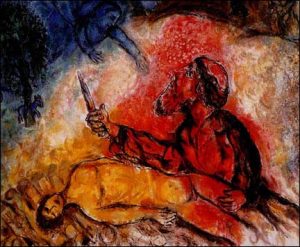 The great Anglican preacher Herbert O’Driscoll begins his reflections on our Old Testament lesson, the story of the testing of Abraham and the binding of Isaac, truthfully the near-murder of Isaac, with these words:
 This is “Trinity Sunday,” the only Sunday of the Christian year dedicated to a truly puzzling Christian doctrine, the peculiar Christian notion that God is one-in-three and three-in one. The late Jim Griffiss, the seminary professor with whom I studied systematic theology, once quipped that one could walk into any church on Trinity Sunday and hear heresy preached; that’s because there is no good or easy way to explain this doctrine. There’s also no way to really understand this doctrine as a matter of intellectual assent. But as a friend of mine said recently, “We [are called to] worship one God in Trinity, not understand one God in Trinity. Accept the Mystery, sing the Te Deum, and move on.” (Facebook discussion) I think he’s right. As a way of describing God, one must admit that the doctrine of the Trinity seems paradoxical, more than a little bit ambiguous, and frankly beyond explanation in a short (or even a long) sermon. So, we won’t be singing the Te Deum today, but I would like to use some poetry to explore how we can experience and worship the Triune God.
 As my parishioners know, I often find the images invoked by poets comforting and illuminating in times of grief.
 Almighty God, on this day you opened the way of eternal life to every race and nation by the promised gift of your Holy Spirit who empowered the disciples to proclaim the Good News to peoples from many lands speaking many tongues: we now pray for those in many lands speaking many languages who have been hurt or killed by terrorist violence in the past fortnight in: London (England), Kabul (Afghanistan), Mosel (Iraq), Minya (Egypt), Khost (Afghanistan), Mastung (Pakistan), Gao (Mali), Borno State (Nigeria), Raqqa (Syria), Mogadishu (Somalia), rural Colombia, Manila (Philippines), Baghdad (Iraq), Basra (Iraq), Portland (Oregon, USA) and Manchester (England). May God grant eternal rest to the departed, healing to the injured, and comfort to those in grief. And since Jesus taught us to love and pray for our enemies, we pray also for those who have committed these violent acts, and for those who may be contemplating additional violence. May God change their hearts and shed abroad the gift of peace throughout the world by the preaching of the Gospel, that it may reach to the ends of the earth; through Jesus Christ our Lord, who lives and reigns with you, in the unity of the Holy Spirit, one God, for ever and ever. Amen.
 As I read our lessons for today and again as I heard them this morning, two verses in particular have leapt out at me. One from the Gospel of John in which Jesus says: “And this is eternal life, that they may know you, the only true God, and Jesus Christ whom you have sent.” (Jn 17:3) The other is from the story in the Book of Acts in which, after Jesus has been lifted up and a cloud has taken him out of the apostles’ sight, two suddenly-appearing “men in white robes” (angels, one presumes) ask the apostles, “Men of Galilee, why do you stand looking up toward heaven?” (Acts 1:11)
 If you have seen Avatar, you know that the human character Jake Sully is a disabled Marine; he is confined to a wheelchair in his “real” human life. But his avatar, a synthetic body into which his conscience is temporarily transferred, is a fully functional Na’Vi male body. At the end of the movie, after Jake has rebelled against his superiors and championed the Na’Vi’s cause against Pandora’s exploitation by Earth, Jake’s crippled body is trapped in a damaged mobile laboratory. Neytiri finds him, breaks into the lab, and rescues him: “In the end, the real Jake is not his avatar. The real Jake is a man, unshaven and unkempt, without functional legs. And Neytiri sees this. As she holds the dying Jake, she tells him ‘I see you.’ This is what love is. Love is not trying to change the other person, to make them perfect, or to focus on their weaknesses. Love is seeing a person for who they are and embracing that person.” (

