From the Prophet Ezekiel:
[God said to Ezekiel] “You shall eat it as a barley-cake, baking it in their sight on human dung.”
(From the Daily Office Lectionary – Ezekiel 4:12 (NRSV) – May 13, 2013.)
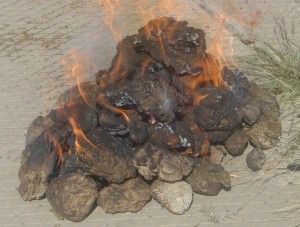 Today’s Old Testament reading is a disturbing piece in which the Prophet Ezekiel is instructed to lie down for several days (in fact, for more than a year) as a sign of the number of years Israel and then Judah will be punished.
While lying down, he is to make grain cakes from specific measures of spelt, millet, wheat, barley, lentils, and beans, and he is to drink specific measures of water each day. This is to symbolize that during their punishments, the Israelites and the Judeans will lack bread and water; they will experience poverty and deprivation, and “look at one another in dismay, and waste away under their punishment.” (v. 17)
The selected verse is from God’s instructions to Ezekiel on how he is to prepare and bake his grain cakes, representative of the way in which the soon-to-be-exiled People of God will have to cook their food during their banishment.
The very thought of cooking with excrement must have been shocking to Ezekiel who objected and was given leave to use cow dung rather than human excreta. It would have been shocking in the extreme to people whose God had commanded them to cover their bodily wastes immediately after defecation because the very sight of it was offensive to God:
You shall have a designated area outside the camp to which you shall go. With your utensils you shall have a trowel; when you relieve yourself outside, you shall dig a hole with it and then cover up your excrement. Because the Lord your God travels along with your camp, to save you and to hand over your enemies to you, therefore your camp must be holy, so that he may not see anything indecent among you and turn away from you.
The “designated area outside the camp,” though initially commanded as the latrine, was where everything unclean was to be disposed: the offal of sacrificed animals, warriors’ garments soiled with the blood the enemy, the stones of houses in which plague has been found, and the idols and altars of other nations are all commanded in the Law to be taken there. Persons deemed unclean because of leprosy, menstruation, issue of semen, or slaughter of animals were sent outside the camp. The “designated area outside the camp” was a place of defilement, uncleanness, impurity, corruption, dirtiness, filthiness, pollution, contamination, condemnation, punishment, rejection, castigation, and reproach. It is where disease, dung, and death were. To cook one’s food over excrement wasn’t simply distasteful, it was to imbue one’s nourishment with everything foul and unholy from the “designated area.” The smoke from a cooking fire of whatever fuel flavors anything cooked upon it; the smoke from a fire of human feces would pollute everything cooked over it.
In modern kitchens where we cook on electric burners or over clean natural gas flames, we no longer appreciate how the cooking fuel affects the flavor of the food. Many years ago, the summer of 1969 to be exact, I went to study in Florence, Italy. Upon arrival, I discovered that my pensione (boarding house) would not have a room for me until the next day. So, I checked into a small bed-and-breakfast hotel where I was offered an evening meal of chicken cacciatore. Having no other plans, I accepted. Unfortunately, the hotel kitchen used a kerosene stove. Chicken cacciatore cooked over kerosene is inedible; so too (I discovered the next morning) is coffee.
On the other hand, several years later, I had occasion to rent a cottage near the River Shannon in Ireland. It was heated by a peat stove and on that stove I could also boil water for my breakfast tea. Although I prefer coffee, one does want to be traditional occasionally when living in a 200-year-old, turf-fire-heated Irish farm cottage. My tea tasted of peat, which was an odd flavor, but not an inedible one (like kerosene). By the end of my month there everything I owned – my luggage, my books, all my clothing – smelled of peat. A couple of weeks later, touring a whisky distillery on the Isle of Skye, I discovered that good Scotch whisky (the malt for which is toasted over open peat fires) reminds me of my Irish cottage and, especially, of my morning tea.
I cannot imagine what food cooked over human feces might taste like, and I certainly do not want to find out! Apparently I’m not alone: a couple of years ago, a Japanese scientist perfected a method of making a vegan meat substitute using proteins extracted from human waste. Of over 12,500 who responded to an internet survey, 76% said there was no way they would even try the substance and another 11% said they were unsure whether they would. We can be very sure that the Israelites and the Judeans would not have wanted to; even the thought (or the threat) of eating food cooked over excrement was a religious affront to them.
However it might have tasted, the prophetic meaning is clear: food cooked over human feces is a symbol of abject poverty and want. It is a symbol of something unclean and contaminated to be avoided, not only for ourselves but for everyone. Poverty and deprivation are an abomination; any system which creates them should be viewed as corrupt and filthy, as economic excrement, as financial feces. It does not matter what name we may give such systems — capitalist or communist, socialist or fascist — if the success of the financial institutions created by those systems depends upon human beings being made destitute, those institutions and the system which creates them should be relegated to the “designated area outside the camp.” Like the smoke from a cooking fire of human dung, they pollute everything they touch. They are, simply put, shit not fit for human society.
====================
A request to my readers: I’m trying to build the readership of this blog and I’d very much appreciate your help in doing so. If you find something here that is of value, please share it with others. If you are on Facebook, “like” the posts on your page so others can see them. If you are following me on Twitter, please “retweet” the notices of these meditations. If you have a blog of your own, please include mine in your links (a favor I will gladly reciprocate). Many thanks!
====================
Father Funston is the rector of St. Paul’s Episcopal Church, Medina, Ohio.
 As I read this verse from the Letter to the Hebrews, continuing education in the faith (an “adult Christian formation” program) has apparently been an issue in the church for quite a while. There is certainly a crisis of lifelong learning – or the lack of it – in the church today!
 I have an inch-long scar on the palm of my left hand; if I look closely, I can still see the pin-prick scars on either side of it which represent where the sutures that closed the wound were placed. The scar is just below my left pinky finger, which doesn’t work quite so well as my right pinky because underneath the scar the tendon was cut and had to be reconstructed. I’ve had this scar and this less-than-functional finger since I was not quite nine years old. It is a reminder of the need for boldness.
  It’s sort of the basic existential question, isn’t it? I mean it strikes me as equivalent to asking such questions as “What is the meaning of life? Who am I? What is my purpose? Is there a god, and, if so, what is God’s nature?” These are the questions that, in my life, occupy the “wee hours,” the dark times. I never seem to ask these questions when it’s bright and sunny, when it feels like “God’s in his heaven and all’s right with the world.” It’s when things aren’t right that these questions arise.
 Note: Today, my verse for contemplation isn’t from the Daily Office Lectionary. It’s from the sanctoral lectionary for the commemoration of Julian of Norwich. Today is the 23rd anniversary of my ordination to the Sacred Order of Deacons; we used the lessons for Julian’s feast. So, I took the personal prerogative of reading those lessons this morning.
 There are a lot of people today who claim to be religious but do not bridle their tongues. Just spend a few hours searching the internet. Limit yourself even to Facebook. Plenty of “religious” people saying lots of, shall we say, non-religious things. I won’t say their religion is worthless, but I do wonder how much they actually value their religion and what it teaches.
 Recently, I sat down with a fellow clergy person, a cleric about my own age who is also a parent. We were talking about our kids and how there are times when, as mothers and fathers, we simply have to let go and let our children live their own lives and make their own mistakes. He made the interesting comment that, until he was parent to a maturing teenager, he hadn’t really understood what helplessness is. “As parents, ” he said, “we are essentially helpless.” This, he suggested, gives us a clue to understanding God.
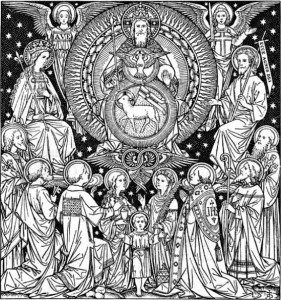 It’s Good Shepherd Sunday . . . the Fourth Sunday of the Easter Season is always Good Shepherd Sunday. Every year, regardless of which of the three years of the Lectionary cycle we are in, we hear some lessons which mention shepherds or lambs, and we recite the 23rd Psalm as the Gradual, and we sing every “Shepherd hymn” in the hymnal. I’ve been preaching Good Shepherd sermons for 25 years, so I pretty much thought this was going to be one of those Sundays when I could just “wing it” and preach extemporaneously.
  The first verse of this bit from John’s Third Letter brings to mind an old hymn, the first verse of which is
 Reading this on a morning when parts of Watertown and Cambridge, Massachusetts, are “locked down,” when the entire city of Boston and its environs are under a “shelter in place” order as police engage in a massive manhunt for one of the two suspected perpetrators of the Boston Marathon bombing (the other having been killed already) is a bit strange.

