 “They’re eating the dogs, they’re eating the cats.”
That was the headline on the website of Raidió Teilifís Éireann, the national public broadcaster in the Republic of Ireland, on September 11. What the candidate in the U.S. presidential debate the night before had said in full was:
In Springfield, they’re eating the dogs, the people that came in, they’re eating the cats. They’re eating, they’re eating the pets of the people that live there.[1]
As I’m sure you know, in the twelve days since the debate, the people of Springfield, Ohio, have been through hell. They’ve been put under a media microscope; white supremacists have marched through the town; there are have been more than 30 bomb threats against schools and public buildings.
 Again this week as last, our first reading today is from the First Book of Kings and like last week’s, it is a prayer spoken by King Solomon. Last week, it was a private prayer spoken in a dream late at night. Today, it is a public prayer. As long as it was, this reading is just a small part of the dedicatory prayer that Solomon offered when the Temple was finished and consecrated. In it, Solomon asks an important question, “[W]ill God indeed dwell on the earth?”
 Are you a music fan? A classical music fan? I am. I love the great symphonies – Beethoven’s Fifth, his Ninth, Tchaikovsky’s Fifth, Dvorak’s From the New World, and many others – they just bowl me over. I can sit down in a concert venue and no matter what emotional state I may be in, a good symphony or concerto can overcome it – cynicism, depression, grumpiness, whatever my condition may be it will be conquered by the music and I will be uplifted. It doesn’t even have to be live in a concert hall. Sometimes when I’m feeling a bit out of sorts, I’ll put on a CD or an MP3 and just let the music fill me. At its best, music literally lifts me up and sets me dancing. In fact, in the proper setting, even badly played band music can have that effect.
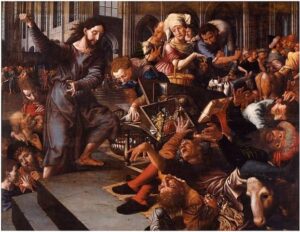 When I was about 8 or 9 years of age, my grandparents gave me an illustrated bible with several glossy, color illustrations of various stories. They weren’t great art, but they were clear and very expressive. My favorite amongst them was the illustration of today’s gospel lesson.
 Here we are at the end of the first period of what the church calls “ordinary time” during this liturgical year, the season of Sundays after the Feast of the Epiphany during which we have heard many gospel stories which reveal or manifest (the meaning of epiphany) something about Jesus. On this Sunday, the Sunday before Lent starts on Ash Wednesday, we always hear some version of the story of Jesus’ Transfiguration, a story so important that it is told in the three Synoptic Gospels, alluded to in John’s Gospel, and mentioned in the Second Letter of Peter.
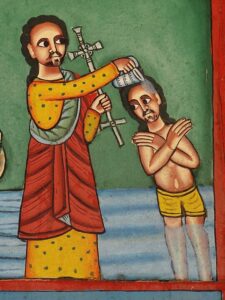
 In the Episcopal Church, when we baptize a person, we pray that God will “give them an inquiring and discerning heart, the courage to will, and to persevere, a spirit to know, and love, [God], and the gift of joy, and wonder in all [God’s] works.”
 There’s a story about a pastor giving a children’s sermon. He decides to use a story about forest animals as his starting point, so he gathers the kids around him and begins by asking them a question. He says, “I’m going to describe someone to you and I want you to tell me who it is. This person prepares for winter by gathering nuts and hiding them in a safe place, like inside a hollow tree. Who might that be?” The kids all have a puzzled look on their faces and no one answers. So, the preacher continues, “Well, this person is kind of short. He has whiskers and a bushy tail, and he scampers along branches jumping from tree to tree.” More puzzled looks until, finally, Johnnie raises his hand. The preacher breathes a sigh of relief, and calls on Johnnie, who says, “I know the answer is supposed to be Jesus, but that sure sounds an awful lot like a squirrel to me.”
 “As Jesus was walking along, he saw a man called Matthew sitting at the tax booth; and he said to him, ‘Follow me.’ And he got up and followed him.”
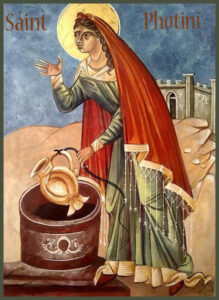 We “boast in our sufferings,” writes Paul to the Romans, “knowing that suffering produces endurance, and endurance produces character, and character produces hope, and hope does not disappoint us….”
 There is an old tradition in the church: on Trinity Sunday, rectors do their best to get someone else to preach. If they have a curate or associate priest, he or she gets the pulpit on that day. If not, they try to invite some old retired priest to fill in (as Rachel has done today). No one really wants to preach on Trinity Sunday, the only day of the Christian year given to the celebration or commemoration of a theological doctrine, mostly because theology is dull, dry, and boring to most people and partly because this particular theological doctrine is one most of us get wrong no matter how much we try to do otherwise.

