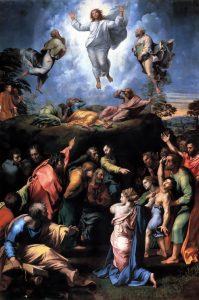
 Today, as I write this, is Trinity Sunday 2020, but my imagination this morning is not caught up by the Lectionary gospel lesson of the day, the last mountain-top experience of the Eleven when, just before his Ascension, Jesus gives them the Great Commission.[1] Rather, my mind is taken to another mountain-top story, the one New Testament story Episcopalians can count on hearing twice each year at celebrations of the Holy Eucharist, that of the Transfiguration of Jesus. It is heard on the Feast of the Transfiguration, August 6, when Luke’s version is read at the mass:
Jesus took with him Peter and John and James, and went up on the mountain to pray. And while he was praying, the appearance of his face changed, and his clothes became dazzling white. Suddenly they saw two men, Moses and Elijah, talking to him. They appeared in glory and were speaking of his departure, which he was about to accomplish at Jerusalem. Now Peter and his companions were weighed down with sleep; but since they had stayed awake, they saw his glory and the two men who stood with him. Just as they were leaving him, Peter said to Jesus, “Master, it is good for us to be here; let us make three dwellings, one for you, one for Moses, and one for Elijah” — not knowing what he said. While he was saying this, a cloud came and overshadowed them; and they were terrified as they entered the cloud. Then from the cloud came a voice that said, “This is my Son, my Chosen; listen to him!” When the voice had spoken, Jesus was found alone. And they kept silent and in those days told no one any of the things they had seen.[2]
It is also always heard on the Last Sunday after Epiphany when, depending on the Lectionary year, it may be Luke’s story or the essentially similar versions from Matthew[3] or Mark.[4]
 A Buddhist tells this story:
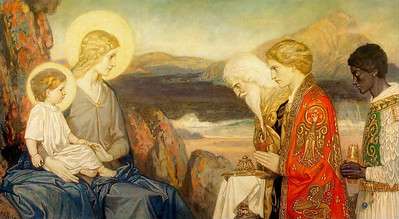 “In the Name of God the Broken-Hearted. Amen.”
 Back in May of 2016, after hearing about the #WearOrange movement, which supports reasonable gun sales and gun ownership regulation, I got the idea to wear an orange stole at worship as a witness against gun violence. The idea caught on and spread. Recently, my friend Rosalind Hughes, who made my orange stole and a hundred others, asked me to sum up what I thought might achieved by the importing the #WearOrange movement into the liturgy of the church. This is what I wrote for her:
 There is an old tradition in the church: on Trinity Sunday, rectors do their best to get someone else to preach. If they have a curate or associate priest, he or she gets the pulpit on that day. If not, they try to invite some old retired priest to fill in (as Father George has done today). No one really wants to preach on Trinity Sunday, the only day of the Christian year given to the celebration or commemoration of a theological doctrine, mostly because theology is dull, dry, and boring to most people and partly because this particular theology is one most of us get wrong no matter how much we try to do otherwise. Back when I was a curate getting the Trinity Sunday assignment, my rector encouraged me with the sunny observation that, listening to a sermon in almost any church on Trinity Sunday, one could be practically guaranteed to hear heresy.
 I have a friend whose face I have seen only in photographs. We have never been in the same room; we have never shaken hands; we have never spoken. Nonetheless, I have considered this person a friend for many years. We met (if that’s the right word) through a listserve of Episcopalians and Anglicans many years ago and continued our friendship when most of that group migrated to Facebook. A couple of months ago, I noticed that my friend had stopped posting to Facebook. I tried to contact them
 Lenten Journal, Day 21
 Lenten Journal, Day 11 – Second Sunday in Lent
 Lenten Journal, Day 3
 John said to the crowds that came out to be baptized by him, “You brood of vipers! Who warned you to flee from the wrath to come?” (Luke 3:7)

