 Today the Lectionary gives us what, at first glance, are two stories about leadership, but what they really are are stories of people trying to protect God (or God’s appointed leader) in inappropriate ways
First, we have the story from the Book of Numbers which tells of the complaints of hunger voiced by the Hebrew wanderers to Moses. I have to admit that, growing up in Nevada as I did, I always thought that “fleshpots” was a much more lascivious word than it turns out to be; all it means is “stewpots.” The people yearned for the foods with which they had become familiar in Egypt.
Living along the Nile, they had been able to fish and get that source of protein for free. When they worked on whatever project they were assigned as “slaves of Pharaoh,” apparently they were fed from the fleshpots. Bible commentator Adam Clark writes, “They were doubtless fed in various companies by their task masters in particular places, where large pots or boilers were fixed for the purpose of cooking their victuals.”[1] They had grown used, perhaps, to receiving a ration of a stew probably made of lentils, some sort of grain, and mutton flavored with leeks, garlic, and onions. Even though they were getting manna from God, they longed for the familiar flavors of Egypt, the familiar certainties of slavery. As a colleague of mine has commented, “You can take the people out Egypt, but you can’t take Egypt out of the people.”
 The collect for today from The Book of Common Prayer:
 Children, as those of us who have had or who have been children know, grow in their ability to communicate. Vocabularies grow. Grammars develop. They move from simple one- or two-syllable concepts – such as “Mama” or “Dada” or “NO!” – to more complex ideas.
 In 2014, Evie and I were privileged to join a group of other pilgrims from Ohio and Michigan and spend not quite three weeks in Palestine and Israel visiting many of the sites we hear about in the Bible, especially the Christian holy places of the Gospel stories. One of those was a hilly place overlooking the Sea of Galilee called Tabgha. Until 1948, when the Israelis uprooted its residents, a village had been there for centuries; now it is simply an agricultural area and a place of religious pilgrimage.
 It had gone on so long she couldn’t remember a time that wasn’t like this. She lived in constant fear. She wasn’t just cranky and out-of-sorts; she was terrified. Her life wasn’t just messy and disordered; it was perilous, precarious, seriously even savagely so. It was physically and spiritually draining, like being whipped every day.
 Our Old Testament lesson this morning is a very small bit of the Book of Job, that really sort odd bit of Biblical literature that tells the story of a wager between God and Satan. Some scholars believe that it may find its origins in an earlier Babylonian work known as the Poem of the Righteous Sufferer, that the Jews in Exile became familiar with the older Babylonian story and adapted it to their own theology.
 In 2011 a young man in New York City named Gabriel went to a party. While there, he drank some of the alcoholic punch being served. Unknown to the young man, the punch had been spiked with a drug called Gamma-Hydroxybutyric Acid, commonly called GHB. Prescribed as Xyrem and also called by a variety of “street names,” it is known as a “date rape” or rave drug. It comes as a liquid or as a white powder that is dissolved in water, juice, or alcohol. In most people it produces euphoria, drowsiness, decreased anxiety, excited behavior, and occasionally hallucinations. For Gabriel, however, who suffered from medication-controlled epilepsy, it caused a seizure. Apparently interacting with his regularly prescribed medication, the GHB he had unknowingly consumed caused a fatal convulsion.
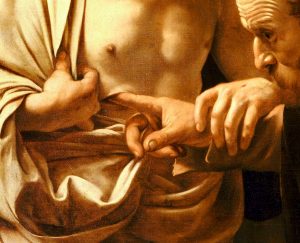 Every year, for as long as any of us can remember, on the Second Sunday of Easter the church has told the story of Thomas, Thomas the Doubter, “Doubting Thomas” who wouldn’t believe that Jesus had risen, the poster child for those who are uncertain. But, believe me, Thomas gets a bad rap! He was no worse a doubter or disbeliever than any of the others, including Peter!
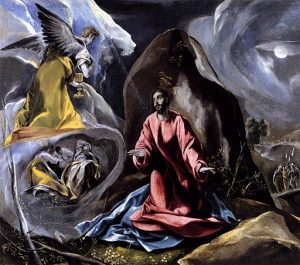 Across the Kidron valley from Jerusalem, at the foot of the Mount of Olives, is a small grove of olive trees. In the midst of it is a church called “The Church of All Nations” and in the center of that church, surrounded by a low wrought iron fence sculpted to resemble brambles and thorns, is a large, rough, flat rock. It is called “the stone of agony” and tradition tells us it is the place where Jesus prayed on the night before he died.

