Occasional thoughts of an Anglican Episcopal priest

Category: Poetry (Page 7 of 12)

Baseball and a Father’s Death: A Funeral Homily, 18 November 2015

====================

A sermon offered at the requiem for James E. Freiberger, held November 18, 2015, at St. Paul’s Episcopal Church, Medina, Ohio, where Fr. Funston is rector.

(The lessons for the requiem were Lamentations 3:22-26,31-33; Psalm 27:1-7; Romans 8:14-19,34-35,37-39; and John 11:21-27. These lessons may be found at the Burials Lectionary Page The Lectionary Page. Mr. Freiberger’s obituary may be found here.)

====================

Baseball and GloveThe death of anyone important in our lives is a tragic and painful thing, even if the relationship was strained or even broken. This is especially so when a parent dies and, for some reason, more so when that parent is our father, perhaps because we use that metaphor of fatherhood to explain God’s relationship to us. Whenever someone’s father passes away, I cannot help but remember the poem by the Welsh poet Dylan Thomas, Do Not Go Gentle Into That Good Night:

Do not go gentle into that good night,
Old age should burn and rave at close of day;
Rage, rage against the dying of the light.
Though wise men at their end know dark is right,
Because their words had forked no lightning they
Do not go gentle into that good night.
Good men, the last wave by, crying how bright
Their frail deeds might have danced in a green bay,
Rage, rage against the dying of the light.
Wild men who caught and sang the sun in flight,
And learn, too late, they grieve it on its way,
Do not go gentle into that good night.
Grave men, near death, who see with blinding sight
Blind eyes could blaze like meteors and be gay,
Rage, rage against the dying of the light.
And you, my father, there on the sad height,
Curse, bless, me now with your fierce tears, I pray.
Do not go gentle into that good night.
Rage, rage against the dying of the light.

The death of a parent, especially a father (I think) no matter what our relationship with him may have been, fills us with rage, with conflicted emotion, with a frustration difficult to name. Let us commend all of that to God, as we commend the soul of James E. Freiberger to God’s eternal care.

I didn’t know Jim Freiberger; I do not know if he was (to use poet Thomas’s labels) a wise man, a good man, a wild man, or a grave man, so I cannot eulogize him. But I do know that he was a father and I know that he was in the Navy, that he had a career in data processing, and that he had three children, one of whom I know. I am told that he was a gifted athlete and almost had a chance to play professional baseball, a game about which he was passionate . . . a love I know he passed on to his daughter.

So I got to thinking about baseball and did some research and found an article about the lessons baseball can teach us, lessons that can be applied in business and management. I think what the author has to say suggests that baseball can also teach us something about our spiritual life, as well. It’s a cliché, I think, that baseball is a metaphor for life, but (in many ways) it actually is.

The author of that business article contrasts the timing of baseball with the timing of sports such as football or basketball, noting that in those sports there is a clock which limits the time of the game and ticks down inexorably and finally, and although there might be overtime in the event of a tie at the end of regulation play, even that is bounded by the clock. In contrast, he writes:

Baseball is a game that is pastoral in nature, a reminder of a time that our life was slower and most of us lived on farms and small towns. You have 27 outs and the game is not over until all outs are exhausted. There is no clock to pressure you. You simply go on your business until it is done. Time marches slowly in baseball and baseball allows us to simply relax for three hours while drinking a few adult beverages.

I think this is part of the message of the lesson from Lamentations: “[God’s] mercies never come to an end; they are new every morning.” God’s time marches slowly and it is always merciful and every morning is new. We can relax into God’s time; we can find comfort in God’s time; we can find all things renewed in God’s time; we can abandon our frustrations, our rages, and our fears in God’s time. “The Lord is the strength of my life,” says the Psalmist today, “of whom then shall I be afraid?”

In the article, then, the author talks about the way baseball deals with failure:

Baseball teaches about failure as the length of the season reflects the pace of our life. You have 162 games and there are days in which the batter can’t see the ball or the pitches look more like beach balloons as the opposing hitters feast on the big fat pitches coming their way. The beauty of baseball is that you can suck one day but the next you can redeem yourself. You don’t have to wait a week before getting a chance to get it right.

And you don’t have to dwell on getting it wrong. It occurred to me this morning that there’s a real contrast between football and baseball with regard to getting it wrong. In football, every mistake a player or a team can make has a name and is remembered by that name: the quarterback sack, the fumble, the incomplete pass, the missed block, and so forth. Fans and players relive, again and again, all the mistakes of past games. In baseball, on the other hand, there’s just one word for every sort of mistake: error. The scorekeeper and the statisticians keep track of “errors,” but the rest of us move on. There’s no point in dwelling on mistakes, because (after all) they are forgiven. They will be of no consequence in the end. As Paul said, “I am convinced that neither death, nor life, nor angels, nor rulers, nor things present, nor things to come, nor powers, nor height, nor depth, nor anything else in all creation, [and I would add that includes ourselves and any mistakes or errors or bad decisions we have made] will be able to separate us from the love of God in Christ Jesus our Lord.”

The author of our article on baseball and business then takes a look at the game’s attitude towards success, something that none us (especially in our families and interpersonal relationships) really have much of. He writes:

In baseball, if you hit .300, you are very good. In most sports, hitting .300 represent failures. Quarterbacks lose their jobs if their accuracy is 55% but in baseball, a manager who win 55% of the games is brilliant. In college football winning only 55% of your games will get you fired. Ask any good salesman and they will tell you if they get 30% of their prospects to buy their products, this will produce a successful year. There are days that you wonder why you got up and then there are days in which wow, you can’t do no wrong just like the baseball player who hits for the cycle.

In the Christian faith we believe in a cycle . . . a cycle of birth, life, death, and rebirth that we call “Resurrection,” not a rebirth into this world as taught by some other religions, but a rebirth into the Presence of God. This is the assurance Jesus gave to Martha, to Mary, to their brother Lazarus; it is the assurance that his own birth, life, death, resurrection, and ascension gives to us. “I go,” he told his disciples, “to prepare a place for you . . . and I will gather you to myself, that where I am you may also be.” Martha said to Jesus about her brother, “I know that he will rise again in the resurrection on the last day.” And we can say that now about Jim Freiberger and about all of us, no matter what our “batting average” or our “percentage of accuracy” may have been.

So, baseball (about which Jim was passionate) has something to teach us about our spirituality; it may be a cliché, but it is true that baseball can be a metaphor for life. If you “Google” that phrase – “baseball is a metaphor for life” – you will find, among many other less colorful explanations, this somewhat off-color monologue by the character Kenny Shea in the television program Rescue Me:

Anyway, baseball and life, one in the same. Everybody always says that life is too short. Bullshit. Life, unless you get cancer or hit by a bus or set on fire, takes forever. Just like baseball. It’s a series of long, mind-boggling boring stretches of time where absolutely nothing happens. So, you take a nap, and then, after a little while, when that crisp crack of the bat hittin’ the ball, so crisp you could almost smell that wood burning, jolts you awake and you open your eyes to see something so exciting and intricate, and possibly, very, very meaningful has just happened, but you missed it ’cause you were just so goddamn bored in the first place. Oh, you know, a couple of hot dogs, throw in some beers, . . . and that’s that.

So baseball is a metaphor for life with its long boring stretches and its moments of excitement and its disappointments. The author L.R. Knost didn’t mention baseball but she made the same point when she wrote:

Life is amazing. And then it’s awful. And then it’s amazing again. And in between the amazing and the awful, it’s ordinary and mundane and routine. Breathe in the amazing, hold on through the awful, and relax and exhale during the ordinary. That’s just living heartbreaking, soul-healing, amazing, awful ordinary life. And it’s breathtakingly beautiful.

Today, we commend to almighty God the soul of James E. Freiberger – Navy man, father, grandfather, data processing worker, lover of baseball – whose life was amazing and awful and ordinary and routine and, like everyone’s in its own way, breathtakingly beautiful. Remember that, remember the beautiful part, and remember that, whatever else may be true about Jim Freiberger, remember that “nothing in all of creation will be able to separate [him] from the love of God in Christ Jesus our Lord.” Amen.

====================

A request to my readers: I’m trying to build the readership of this blog and I’d very much appreciate your help in doing so. If you find something here that is of value, please share it with others. If you are on Facebook, “like” the posts on your page so others can see them. If you are following me on Twitter, please “retweet” the notices of these meditations. If you have a blog of your own, please include mine in your links (a favor I will gladly reciprocate). Many thanks!

====================

Father Funston is the rector of St. Paul’s Episcopal Church, Medina, Ohio.

Neither Island nor Mist – From the Daily Office Lectionary

Neither Island nor Mist

From the Daily Office Lectionary for Friday in the week of Proper 17, Year 1 (Pentecost 14, 2015)

James 4:14 ~ Yet you do not even know what tomorrow will bring. What is your life? For you are a mist that appears for a little while and then vanishes.

I’m going to have to disagree with James. People are not mere “mists” (atmis is the Greek, also translated as “vapor”) which appear briefly then disappear. Our lives are more substantial than that and when we die we leave much more behind than does the fog.

In the past six days I have received notices of the deaths of four old friends: two clergy colleagues, one former law partner, and a former long-time parishioner. Although none of us had been in close contact for years (although the clergy had recently been my Facebook friends), they impacted my life and many others much more than a mist. My former partner and I did not separate on good terms and if you’d asked us if we were friends, despite our 15 year association in the law, I am certain the answer from either would have been “No.” Nonetheless, his death diminishes me as much as do the others. Their lives have touched mine much more substantially than would have a vapor.

Another Anglican priest expressed this much more eloquently than I can:

No man is an island,
Entire of itself,
Every man is a piece of the continent,
A part of the main.
If a clod be washed away by the sea,
Europe is the less.
As well as if a promontory were.
As well as if a manor of thy friend’s
Or of thine own were:
Any man’s death diminishes me,
Because I am involved in mankind,
And therefore never send to know for whom the bell tolls;
It tolls for thee.
(John Donne, Meditation 17, Devotions upon Emergent Occasions)

Neither island nor mist, but rather human beings of whom God is mindful and whom God seeks out, whom God has made “but little lower than the angels . . . with glory and honor,” and to whom God has given “mastery over the works of [God’s] hands.” (Ps 8:5-7)

You are neither island nor mist, and when you “vanish” the loss will be palpable. Be aware, therefore, of the lives you touch.

Silence, Morpheus! (Love in Old Age) – A Poem

rumpled-bed

Silence, Morpheus! (Love in Old Age) – A Poem

It is not passionate, this companionship of ours.
Not often physical, but it is comfortable.
Shared solitude stretching for endless hours,
Lovingly, we languish in stillness amiable.

Eros once eagerly found our bed; Agape tended board.
Phileo, surely, has been with us, and Storge often hovered near.
Now old friends of passing ‘quaintance ‘casionally restored,
They, like us, relaxed in wonder, softly murmur, “Oh, my dear!”

There was another long ago, long before I knew your name;
Another whose heart I treasured, another body that I prayed
Would lay beside me in the dark and to my body would stake claim.
That other now is gone, departed; but you have never strayed.

Silence, Morpheus! Be gone, thou tempter with thy silken touch.
I want not thy former dreams! I have my love with whom I share so much.

By C. Eric Funston – 1 September 2015

Turn, Turn, Turn: Sermon for Pentecost 14 (Proper 17B) — 30 August 2015

====================

A sermon offered on Fourteenth Sunday after Pentecost (Proper 17B, Track 1, RCL), August 30, 2015, to the people of St. Paul’s Episcopal Church, Medina, Ohio, where Fr. Funston is rector.

(The lessons for the day are Ecclesiastes 3:1-15; Psalm 15; James 1:17-27; and Mark 7:1-8, 14-15, 21-23. The Ecclesiastes lesson may be found in the Oremus Bible Browser; the others may be found at The Lectionary Page.)

====================

Clock face and calendar composite“This is neither the time nor the place . . . .”

Have you ever heard anyone say that? My mother and her mother were very fond of that saying. If you were doing something they didn’t approve of, that was the sure fire way to stop it. If you were asking something they didn’t want to answer, that was the answer you got. If you wanted to discuss something they didn’t want to talk about, that put an end to the conversation.

“This is neither the time nor the place . . . .” (I learned very early on that, in my mother’s and grandmother’s estimation, there were somethings that never had a time or a place!)

Three weeks ago, you may recall, we heard part of the story of the rebellion of King David’s son Absalom who had set himself up as a rival king leading to a civil war in ancient Israel. At the beginning of the Proper 14 reading from the Second Book of Samuel, David is sending out his army and giving instructions to his generals: “The king, David, ordered Joab and Abishai and Ittai, saying, ‘Deal gently for my sake with the young man Absalom.’” (2 Sam 18:5) But Joab fails to follow the king’s orders and Joab’s armor bearers kill Absalom. As the army is returning to Jerusalem, a Cushite messenger runs ahead and informs the king of his son’s death and, at the end of that reading, we are told:

The king was deeply moved, and went up to the chamber over the gate, and wept; and as he went, he said, “O my son Absalom, my son, my son Absalom! Would I had died instead of you, O Absalom, my son, my son!” (2 Sam 18:33)

What we did not read on that Sunday but were given to read this year in our Daily Office lessons is Joab’s rebuke of the king for his mourning. You see, when his soldiers returned they found their king weeping and so, says the writer of Second Samuel, “the victory that day was turned into mourning for all the troops.” (2 Sam 19:2) Joab tells the king “you have covered with shame the faces of all your officers who have saved your life . . . . You have made it clear today that commanders and officers are nothing to you.” (vv. 5-6) He tells David to “go out at once and speak kindly to your servants; for I swear by the Lord, if you do not go, not a man will stay with you this night; and this will be worse for you than any disaster that has come upon you from your youth until now.” (v. 7)

In other words, what Joab says to David is, “This is neither the time nor the place . . . .”

So David did what Joab advised him and nowhere again do we read about him mourning the death of his son. But I have a feeling that David was left to wonder, “If that wasn’t the time, when is it? If that wasn’t the place, where is it? When is the time to mourn the death of one’s child?”

There must be one because elsewhere in Scripture, in the Book of Ecclesiastes, we are told:

For everything there is a season, and a time for every matter under heaven: . . . a time to weep, and a time to laugh; a time to mourn, and a time to dance . . . . (Eccl. 3:1,4)

When is the time to weep and mourn the death of one’s child? When is the time to shake one’s fist at reality and exclaim, “It isn’t supposed to be this way! Parents are not supposed to outlive their children!?”

I don’t know the answer to a lot of questions I get asked as a priest, but I do know the answer to that one as I have lived with it most of my life. Both my father and his only brother died before their parents, my grandparents. My only brother died before our mother. I know that the answer to that question is, “All the time and any time.” Oh, one doesn’t cry and carry on every minute of every day, and though pain of loss is never gone it’s not always present, either. One gets on with life, like King David did because as Qoheleth the Preacher (as the author of Ecclesiastes is called) says, there is also a time to laugh and a time to dance and times for all those other things that make up our lives.

Today, we will formally accept and dedicate gifts from two of our parish families who, like my mother and my grandparents, have lived through the loss of their children in whose memory these gifts are given. Susan and Paul _________ have given us a new set of green vestments and hangings in memory of Susan’s son Paul who died of cancer; Nancy and Michael ____________ have given us our new piano in memory of their son Colin who was lost to an immune-deficiency disorder. We are grateful to them for their generosity and hope that, in some way, their ability to make these gifts in memory of their sons eases their weeping and pours some small amount of the oil of joy onto their mourning.

The reading from Ecclesiastes which we heard to as our Old Testament lesson this morning is not the reading prescribed by the Lectionary. I chose to deviate from the Lectionary and use this text for a couple of reasons. One of which will become clear in a bit, but mostly I chose it because several years ago, Evelyn and I had the great misfortune to attend the funeral of a 6th Grade boy who had accidentally killed himself with his father’s handgun. He was a school friend and fellow Boy Scout of our son. The preacher at the funeral used this text, or really I should say “misused this text,” to deliver the message that the boy’s death was “God’s will and we just have to accept it.” I cannot tell you how angry that sermon made me. Death of a child by whatever means, accident or disease or whatever, is never, ever God’s will! “I have no pleasure in the death of anyone, says the Lord God,” in the Book of the Prophet Ezekiel (Ezek 18:32). This first part of 8th Chapter of Ecclesiastes is one of my favorite parts of the Hebrew Scriptures, so I hated to see it misused that way; I want to set the record straight!

The great folksinger Pete Seeger set the words of Ecclesiastes 3:1-8 to music in the late 1950s and in 1965 the British rock group The Byrds covered it and had a No. 1 hit. I’m told Turn, Turn, Turn is the No. 1 pop song with the oldest lyrics. I’ll bet most us who sang along with them during the rebellious 1960s had no idea we were singing words from the Bible. Anyway, it’s a great song with a great message . . . and that message is not that everything happens according to some mysterious and arbitrary plan of God that we just have to accept and it is not that “everything happens for a reason.”

Among those who believe that there is a God and that God created all that is, there is a spectrum of understanding about the involvement of God in the running of the universe. At one end of the spectrum is so-called “Deist” position; this is the belief that was held by many highly educated people in the 18th Century, among them most of the Founding Fathers of our nation. Deists held that God was less in the nature of a father-figure intimately involved with his children, and more like a clockmaker who had set the world running, wound up its spring and then let it function; this clockmaker God really takes little or no notice of what is happening in the lives of human beings. At the other extreme is the notion that “God has a plan for your life … for everyone’s lives” … and that everything that happens in anyone’s life is in accordance with that plan, everything is predetermined, and everything happens for a reason, which is God’s reason and we should just accept that.

The truth is, most likely, somewhere in between and that’s clearly where Qoheleth is. “Things and actions have their time,” he says, “then they pass and other things and actions have their time;” there is a natural cycle to things. (P. Tillich, The New Being, Scribner’s Sons, 1955) Qoheleth starts his enumeration of these things, these natural cycles, with birth and death. The natural cycles of time are beyond human control. We cannot control them and whatever control we may have of time is limited by them. They are the signposts which we cannot trespass.

Ecclesiastes is best known, perhaps, for its refrain, “Vanity of vanities; all is vanity!” (Eccl 1:2) In this regard, Qoheleth is testifying that “any human attempt to change the rhythm of birth and death, of war and peace, of love and hate and all the other contrasts [which he lists] in the rhythm of life is” a vanity. (Tillich) Instead, Qoheleth encourages us to be aware of these cycles, to understand that within them there is a “right time” to do one thing and not to do another. He does not suggest, in any way, that God is the micro-manager of every human life. Rather, he counsels us to follow these cycles as we exercise responsibility for our lives, do our own planning, and exercise our limited control according to them.

Qoheleth’s assurance that there is a time for everything is part of what another preacher has called “the background operating system of [our] faith,” the core truth that there is a God who is good and that existence. But this “operating system, this core truth “doesn’t come with the assumption that all things, (including all the horrors we might encounter here), have a purpose,” that “everything happens for a reason” known only to God.

That other preacher, the Rev. John Pavlovitz (who writes for Relevant Magazine), suggests such a distortion paints a picture of a god who makes us suffer for sport, who throws out obstacles and injuries and adversities “just to see what we’ll do, just to toughen us up or break us down.” To me, statements that “everything happens for a reason” or that something “is just the will of God” describe an arbitrary god who decides that this child will die of cancer while that one will become a star football player, or that this person will die of an accidental gun shot in the 6th Grade while that one will live to be 91. That is not the God in whom I believe and it is not the God testified to in these verses from Ecclesiastes. Qoheleth’s God and ours does not arbitrarily micro-manage our lives. Rather, God wants to be “be happy and enjoy [our]selves as long as [we] live,” for “it is God’s gift that all should eat and drink and take pleasure in all” that we do (vv 12-13).

To believe otherwise leads to the religion of what James, in today’s epistle, calls “hearers” who “on going away, immediately forget,” rather than to the religion of “doers” who practice a holy generosity. To believe otherwise leads to the sort of religion that Jesus condemns in today’s Gospel, a religion of arbitrary rules, of “washing of cups, pots, and bronze kettles” as Mark puts it, a religion of vain worship “teaching human precepts as doctrines” as Jesus puts it quoting Isaiah. To believe otherwise leads to “wickedness, deceit . . . envy, slander, pride, folly” and all those other “evil things [that] come from within and . . . defile a person.”

Qoheleth’s list of contrasting times, as one commentator has put it, “provides structure rather than a calendar,” a structure within which “individual human moral decision making is possible.” Ecclesiastes challenges us “to be wise, to be ethical, to discern when [our] actions are in keeping with God’s time and then to act decisively.” (NIB, Vol. V, page 308) Then, in the words of the Psalmist, we “may dwell in [God’s] tabernacle,” we “may abide upon [God’s] holy hill.” (Ps 15:1)

“This is neither the time nor the place . . . .” My mother and my grandmother were probably right about that most of the time. But Ecclesiastes is also right, “For everything there is a season, and a time for every matter under heaven . . . .”

I don’t know why some children die before their parents, and some live to ripe, old age; I don’t know why some people get cancer, and some don’t; I don’t know why some people get shot, or have to deal with disability, or suffer with mental illness. I don’t know why there have to be hurricanes, and earthquakes, and parasitic worms that eat children’s eyeballs. But I do know that these things do not happen for some arbitrary God-determined reason, that these things are not the will of God.

What is the will of God is that there is a time to deal with such things and there is a time to live life in spite them. Remember what Qoheleth wrote: “[God] has made everything suitable for its time; moreover [God] has put a sense of past and future into [our] minds . . . . [Therefore,] there is nothing better for [us] than to be happy and enjoy [our]selves as long as [we] live.” The Indian poet and sage Kalidasa, about 400 years before the time of Christ, expressed the same thought:

Listen to the exhortation of the dawn!
Look to this day!
For it is life, the very life of life.
In its brief course lie all the
verities and realities of your existence.
The bliss of growth,
the glory of action,
the splendor of beauty;
for yesterday is but a dream,
and tomorrow is only a vision;
but today well lived makes
every yesterday a dream of happiness,
and every tomorrow a vision of hope.
look well therefore to this day!
Such is the salutation of the dawn!

Now is the time and now is the place when we give thanks with and to Nancy and Michael, and Susan and Paul, as they remember their sons, not their deaths but their lives, not with mourning but with joy, not with weeping but with generous acts of giving. May we all look well to this and every day and never be overthrown. Amen.

====================

A request to my readers: I’m trying to build the readership of this blog and I’d very much appreciate your help in doing so. If you find something here that is of value, please share it with others. If you are on Facebook, “like” the posts on your page so others can see them. If you are following me on Twitter, please “retweet” the notices of these meditations. If you have a blog of your own, please include mine in your links (a favor I will gladly reciprocate). Many thanks!

====================

Father Funston is the rector of St. Paul’s Episcopal Church, Medina, Ohio.

The Priest at Home in the Dark – A Poem, 27 August 2015

Gin_and_Tonic

The Priest at Home in the Dark

In the darkness, the tears fall silent to the table,
keeping company the pool of melted ice and gin.
Today I lunched and laughed with tutors wanting money;
I had to tell them no, though I really want them to win.
They do good things with disadvantaged children,
an unfunded effort in the local middle school.
I listened to their story, their very praise-worthy story,
but had to tell them no. We parted; I felt like a fool.
And then the phone call from another parish, asking for advice.
“We have a small endowment. What should we do with it?”
Give it to the tutors, I wanted to say, give it to the tutors!
“How shall we invest it?” No! Give it to the tutors; they can use it!
I didn’t say what I wanted to say; I talked about the brokers,
the learned advisers who counsel sound and solid savings.
I should have told them to give it away; use it for the poor,
but if I had said that they’d have thought me mad and raving.
And then … home to news of an old friend’s death so far away
and another friend’s email about his new cancer diagnosis
and a call from an old friend whose job is a shambles, his life a mess.
I put down the phone … and picked it up,
but I had no one to call, no number to dial.
I remembered someone once asked
“Who cares for the caregivers?
Who ministers to the priests?”
and no one answered.
I had no one to call, no number to dial …
and if I had
no one would answer.
I filled a glass.
In the darkness, the tears fall silent to the table,
keeping company the pool of melted ice and gin.
– By C Eric Funston, 27 August 2015

And Curse the Fools – A Poem (26 July 2015)

bunting

And Curse the Fools – A Poem (26 July 2015)

Bunting, red and white and blue, hung on the porch rail
like the skirt on a girl who just had sex
with the high school janitor in an unused classroom.
Patriotism on display, so proud, so dignified, so bogus.

I drive by and wonder what and wonder why
and curse the fools who never question

A flag, red and white and blue, hung from a wooden pole
dirty with bird crap, the flag’s white yellowed, water-stained;
the flag hung limp like a high school janitor’s sated dick.
Patriotism on display, so proud, so dignified, so bogus.

I drive by and wonder what and wonder why
and curse the fools who never question

“Support Our Troops” on the bumper of a truck in the drive,
small-town midwestern politics displayed on chrome
beside the Confederate battle flag, a high school janitor’s bed.
Patriotism on display, so proud, so dignified, so bogus.

I drive by and wonder what and wonder why
and curse the fools who never question

by C. Eric Funston
26 July 2015

A Year of Sunlight: Every Surface Illumined – A Poem (25 July 2015)

sunlight

A Year of Sunlight: Every Surface Illumined – A Poem

Sunlight on a cloudless spring day
pouring from a clear blue sky
like spring water, icy and piercing,
no matter how warm or even hot,
crystalizing everything it touches.
Maybe a squeeze of lemon juice
sharpens the clarity and the crystal,
brightens the photon’s aspect.
If you could hear it, it would sound
with the shocking decrescendo
of fine crystal shattering
into finer shards, falling away
with wind chime notes ringing
diminuendo
on every surface illumined.

Sunlight filtered through late summer clouds
oozes across a polished hardwood floor
like heavy cream, softening as it spreads,
a warm hard sauce of lazy luminescence,
hazily caressing everything it touches.
Perhaps a grating of nutmeg
darkens momentarily,
obscuring the photon’s aspect.
If you could hear it, it would sound
with the droning of the cello’s strings,
maestoso e misterioso,
a canon by Pachelbel
with fluid notes clinging
sostenuto
to every surface illumined.

Sunlight breaking through autumn leaves,
dripping from limb to trunk to ground to root
like juices from a grilled roast carved too soon,
hot, bloody, spicy, herbal, meaty,
tantalizing everything it touches.
Imagine a sprig of rosemary
lifting briefly the fallen veil
revealing the photon’s aspect.
If you could hear it, it would sound
with the wailing of a tenor sax,
bluesy, and woozy, and sad, so sad,
hot, spicy notes falling
lacrimoso
over every surface illumined.

Sunlight refracted through winter’s ice,
Darting and dancing, restless and wheeling,
like the almost-sour sweetness of lime sorbet,
a biting, tangy, not quite sarcastic tartness,
appraising everything it touches.
A soupçon, just a hint, of mint
moderating its attitude,
relaxing the photon’s aspect.
If you could hear it, it would sound
of bells in carillons tolling time,
ringing joy but knowing death
con amore
in every surface illumined.

by C. Eric Funston
25 July 2015

Flaunting Fireflies – A Poem (19 July 2015)

fireflies

Fireflies danced across the lawn
like David before the Ark
cavorting to melodies
known only to them
wearing not even an ephod
flaunting their sexuality

No Michael despised them
No Bathsheba enticed them
No Nathan condemned them
They danced in celebration
of creation, of procreation
flaunting their sexuality

I walked on
disinterested

– by C. Eric Funston
19 July 2015

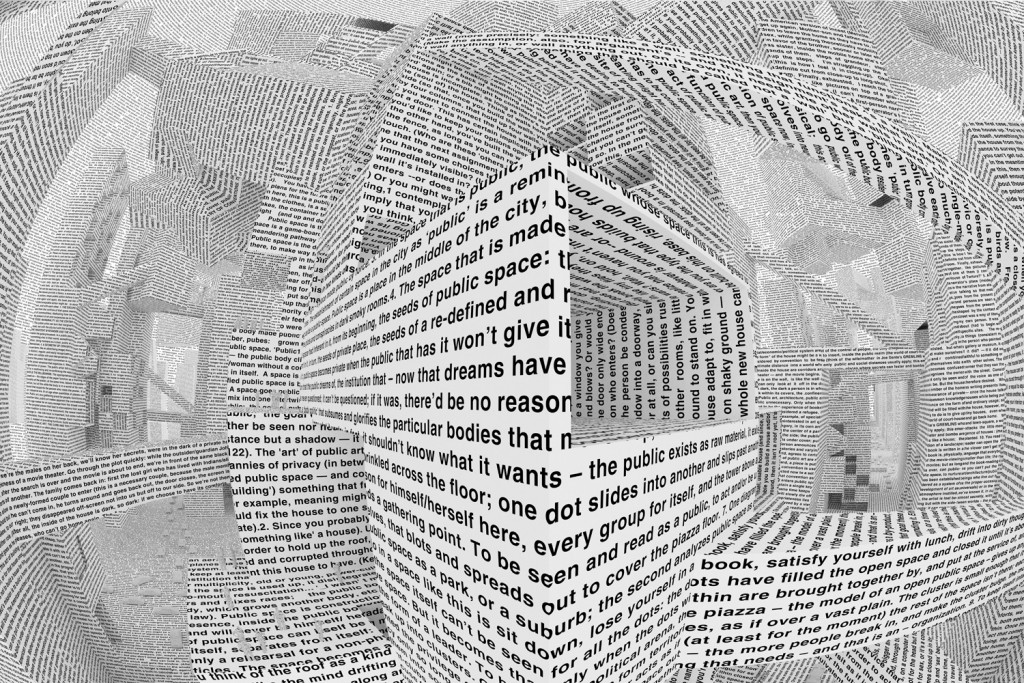
Words (a poem)

City Of Words by Vito Acconci

City Of Words by Vito Acconci

words
written words
typewritten words
computer-generated
pixelated
variegated
variable space font
words
light tipped
tight lipped
linear symbols
words
prance across page
know not
no what
meaning to see
seeming to be
words
feeling
failing
falling
words

– C. Eric Funston, 3 June 2015

Loss of Sabbath – From the Daily Office Lectionary

From the OT lesson for Friday in the week after Pentecost
Deuteronomy 5
12 Observe the sabbath day and keep it holy, as the Lord your God commanded you.
13 For six days you shall labor and do all your work.
14 But the seventh day is a sabbath to the Lord your God; you shall not do any work – you, or your son or your daughter, or your male or female slave, or your ox or your donkey, or any of your livestock, or the resident alien in your towns, so that your male and female slave may rest as well as you.

I usually take Friday as my day away from the office, my “day of rest.” However, this week I “stayed home” yesterday and later in the day posted this summary of the day to my Facebook page: “This has been a productive, if somewhat expensive, alternative day off. I took today rather than tomorrow because [a] I have a wedding rehearsal tomorrow and [b] I was able to schedule some much needed auto maintenance today. Auto maintenance was the first accomplishment – new right front lower ball joint ($600, also the expensive part of the day). Mowed the lawn, whole thing, and cut two huge low-hanging branches off the thorny-something-or-other in the back garden that have made mowing a pain (in reality – the thing has 1-1/2″ long needle sharp spines!) Did three loads of laundry (one a big load of black shirts so I have uniforms for rehearsal, wedding, and Sunday). Made a big batch of ‘copper penny salad’ for church choir end-of-program-year picnic this evening. Hard boiled a dozen eggs and put them to pickle in a mixed brine saved from three sources: Lebanese pickled turnips, Palestinian pickled baby eggplants, and home pickled ramps and garlic. In a week or two I will be able to report on the success of said pickling of eggs. – It was also a day of memories of our pilgrimage to the Holy Land, set off by a lunch of pickled turnips, pickled eggplants, and toasted pita (spread with labneh and sprinkled with za’atar). – And I realized while driving home from the auto shop that it’s been ages since I wrote any poetry and also realized that it’s been about the same period of time that I stopped carrying an actual paper notebook to record random thoughts. My ‘mobile device’ just doesn’t function in the same way for that purpose…. loss of paper = loss of poetry. Going back to paper.”

Not only have I lost my poetry, I seem to have lost sabbath. I think the two are related.

« Older posts Newer posts »