 I understand that St. Andrew’s Parish is, today, beginning its annual stewardship campaign, so I suppose it’s appropriate that we heard the story of Jesus being confronted by the wealthy man who wants to inherit eternal life in today’s Gospel reading from Mark. This tale must have been an important one to the earliest Christians, because we find it in all three of the Synoptic Gospels. Mark tells us only that the man is wealthy; Matthew adds that he is young; and Luke informs us that he is a ruler of some sort. But none of those details really changes the basic nature of the encounter: a potential disciple comes to Jesus seeking guidance and Jesus tells him that he must give up everything he possesses – “You lack one thing; go, sell what you own, and give the money to the poor….”[1] The obligations of discipleship, in other words, are total.
Preachers through the ages have sought to soften the demands of this story. Generally, they’ve taken one of four approaches to make the story seem less burdensome. The most popular for quite a while was to interpret Jesus’ comment – “It is easier for a camel to go through the eye of a needle than for someone who is rich to enter the kingdom of God”[2] – to mean something other than it seems to mean at first blush.
 “They’re eating the dogs, they’re eating the cats.”
 Again this week as last, our first reading today is from the First Book of Kings and like last week’s, it is a prayer spoken by King Solomon. Last week, it was a private prayer spoken in a dream late at night. Today, it is a public prayer. As long as it was, this reading is just a small part of the dedicatory prayer that Solomon offered when the Temple was finished and consecrated. In it, Solomon asks an important question, “[W]ill God indeed dwell on the earth?”
 We have had more than enough of contempt,
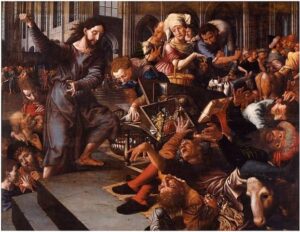 When I was about 8 or 9 years of age, my grandparents gave me an illustrated bible with several glossy, color illustrations of various stories. They weren’t great art, but they were clear and very expressive. My favorite amongst them was the illustration of today’s gospel lesson.
 What is Lent all about?
 Here we are at the end of the first period of what the church calls “ordinary time” during this liturgical year, the season of Sundays after the Feast of the Epiphany during which we have heard many gospel stories which reveal or manifest (the meaning of epiphany) something about Jesus. On this Sunday, the Sunday before Lent starts on Ash Wednesday, we always hear some version of the story of Jesus’ Transfiguration, a story so important that it is told in the three Synoptic Gospels, alluded to in John’s Gospel, and mentioned in the Second Letter of Peter.
 There’s a story about a pastor giving a children’s sermon. He decides to use a story about forest animals as his starting point, so he gathers the kids around him and begins by asking them a question. He says, “I’m going to describe someone to you and I want you to tell me who it is. This person prepares for winter by gathering nuts and hiding them in a safe place, like inside a hollow tree. Who might that be?” The kids all have a puzzled look on their faces and no one answers. So, the preacher continues, “Well, this person is kind of short. He has whiskers and a bushy tail, and he scampers along branches jumping from tree to tree.” More puzzled looks until, finally, Johnnie raises his hand. The preacher breathes a sigh of relief, and calls on Johnnie, who says, “I know the answer is supposed to be Jesus, but that sure sounds an awful lot like a squirrel to me.”
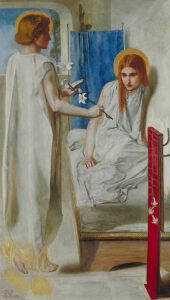 When I find myself in times of trouble,
 On April 12, a little more than seven months ago, I was privileged to officiate and preach at a service of Choral Evensong at Trinity Episcopal Cathedral in Cleveland. Following the service, on our way home to Medina, my wife Evelyn and I stopped at a Lebanese restaurant in Middleburg Heights for a late dinner in celebration of our 43rd wedding anniversary, which that day was. After a lovely meal of hummus, baba ganoush, spicy beef kafta, and chicken shwarma, we went home to bed. A few hours later, around 2 a.m., I woke up with a horrendous case of heartburn. I took some antacid and went back to sleep sitting up in my favorite armchair. At 7 a.m. the next morning, I woke up knowing that I hadn’t had indigestion after all; I was having a heart attack.

