 There’s a story about a pastor giving a children’s sermon. He decides to use a story about forest animals as his starting point, so he gathers the kids around him and begins by asking them a question. He says, “I’m going to describe someone to you and I want you to tell me who it is. This person prepares for winter by gathering nuts and hiding them in a safe place, like inside a hollow tree. Who might that be?” The kids all have a puzzled look on their faces and no one answers. So, the preacher continues, “Well, this person is kind of short. He has whiskers and a bushy tail, and he scampers along branches jumping from tree to tree.” More puzzled looks until, finally, Johnnie raises his hand. The preacher breathes a sigh of relief, and calls on Johnnie, who says, “I know the answer is supposed to be Jesus, but that sure sounds an awful lot like a squirrel to me.”
My best friend (another retired priest) and I often ask one another, “What are you preaching about on Sunday?” and our answer is always “Jesus.” For a preacher, the answer is always supposed to be Jesus. We’re supposed to take Paul as our model; he wrote to the Corinthians, “When I came to you, brothers and sisters, I did not come proclaiming the mystery of God to you in lofty words or wisdom. For I decided to know nothing among you except Jesus Christ, and him crucified.”[1] So we are to do the same, preach Christ and him crucified, or perhaps today preach Christ and him baptized.
 On April 12, a little more than seven months ago, I was privileged to officiate and preach at a service of Choral Evensong at Trinity Episcopal Cathedral in Cleveland. Following the service, on our way home to Medina, my wife Evelyn and I stopped at a Lebanese restaurant in Middleburg Heights for a late dinner in celebration of our 43rd wedding anniversary, which that day was. After a lovely meal of hummus, baba ganoush, spicy beef kafta, and chicken shwarma, we went home to bed. A few hours later, around 2 a.m., I woke up with a horrendous case of heartburn. I took some antacid and went back to sleep sitting up in my favorite armchair. At 7 a.m. the next morning, I woke up knowing that I hadn’t had indigestion after all; I was having a heart attack.
 We have three intriguing lessons from scripture today. First we have a denunciation of Hebrew worship, which also interestingly contains a verse most famous in American politics for having been spoken on the steps of the Lincoln monument by Dr. Martin Luther King, Jr. Some people who dislike liturgy, or some aspect of liturgy, like incense, or vestments or music, ignoring that sentence about justice flowing like streams, have used this text to prove that God also dislikes, liturgy, or incense, or vestments, or whatever. However, that’s not what this lesson is about and I’ll get back to that in just a moment.
  This is an old and familiar story, a comfortable story if you will … the parable of the sower.
 “As Jesus was walking along, he saw a man called Matthew sitting at the tax booth; and he said to him, ‘Follow me.’ And he got up and followed him.”
 When my nephew, who’s now in his mid-40s, was about six years old, he was given a homework assignment that he found frustrating and he just didn’t want to finish it, but his mother made him sit down and do it rather than something else more to his liking. In his frustration, he blurted out, “I hate you!” My late sister-in-law responded calmly, “That’s too bad because I love you.” After a moment of reflection, my nephew amended his angry outburst: “I love you, too,” he said, “but I don’t like you right now.”
 I really don’t like television commercials, and I’m pretty sure I’m not alone in that regard. It’s a common complaint; we all talk about how much we dislike TV advertising. We all subscribe to Amazon Prime, Netflix, Hulu, and other streaming services so we can avoid them. And yet, sometimes a particularly memorable advertisement tag-line will worm it’s way into one’s regular conversation. My step-father had one of those: whenever my mother made anything even slightly piquant he would say, “Mama mia, that’s a spicy meatball,” which some of you may recognize from an old Alka-Seltzer commercial.
 Anthelme Brillat-Savarin , an 18th century French politician once said, “Tell me what kind of food you eat, and I will tell you what you what kind of man are.”
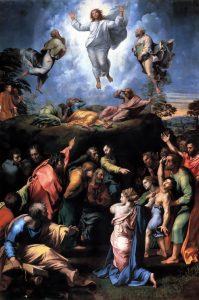 Today, as I write this, is Trinity Sunday 2020, but my imagination this morning is not caught up by the Lectionary gospel lesson of the day, the last mountain-top experience of the Eleven when, just before his Ascension, Jesus gives them the Great Commission.
 Today marks the beginning of the season we call “Lent,” an old English word which refers to the springtime lengthening of the days. What is this season all about, these forty days (not counting Sundays) during which we are to be, in some way, doing what a hymn attributed to St. Gregory the Great says: “Keep[ing] vigil with our heavenly lord in his temptation and his fast?”

