 Monday being “Memorial Day,” this weekend, in the traditions of our country, we are remembering and celebrating those who have fought on behalf of, and given their lives for, the United States. In the traditions of the church today, we are celebrating something called “Rogation Sunday,” on which we give thanks for the abundance of the earth and ask God’s blessings upon agricultural pursuits, upon the fields and the herds. I’d like to read you a story about giving thanks for abundance. It is from the Paul Harvey radio program.
Category: Acts (Page 2 of 9)
 A few years ago, at my former parish, we had a Sunday school presentation in which each of the kids was to recite a verse of Scripture. On little guy came up and just stood there, shuffling his feet and looking very uncomfortable; he just couldn’t remember his line… His mother was in the front row to prompt him. She gestured and formed the words silently with her lips, but it did not help. Her son’s memory was blank. Finally, she leaned forward and whispered the cue, “I am the light of the world.” The child beamed and with great feeling and a loud clear voice said, “My mother is the light of the world.”
Today, we have the happy coincidence of celebrating Mother’s Day and contemplating another of Jesus famous “I am” statements: “I am the good shepherd.” I believe that this coincidence can help us to understand this famous metaphor. Last Monday was the feast of Julian of Norwich, the early 15th Century mystic who was given, and recorded, a series of “divine shewings.” In her text, The Revelations of Divine Love, published in modern translation under the title Showings, she wrote this:
The human mother will suckle her child with her own milk, but our beloved Mother, Jesus, feeds us with himself, and with most tender courtesy, does it by means of the Blessed Sacrament, the precious food of all true life.[1]
A clergy person of my acquaintance, following Julian’s vision of Jesus as our “beloved mother,” recast today’s Gospel lesson in terms of motherhood, rather than shepherding.
 Our kids this week have been “Shipwrecked,” but they’ve also been “rescued by Jesus.”[1] They’ve been learning the truth of that promise emblazoned on neon crosses at innumerable inner-city rescue missions in nearly every English-speaking country in the world, “Jesus saves,” through the metaphor of being lost at sea and washed up on a deserted island. That’s something that happened to St. Paul at least three if not four times![2]
But, unfortunately, St. Paul’s experiences at sea are not in the lectionary this week. Our readings from the bible have nothing to do with ships or the ocean or being lost or getting rescued and aren’t really easy to tie to what the kids have been doing with all these shipwreck decorations in the church. Instead of shipwrecks, the readings this week give us trees. Ezekiel reminds us of one of God’s metaphors for Israel, the noble cedar planted on a mountaintop spreading its branches to provide homes for the birds and winged creatures of every kind (which represent all the nations of the world), producing mighty boughs and the plenteous fruit of righteousness and justice.[3]
 What do you suppose it was like in Jerusalem on that Pentecost morning so long ago?
Did you watch the coverage of the Royal Wedding of Prince Harry and Meghan Markle yesterday? Did you see the crowds along the streets of London as they took their post-nuptial carriage ride? The narrow streets of ancient Jerusalem would have been something like that. Shoulder to shoulder people moving through the streets and alleyways, past vendors’ stalls, moving toward the Temple to make their festival offerings.
Our Christian holiday of Pentecost takes its name from the Greek name of the Jewish festival called Shavuot. The Hebrew name means “festival of weeks” referring to the fact that it takes place seven weeks after the Passover. The Greek name comes from words meaning “fifty days” referring similarly to its being the fiftieth day after Passover. Shavuot commemorates the giving of the Torah on Mount Sinai seven weeks after the Exodus from Egypt remembered at Passover. This is why our Christian feast of Pentecost occurs fifty days after the Resurrection of Jesus which took place at Passover.
 Our gospel lesson today is from John’s story of the last supper. This is part of a long after-dinner speech that Jesus gives including a section known as the “high priestly prayer.” In it, among other petitions, Jesus asks God the Father to look after his disciples. He prays:
All mine are yours, and yours are mine; and I have been glorified in them. And now I am no longer in the world, but they are in the world, and I am coming to you. Holy Father, protect them in your name that you have given me, so that they may be one, as we are one. While I was with them, I protected them in your name that you have given me. I guarded them, and not one of them was lost except the one destined to be lost . . . .[1]
As we gather today on this Sunday after the Ascension, essentially the last Sunday of the Easter Season, which also happens this year to be Mother’s Day on the secular, I am struck by how maternal this prayer sounds; it sounds like a mother leaving her children.
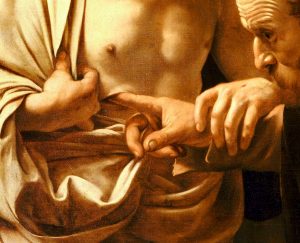 Every year, for as long as any of us can remember, on the Second Sunday of Easter the church has told the story of Thomas, Thomas the Doubter, “Doubting Thomas” who wouldn’t believe that Jesus had risen, the poster child for those who are uncertain. But, believe me, Thomas gets a bad rap! He was no worse a doubter or disbeliever than any of the others, including Peter!
Consider this from the end of Mark’s Gospel:
Now after he rose early on the first day of the week, he appeared first to Mary Magdalene, from whom he had cast out seven demons. She went out and told those who had been with him, while they were mourning and weeping. But when they heard that he was alive and had been seen by her, they would not believe it. After this he appeared in another form to two of them, as they were walking into the country. And they went back and told the rest, but they did not believe them. Later he appeared to the eleven themselves as they were sitting at the table; and he upbraided them for their lack of faith and stubbornness, because they had not believed those who saw him after he had risen.[1]
 A couple of months ago, I was part of a conversation among several parishioners about the set-up for our celebrations of the Nativity. We looking at our plans for Christmas services, and a member of our altar guild exclaimed, “That’s the problem! Things are always changing around here!”
A few days later at the November vestry meeting, as we were discussing our preliminary work on the 2018 budget and looking over the church’s calendar for the coming year, one of our vestry persons expressed some frustration saying, “That’s the problem! Nothing ever changes around here!”
 Christmas is now done. It ended Friday on Twelfth Night. I am sure than none of you, good Anglican traditionalists that we all are, put away any of your decorations before then, but have by now put them all away.
Yesterday, of course, was the Feast of the Epiphany, the day on which we remember especially the visitation of the Magi. We don’t know exactly when they visited the Holy Family, but most scholars seem certain that it was a lot more than 13 days after Jesus’ birth! More likely, it was about two years. We’ve left the Creche in place this morning and you’ll notice that the Wise Men have made their way from the table at the rear of the Nave up the Epistle side aisle, have visited Joseph, Mary, and Jesus, and are now heading back down the Gospel side aisle, returning to “their own country (as Matthew tells us) by another road.”1
====================
A homily offered by the Rev. Dr. C. Eric Funston on Pentecost Sunday, June 4, 2017, to the people of St. Paul’s Episcopal Church, Medina, Ohio, where Fr. Funston is rector.
(The lessons for the service are from the Revised Common Lectionary: Acts 2:1-21; Psalm 104:25-35,37; 1 Corinthians 12:3b-13; and St. John 7:37-39. These lessons can be read at The Lectionary Page.)
====================
 Almighty God, on this day you opened the way of eternal life to every race and nation by the promised gift of your Holy Spirit who empowered the disciples to proclaim the Good News to peoples from many lands speaking many tongues: we now pray for those in many lands speaking many languages who have been hurt or killed by terrorist violence in the past fortnight in: London (England), Kabul (Afghanistan), Mosel (Iraq), Minya (Egypt), Khost (Afghanistan), Mastung (Pakistan), Gao (Mali), Borno State (Nigeria), Raqqa (Syria), Mogadishu (Somalia), rural Colombia, Manila (Philippines), Baghdad (Iraq), Basra (Iraq), Portland (Oregon, USA) and Manchester (England). May God grant eternal rest to the departed, healing to the injured, and comfort to those in grief. And since Jesus taught us to love and pray for our enemies, we pray also for those who have committed these violent acts, and for those who may be contemplating additional violence. May God change their hearts and shed abroad the gift of peace throughout the world by the preaching of the Gospel, that it may reach to the ends of the earth; through Jesus Christ our Lord, who lives and reigns with you, in the unity of the Holy Spirit, one God, for ever and ever. Amen.
==============================
“The teaching of the wise is a fountain of life,” says the Book of Proverbs (13:14). The word translated there as “teaching” is Torah, the Hebrew name for the Law of God given to Moses on Mt. Sinai. The biblical tradition tells us that seven weeks after the Passover the Hebrews camped at the foot of Mt. Sinai and Moses went up the mountain, met God, and returned with the Torah inscribed on stone tablets. Therefore, the Jews celebrate on the fiftieth day after Passover the feast called Shavuot, which literally means “the feast of weeks.” It is also called “the feast of the giving of the Law” and “the feast of first fruits” because it also became a celebration of the barley harvest and a time of prayer for the success of the wheat harvest; it was a time when the tithe of the barley harvest, the first ten percent of the grain was brought to the Levites in obedience to the Torah’s requirement: “All tithes from the land, whether the seed from the ground or the fruit from the tree, are the Lord’s; they are holy to the Lord.” (Lev. 27:30)
When worship became centered on the Jerusalem Temple in Jerusalem, Shavuot became a pilgrimage feast, one of the three annual festivals on which every male Jew is commanded to make a pilgrimage to the Temple, which explains why there were so many people “Parthians, Medes, Elamites, and residents of Mesopotamia, Judea and Cappadocia, Pontus and Asia, Phrygia and Pamphylia, Egypt and the parts of Libya belonging to Cyrene, and visitors from Rome, both Jews and proselytes, Cretans and Arabs” (Acts 2:9-11) in the streets of Jerusalem when the disciples of Jesus, empowered by the Holy Spirit, went out to proclaim the Good News. They were the Jews of the Diaspora and for many of them, Greek rather than Hebrew was the language in which they read Scripture and worshiped, and they called this feast “Pentecost,” a word which means “fiftieth day.” They had returned to Jerusalem on the fiftieth day after Passover to offer their tithes at the Temple in gratitude for the giving of the Law.
A rabbi of the time famously described the Torah as a “disciplinarian” or “schoolmaster” (Gal. 3:22). Writing in Greek, the word he used was paidagogos, a word describing someone in Greek society, usually a family slave, who was charged with the duty of supervising the life and morals of growing boys. In other words, the paidagogos’ obligation was to teach the boys to be good. This was the purpose of the Law given at Mt. Sinai. A modern rabbi writes that one should immerse oneself in the Torah
to gain a sense of how the Creator of the Universe relates to His creations. To think in a Godly way. It is a sharing of spirit, until the same preferences and desires breathe within . . . you, [until God’s] thoughts are your thoughts and your thoughts are [God’s]. (Tzvi Freeman, What Is Torah?)
That is what we as Christians believe happened in the event described by Luke in today’s reading from the Book of Acts, a sharing of the Holy Spirit of God until God’s preferences and desires breathed within the disciples, until God’s thoughts were their thoughts and they had no alternative but to speak them to the world around them.
That First Century rabbi of whom I spoke was none other than our own parish Patron Saint, Paul of Tarsus, writing to the Galatians. He would continue to say that with the coming Christ we are freed from the discipline of the schoolmaster, and instead are led by the Holy Spirit to bear the “fruit of the Spirit [which] is love, joy, peace, patience, kindness, generosity, faithfulness, gentleness, and self-control.” (Gal. 5:22) Another word that describes this fruit is “virtue,” which St. Augustine of Hippo defined as “a good habit consonant with our nature.” (Catholic Encyclopedia, Virtue)
The “fruit of the Spirit” should not be confused with the gifts of the Spirit. In the epistle reading today from the First Letter to the Corinthians, Paul details many of the gifts of the Spirit (wisdom, knowledge, faith, healing, miracles, prophecy, discernment, speaking in other tongues, and the interpretation of tongues, 1 Cor. 12:8-10), one of which seems to have been exhibited by the disciples, the ability to speak in other languages. While these gifts are important for a variety of reasons, what is most important about them is that they are, Paul says, “given . . . for the common good.” (v. 7)
In Luke’s Gospel, Jesus instructed his listeners to be good, to do good to all, to enemies as well as friends, saying:
Do not judge, and you will not be judged; do not condemn, and you will not be condemned. Forgive, and you will be forgiven; give, and it will be given to you. A good measure, pressed down, shaken together, running over, will be put into your lap; for the measure you give will be the measure you get back. (Lk 6:37-38)
To the Samaritan woman at Jacob’s well, echoing the words the Book of Proverbs applied to the Torah, Jesus promised that those who follow him will receive the water of life which “will become in them a spring of water gushing up to eternal life.” (Jn 4:14) And in today’s gospel lesson in a similar metaphor, he says, “Out of the believer’s heart shall flow rivers of living water.” (Jn 7:38) This is what Pentecost is all about; this is what happened that morning in Jerusalem; the disciples were given a share of the Holy Spirit of God until, as that contemporary rabbi said, God’s preferences and desires breathed within the disciples, until God’s thoughts were their thoughts, until the Torah of the wise became a fountain of life and flowed out of them like living water to the world around them.
So the Law was given to teach us to be good and the Holy Spirit empowers us to be good, but how do we actually be good?
An author whose poetry has often graced the pages of The Christian Century, a magazine to which I have subscribed for many years, offered an answer to that question a few years ago. His name was Brian Doyle; he lived in Portland, Oregon, taught at the University of Portland, and edited Portland Magazine. He died a week ago from the same sort of brain cancer which killed my own brother several years ago, so I took particular note of his passing. At his requiem day before yesterday at the Roman Catholic cathedral in Portland, mourners were given a copy of an essay he wrote and published in his 2013 book The Thorny Grace of It (Loyola Press, Chicago:2013). The essay is entitled How to Be Good. I would like to read part of it to you now:
First, pick up your wet towel and at least, for heavenssake, hang it up to dry. And wipe the sink after you shave. The sink doesn’t have to be shining and spotless, that would be fussy and false, but at least don’t leave little mounds of your neck hairs like dead insects for your partner and children to find. At least do that. It’s the little things; they aren’t little. You knew that. I am just reminding you. Like the dead sparrow that the old lady across the street picked up from the street, where it fell broken and almost unrecognizable, and she saw it as a holy being and she gently dug it into her garden of fading flowers. A little act, but it wasn’t little. It sang quietly of respect and reverence for what had been alive and was thus holy beyond our ken. Or in the morning, when you rush into the shop for coffee, at least say thank you to the harried girl with the Geelong Cats logo tattooed on her forehead. At least look her in the eye and be gentle. Christ liveth in her, remember? Old Saint Paul said that, and who are we to gainsay the testy little gnarled genius? And the policeman who pulls you over for texting while driving, yes, you are peeved, and yes, he could be chasing down murderers, but be kind. Remove the bile from your tongue. For one thing, it actually was your fault, you could have checked the scores later, and for another, Christ liveth in him. Also in the grumpy imam, and in the surly teenager, and in the raving man under the clock at Flinders Street Station, and in the foulmouthed man at the footy, and in the cousin you detest with a deep and abiding detestation and have detested since you were tiny mammals fresh from the wombs of your mothers. When he calls to ask you airily to help him lug that awful vulgar elephantine couch to yet another of his shabby flats, do not roar and use vulgar and vituperative language, even though you have excellent cause to do so and who could blame you? But Christ liveth in him. Speak hard words into your closet and cast them thus into oblivion. Help him with the couch, for the ninth blessed time, and do not credit yourself with good works, for you too are a package of small sins and cowardices, and the way to be good is not to join the Little Sisters of the Poor in Calcutta, but to be half an ounce better a man today than you were yesterday. Do not consider tomorrow. Consider the next moment after you read this essay. Do the dishes. Call your mother. Coach the kids’ team. Purge that closet of the clothes you will never wear and give them away. Sell the old machinery and turn it into food for those who starve. Express gratitude. Offer a quiet prayer for broken and terrified children. Write the minister and ask him to actually do the job he was elected to do, which is care for the bruised among us, not pose on television. Pray quietly by singing. We do not know how prayers matter but we know that they matter. Do not concern yourself with measuring and calculating, but bring your kindness and humor like sharp swords against the squirm of despair and violence. The Church is you. Christ liveth in you. Do not cloak Him but let Him be about His business, which is using the tools the Creator gave you and only you to bring what light you can. You know this. I am only reminding you. Work with all your grace. Reach out. Do not rest. There will be time and time enough for rest. Care for what you have been given. Give away that which you treasure most. The food of the spirit is love given and granted; savor that and disburse that which is not important. Use less, slow down, write small notes. All the way to heaven is heaven, said old Catherine of Siena, and who are we to gainsay that slight smiling genius? Remember that witness is a glorious and muscular weapon. What you see with your holy eyeballs and report with the holy twist of your tongue has weight and substance. If you see cruelty, call it by its true name. If you hear a lie, call it out in the open. Try to forgive even that which is unforgivable. That is the way forward for us. I do not know how that can be so but it is so. You and I know that. I am only reminding us. Be who only you are. Rise to what you dream. Do not cease with joy. That is the nature of the gift we were given. It is the most amazing and extraordinary and confusing and complicated gift that ever was. Never take it for granted, not for an instant, not for the seventh of a second. The price for it is your attentiveness and generosity and kindness and mercy. Also humor. Humor will destroy the brooding castles of the murderers and chase their armies wailing into the darkness. What you do now, today, in these next few minutes, matters more than I can tell you. It advances the universe two inches. If we are our best selves, there will come a world where children do not weep and war is a memory and violence is a joke no one tells, having forgotten the words. You and I know this is possible. It is what He said could happen if we loved well. He did not mean loving only the people you know. He meant every idiot and liar and thief and blowhard and even your cousin. I do not know how that could be so, but I know it is so. So do you. Let us begin again, you and me, this afternoon. Ready? (Page 15)
On this fiftieth day, this feast of the first fruits, this day of bringing our tithes and offerings of thanksgiving before God, this celebration of the giving of the Torah and the coming of the Holy Spirit, this birthday of the church, let us begin again to be good, and let goodness be in us like the Torah of the wise, a spring gushing up to eternal life, running over, and flowing out, a river into the world around us, so that “justice [may] roll down like waters, and righteousness like an ever-flowing stream.” (Amos 5:24)
Empowered by the Holy Spirit, let us begin again to be good, you and me, today! Ready?
====================
Father Funston is the rector of St. Paul’s Episcopal Church, Medina, Ohio.
====================
A homily offered by the Rev. Dr. C. Eric Funston on the Sunday after the Ascension, the Seventh Sunday of Easter, May 28, 2017, to the people of St. Paul’s Episcopal Church, Medina, Ohio, where Fr. Funston is rector.
(The lessons for the service are from the Revised Common Lectionary: Acts 1:6-14; Psalm 68:1-10,33-36; 1 Peter 4:12-14,5:6-11; and St. John 17:1-11. These lessons can be read at The Lectionary Page.)
====================
 As I read our lessons for today and again as I heard them this morning, two verses in particular have leapt out at me. One from the Gospel of John in which Jesus says: “And this is eternal life, that they may know you, the only true God, and Jesus Christ whom you have sent.” (Jn 17:3) The other is from the story in the Book of Acts in which, after Jesus has been lifted up and a cloud has taken him out of the apostles’ sight, two suddenly-appearing “men in white robes” (angels, one presumes) ask the apostles, “Men of Galilee, why do you stand looking up toward heaven?” (Acts 1:11)
I want to explore the way in which these two verses are connected, but first let me ask you a question. Have you ever had a conversation that went like this?
“Hi, how are you?” asks an acquaintance.
“Fine, thanks! How are you?” you answer, but before you’ve even finished saying the word “fine” you friend has walked on and is paying not the slightest attention to you or your answer and clearly was not really interested in whether you are fine or not and is even less interested in telling you how they are doing.
What would you call the relationship such a dialogue evidences? I used the word “friend,” but that clearly overstates what such a lack of give-and-take demonstrates; I also used “acquaintance,” but I don’t think the conversation shows even that level of association. It’s more like the image in Longfellow’s The Theologian’s Tale:
Ships that pass in the night, and speak each other in passing,
Only a signal shown and a distant voice in the darkness;
So on the ocean of life we pass and speak one another,
Only a look and a voice, then darkness again and a silence.
(Tales of a Wayside Inn, 1863)
You’ve had, I suspect, many conversations of greeting like that. I know I have.
In contrast to such transient and insignificant greetings, consider the way the fictional people of the planet Pandora in the 2009 science-fiction film Avatar greeted one another. Avatar was on TV Friday night. Perhaps you saw it; I did. Avatar was a big splashy tale of the clash of cultures, rapacious exploitative humans from Earth versus the apparently primitive but wise and environmentally attuned Na’Vi of Pandora. It had lots of CGI special effects, very effective use of 3D film technology, and a good action plot that kept viewers entertained. In the midst of all that there was a story about relationships, both relationships in general and a specific relationship, the love affair between the human Jake Sully and the Na’Vi native girl Neytiri.
In the Na’Vi cosmology, all life is connected through a personalized power they call “Ey’Wa.” Ey’Wa is not God – it’s unclear whether the Na’Vi have a god, and at one point Neytiri criticizes and even ridicules Jake when he addresses a prayer to Ey’Wa – but neither is Ey’Wa the impersonal and amoral “Force” of the Star Wars saga. In the world of theology, the Na’Vi understanding is most similar to the teaching called “panentheism,” literally “all-in-God-ism.” This school of thought affirms that although God and the world are distinct, that is, not the same, and although God transcends the world, the world is, nonetheless, “in” God; God is intimately connected to the world and yet remains greater than the world. (Panentheism should not be confused with pantheism, which understands God to be the world.) Some famous theologians associated with the idea of panentheism are the Lutheran Paul Tillich, Wolfhart Pannenberg in the Reformed tradition, the Evangelical Jurgen Moltmann, and the Roman Catholic writer Karl Rahner.
In any event, the Na’Vi’s understanding of Ey’Wa and their connection to her is expressed in their greeting, “I see you.” As the Na’Vi explain in the film, this greeting doesn’t mean ordinary seeing; it means “the Ey’Wa in me sees the Ey’Wa in you; the Ey’Wa in me is connecting with the Ey’Wa in you.” That greeting conveys a much, much greater sense of relationship than any “Hi, how are you? … Fine, and you?”
The conservative Roman Catholic New York Times op-ed writer Ross Douthat didn’t like Avatar at all. The week it came out (just before Christmas in 2009), he wrote a blistering critique of the philosophical underpinnings of its story, accusing the writers of offering a world-view in which human beings are nothing more than “beasts with self-consciousness, predators with ethics, mortal creatures who yearn for immortality” in an agonized and deeply tragic position from which “there is no escape upward.” (http://www.nytimes.com/2009/12/21/opinion/21douthat1.html)
Now, I often find myself in disagreement with Mr. Douthat but I also often find his prose memorable and, having read his negative critique of a movie I rather enjoyed, I often think of it when I see the movie (which I did on Friday night). And his “no escape upward” quip sort of went “click” into the socket presented by that question from today’s lesson from the Acts of the Apostles: “Men of Galilee, why do you stand looking up toward heaven?”
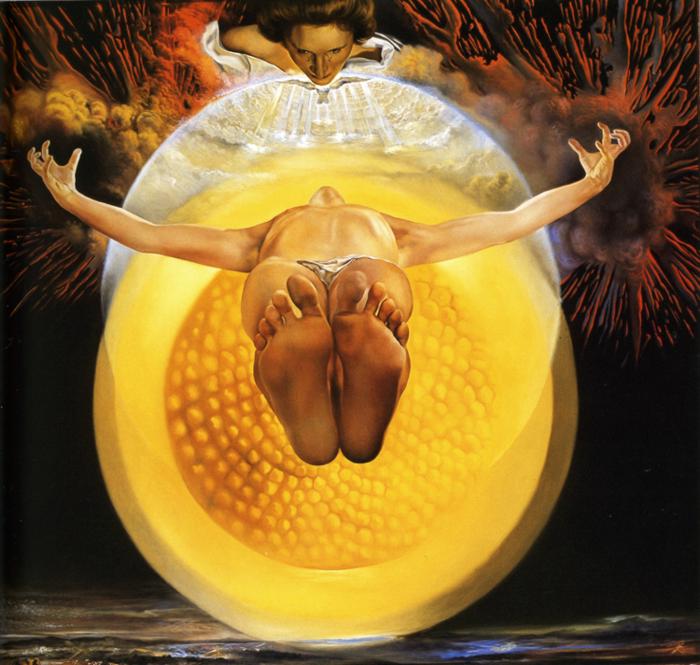
By far my favorite artistic representation of the Ascension is Salvador Dali’s The Ascension of Christ painted in 1958. Dali said that his inspiration for the painting
. . . came from a “cosmic dream’ that he had in 1950, some eight years before the painting was completed. In the dream, which was in vivid color, he saw the nucleus of an atom, which we see in the background of the painting; Dali later realized that this nucleus was the true representation of the unifying spirit of Christ. (Dali Paintings)
The viewer’s perspective is that of apostles, looking upwards at the bottoms of Jesus’ feet.
The feet of Christ point out at the viewer, drawing the eye inwards along his body to the center of the atom behind him. The atom has the same interior structure as the head of a sunflower. (Ibid.)
Dali explained to Mike Wallace in a 1958 television interview that he was intrigued by continuous circular patterns like sunflowers because they follow the law of a logarithmic spiral, which he associated with the force of spirit. (The Mike Wallace Interview, 4/19/1958) Dali often fused his conceptions of Christianity with the science of the mid-20th Century. So the sunflower-like nucleus of the atom was Dali’s representation of the unifying spirit of Christ, which in Dali’s nuclear mysticism connects everyone.
In the distance above the sunflower is the Dove, ready to descend from the clouds as on Pentecost which the church celebrates ten days after the Feast of the Ascension. Also there is a human face, specifically Dali’s wife Gala, who is crying. Dali often used Gala’s image to portray the Virgin Mary, the Queen of Heaven, but here she seems to represent the Father weeping over the Son’s departure from the Earth from the Father’s perspective in heaven.
So when I hear those two white-clad angels asking the men of Galilee why do they stood there looking up toward heaven, I think of Dali’s painting and I know why! There was so much to see, so much to stand in awe of, so much to be overwhelmed by! And yet the angels’ question is a poignantly valid one because, despite Mr. Douthat’s critique of the movie Avatar, there is no immediately available “escape upward.” There is, instead, this world in which we “beasts with self-consciousness, [we] predators with ethics, [we] mortal creatures who yearn for immortality” must get on with the business of living. There is this world into which Jesus sent his followers just before that moment of being lifted up with the command:
Go therefore and make disciples of all nations, baptizing them in the name of the Father and of the Son and of the Holy Spirit, and teaching them to obey everything that I have commanded you. And remember, I am with you always, to the end of the age. (Mt 28:19-20)
There is this world in which Jesus prayed to his Father that his followers might have eternal life, “And this is eternal life, that they may know you, the only true God, and Jesus Christ whom you have sent.” (Jn 17:3)
There it is; the biblical definition of “eternal life.” Eternal life is to know God and Jesus. Professor Karoline Lewis of Luther Seminary in Saint Paul, Minnesota, in her commentary on this gospel lesson asks:
What if it is that simple? How would that change what we imagine in this life? How would it affect our thoughts about and beliefs in our future life with God? How does this alter even our picture of God? Of course, what it means to “know” God is key, and to know God in the Fourth Gospel has no connection to cognitive constructions, creedal consents, or specified knowledge about God. Rather, knowing God is synonymous with being in a relationship with God. (Working Preacher Commentary, 2014)
Another commentator on this text points out that there are
. . . four great examples of discipleship in John are the Samaritan woman in ch. 4, the blind man in chapter 9, Mary in chapter 12, and Thomas, of all people, in chapter 19? What do they have in common? They participated in ongoing relationship and encounter with Jesus. Both the Samaritan woman and the blind guy have lengthy, increasingly deep dialogue with Jesus and as they do, they understand him more and more to the point where they “know” him and understand that he is the source of their lives and loves them like no other. This leads them to worship him and testify to others about him.
Mary is described as one whom Jesus loved (11:5) and John makes it clear and that she, her brother Lazarus and sister Martha regularly spent time with Jesus. Thomas may be a less obvious hero, but he’s a hero nonetheless in this Gospel. He sticks with Jesus even though he discerns trouble is in store (11:16); he asks questions when he doesn’t understand (14:5); he’s not gullible or prone to flights of fancy but he’s willing to believe when confronted with raw glory (chapter 20). On the basis of all of this, Thomas comes to fully know Jesus such that he declares him to be “My Lord and My God” (20:28). (Jaime Clark-Soles, Working Preacher Commentary, 2008)
How do we do that? How do we come to know Jesus the way these four great disciples did? How can we emulate the woman at the well, the man born blind, Mary of Bethany, or Thomas who is wrongly called “the doubter”? Unlike them, we don’t have Jesus walking around here with us. But we do have each other. And we do have all those people out there for whom he died and rose again, and to whom he sent us. And we are commended by John in his first epistle to “love one another, because love is from God; everyone who loves is born of God and knows God.” (1 Jn 4:7) And John continues, “No one has ever seen God; if we love one another, God lives in us, and his love is perfected in us. * * * God is love, and those who abide in love abide in God, and God abides in them.” (1 Jn 4:12,16b)
Which brings me back to the two angels and their question, and to the Na’Vi and their greeting, “I see you.” Jay Michaelson, a writer for The Huffington Post, in an editorial reply to Mr. Douthat’s criticisms suggested that the Na’Vi greeting is equivalent to the Hindu Sanskrit greeting, “Namaste.” Namaste literally means, “I bow to you” and is often translated to mean more fully, “The divine in me bows to the divine in you.” That is pretty similar to the Na’Vi explanation that “the Ey’Wa in me sees the Ey’Wa in you” and I suppose the screenwriters could definitely have had that in mind.
But there is another culture in our world which uses a more direct equivalent of the Na’Vi greeting, the Samburu people of Africa’s Serengeti about whom life-coach Terry Tilman writes in his essay entitled Connecting to the Soul:
About 20 years ago I was on a safari in Africa (Kenya, Tanzania and Rwanda). As we traveled through the villages and Serengeti savanna I noticed a recurring event. When one of the indigenous people would approach another, they would pause, face each other, look directly in each others eyes for 5 -15 seconds, say something and then continue on their way. This would happen in populated villages and in very remote areas where there may be only one human every 20 square miles.
After a couple weeks of noticing this I asked one of our guides from the Samburu tribe what the natives were doing. He said they were greeting each other. “How are they doing that? What are they saying?” I asked.
“One of them says, ‘I see you.’ Connecting through the eyes, the other replies, ’I am here.’”
****
My Samburu guide told me something else that I didn’t get at first. He said that in their language the greeting also meant something like, “Until you see me I do not exist. When you see me, you bring me into existence.” This speaks toward our deep connectedness and that we are in fact All One.
 If you have seen Avatar, you know that the human character Jake Sully is a disabled Marine; he is confined to a wheelchair in his “real” human life. But his avatar, a synthetic body into which his conscience is temporarily transferred, is a fully functional Na’Vi male body. At the end of the movie, after Jake has rebelled against his superiors and championed the Na’Vi’s cause against Pandora’s exploitation by Earth, Jake’s crippled body is trapped in a damaged mobile laboratory. Neytiri finds him, breaks into the lab, and rescues him: “In the end, the real Jake is not his avatar. The real Jake is a man, unshaven and unkempt, without functional legs. And Neytiri sees this. As she holds the dying Jake, she tells him ‘I see you.’ This is what love is. Love is not trying to change the other person, to make them perfect, or to focus on their weaknesses. Love is seeing a person for who they are and embracing that person.” (The Everyday Thomist) Jake, of course, doesn’t die. Through a Na’Vi ritual and the connection with and through Ey’Wa, his consciousness is permanently transferred into the synthetic Na’Vi avatar, and he and Neytiri live happily ever after (one supposes).
Mr. Douthat complained that the panentheism of Avatar encourages us to avert our gaze from the “escape upward” that the Christianity of his conservative understanding affords, but that is precisely what the angels’ question and Jesus’ prayer encourage us to do. Eternal life is not found in “looking up toward heaven.” Eternal life is found when we see and know God and Jesus in those around us. Eternal life comes from knowing that we are not “ships that pass in the night, and speak each other [only] in passing,” but that we are, instead, deeply connected, that (as John wrote) “God is love, and those who abide in love abide in God, and God abides in them.” Eternal life comes from knowing that we are all – as Jesus prayed and as Jesus taught – one, as he and the Father are one. (Jn 17:11)
I see you.
Amen.
====================
Father Funston is the rector of St. Paul’s Episcopal Church, Medina, Ohio.


