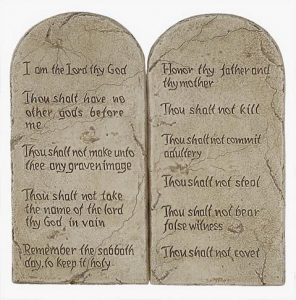
 Here they are. The “Big Ten”! The words of Exodus[1] that Right-wing fundamentalists want to chisel in granite and put in American courthouses unless, of course, they prefer the similar (but not quite the same) version in the Book of Deuteronomy.[2]
My sort of go-to guy on the Old Testament is a Lutheran scholar named Terence Fretheim, who is Professor Emeritus of Old Testament at Luther Seminary, Saint Paul, Minnesota. My first grounding in the Hebrew Scriptures was from a short, two-volume study guide he wrote with co-author Lutheran pastor Darold H. Beekman entitled Our Old Testament Heritage.[3] A couple of years ago, Fretheim wrote a short online commentary on today’s Old Testament lesson in which he said:
The Ten Commandments are not new commandments for Israel (see Exodus 16:22-30), but they are a convenient listing of already existing law for vocational purposes. Moreover, the Commandments were not thought to be transmitted in a never-to-be-changed form. They were believed to require adaptation in view of new times and places.[4]
This is why the version set out in Deuteronomy is slightly different.
 The past couple of days, Friday evening and most of the day on Saturday, the vestry and I were on our annual retreat. Our retreat leader was the Rev. Percy Grant, who is on the diocesan staff as the bishop’s canon for ministry. Percy’s been on the diocesan staff for about ten years in basically the same job, but she’s had three job titles.
 I’m a great fan of Sesame Street. The generation after mine in the Funston family, my niece Saskia, my nephew York, and my own children, Patrick and Caitlin, grew up with that show and it taught them a lot of good things. The show taught my kids literacy, counting, simple logic, and social skills. It did so using a rapid-fire mix of puppetry, animation, and short films. Created in 1969, “it was designed to deliberately mimic the fast pace and style of TV advertising in order to ‘sell’ learning to kids: An Aesop-friendly story featuring the recurring characters on the Street would be intercut with rapid-fire ‘commercials’ for that day’s ‘sponsors’ (‘Sesame Street has been brought to you today by the letters A and S, and the number 7…’).”
 So we once again find ourselves at the beginning of Lent, this Day of Ashes on which we are marked with a sign of death, grief, and penance, and encouraged to enter into a time of fasting, a time of “giving up.” What are you giving up for Lent? We have all heard that question; we have probably asked it of others.
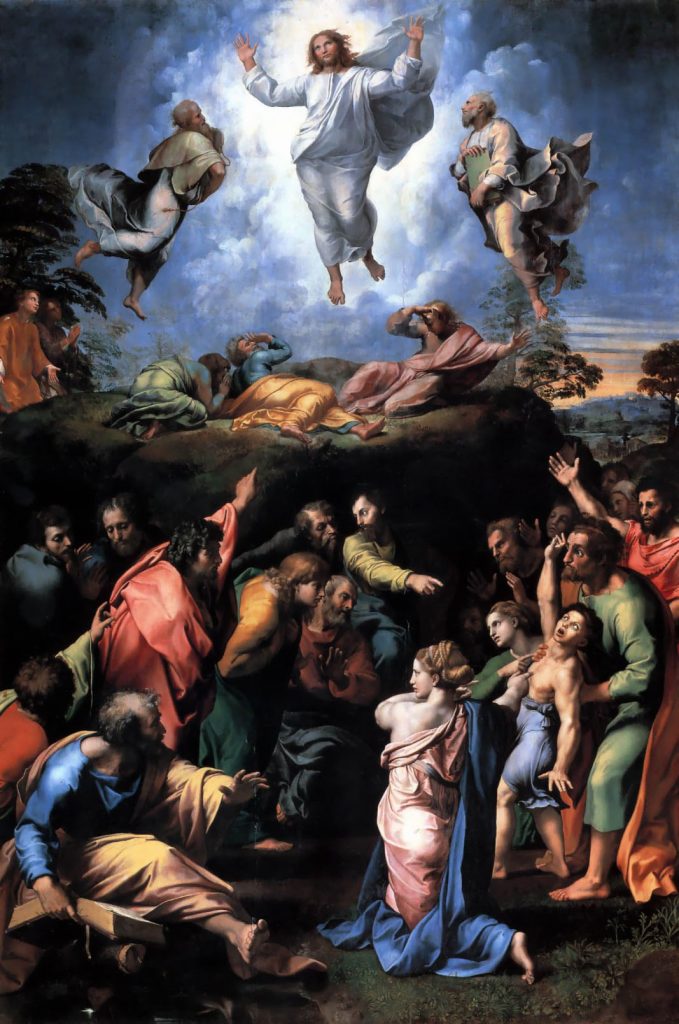 Preachers often focus on Peter’s unthinking outburst offering to make three dwellings for Jesus, Elijah, and Moses on the mountain of the Transfiguration. Such booths would concretize his all-to-human desire to experience continually the radiance of God. Life, however, is not like that; it’s not all mountaintop highs. Life is full of ups and downs, both high mountaintops and low valleys.
 You all know the truth of the statement, “You can’t take it with you.” What you may not know is that that sentiment is straight out of the New Testament! St. Paul, writing to the young new bishop Timothy, says, “We brought nothing into the world – it is certain that we can take nothing out of it.”
 “The Lord your God will raise up for you a prophet like me from among your own people; you shall heed such a prophet.”
 A couple of months ago, I was part of a conversation among several parishioners about the set-up for our celebrations of the Nativity. We looking at our plans for Christmas services, and a member of our altar guild exclaimed, “That’s the problem! Things are always changing around here!”

