 I’m sure you’re all familiar with Howard Thurman’s meditation entitled The Work of Christmas:
When the song of the angels is stilled,
when the star in the sky is gone,
when the kings and princes are home,
when the shepherds are back with their flocks,
the work of Christmas begins:
to find the lost,
to heal the broken,
to feed the hungry,
to release the prisoner,
to rebuild the nations,
to bring peace among the people,
to make music in the heart.[1]
This year I think I would have to suggest that there is one more task to add: to preserve democracy.
In fact, I could make a pretty good argument that that would be the first task because without a good, functioning democracy, we will be unable to find the lost, heal the broken, feed the hungry, or do any of the other things that Thurman lists here or that Jesus describes in the Parable of the Sheep and the Goats.[2]
In 2024, a group of scholars at the Georgetown Center on Faith and Justice drafted what they called A Statement on Christian Faith and Democracy. In it they wrote:
Core to Christianity is the belief that all people are made in the image and likeness of God and that our loving God is incarnate in the humanity of Jesus Christ. God’s love, therefore, embraces all of humanity and calls us to respect every person. Democratic governance is an outgrowth of our divinely endowed dignity and corresponding obligation to protect the rights, freedom, and equality of all.[3]
Similarly, Anglican theologian Luke Bretherton has written:
[E]very human is made in the image of God. In Christian terms, this is not a stand-alone claim, but one aligned with how Jesus Christ is the revelation and incarnation of the true human. Christ reveals the true likeness of God in human form and what it means to live a truly human life. *** A direct implication of all humans being made in the image of God is that everyone matters. There is no fundamental divide in humanity between a ruling elite and everyone else, but quite the opposite.[4]
That the Incarnation is a fundamentally democratic Christian doctrine is made clear by the first sentence of the Fourth Gospel. In Greek it begins, “En arche en ho Logos….” In the beginning was the Word….
“In the beginning….” The author invokes the Book of Genesis, which also starts with these words, “In the beginning….” We might have thought we were going to hear again, as we have heard from the other three gospels, the story of the birth of a Jewish boy in Palestine. Instead these words remind us that “God said, ‘Let us make humans in our image, according to our likeness….’”[5] With his next phrase, “was the Word”, was the Logos, he confirms that his is not a simple human birth story, but part of the cosmic story of creation. This term Logos is taken from Greek philosophy and loaded with more than five hundred years of meaning.
Though interpreted to mean “Word,” Logos is not the Greek term for “word” in its normative sense. That would be Lexis. Logos, instead, is a term of art amongst philosophers finding its origins in the work of Heraclitus, the Sixth Century BC philosopher most commonly known as the man who observed that you cannot step twice into the same river. Heraclitus coined this term to refer to the rational order of the cosmos, a universal intelligence in accordance with which all things come to be. For Heraclitus, the Logos is constantly active in the world:
[A]ll experience is in flux and … change is constant. All things put together are both whole and incomplete; diversity breeds disorder and unity; everything is being assembled and disassembled simultaneously.[6]
From Heraclitus on, the term Logos was used by Greek philosophers, who gave it divers, nuanced meanings including “word, speech, statement, discourse, refutation, ratio, proportion, account, explanation, reason, or thought,”[7] but however it was used, these different meanings of logos all refer to a basic sense of “gathering” or “inclusiveness.”[8] As a term for the “rational, intelligent and thus vivifying principle of the universe,”[9] the fundamental meaning of Logos is relationship, comprehensiveness, and inclusivity.[10]
This Greek term made its way into intertestimental Judaism as a translation of the Hebrew word dabar or the Aramaic term memra, both of which named “the Word by which God made the world, [and] made His Law or Himself known to [humankind],” God’s “world-constructive and world-permeating intelligence.”[11] The Jewish philosopher Philo of Alexandria is a prominent example of this usage.
About two hundred years after Heraclitus, Zeno of Citium, the founder of Stoicism, democratized the Logos concept by taking it a step further, arguing that a seminal bit of the universal Logos, a logos spermatikos, or “seed of reason,” is found in all things, but supremely in human beings allowing us to “participate in divine life.”[12] St. Justin Martyr Christianized this notion, asserting that we know God incarnate in Jesus through the implantation of this Logos within us. Paul alludes to something like this when he writes, “God has sent the Spirit of his Son into our hearts, crying, ‘Abba! Father!’”[13]
Following Zeno, St. Justin argued that even before the birth and ministry of Jesus, this Logos was active in humanity, enabling human beings to live in accordance with right reason, which is itself a sharing in divine reason.[14] This implanted Logos enables us to conceptualize and bring into being entirely new realities. It empowers imagination, problem-solving, and innovation, allowing us to align our thoughts and actions toward others and toward shared goals. For the Christian, this “notion that something reflective of the divine exists in all of humanity is foundational to human personhood.”[15]
Personhood manifests the unity of the spiritual and the corporeal in human existence, and thereby is an essential characteristic of the human species. Personhood gives to the human individual a universal worth and an exceptional standing. And in the transcendent nature of personhood we find the inalienable substance of human rights and the genesis of society and law.[16]
Which brings us back to democracy. The theologian Reinhold Neibuhr once observed, “Man’s capacity for justice makes democracy possible; but man’s inclination to injustice makes democracy necessary.”[17]
Our democracy is supposed to embody “the conditions and means through which human personhood is actualized, in and through free and mutually responsible relationships with and for others.” From a Christian understanding, democracy, “as both a mode of statecraft and set of social practices,” is supposed to “enable humans to realize their true natures as those created in the image of the triune God and redeemed by Christ.”[18]
If we truly believe that every human being is made in the image of God, that every human being bears a logos spermatikos, that the incarnation of Jesus Christ, in his life, death, and resurrection, reveals what it is to be fully human, and that democracy fosters the actualization of full personhood, then it is incumbent upon us to defend, preserve, and participate in the democratic institutions of America. Like Isiaiah, we cannot keep silent, nor can we rest, until our nation’s “vindication shines out like the dawn, and her salvation like a burning torch.”[19]
The song of the angels may not yet be still. The star may still burn in the heavens. The wise men may still be on the road. But the work of Christmas cannot wait. There are lost to be found, broken to be healed, hungry to be fed, prisoners to be released, and a nation, a democracy, to be rebuilt. Amen.
====================
This homily was offered by the Rev. Dr. C. Eric Funston on the First Sunday of Christmas, December 28, 2025, to the people of Harcourt Parish (Episccopal Church of the Holy Spirit), Gambier, Ohio, where Fr. Funston was guest presider and preacher.
The lessons for the service were Isaiah 61:10-62:3; Psalm 147:13-21; Galatians 3:23-25;4:4-7; and St. John 1:1-18. These lessons can be read at The Lectionary Page.
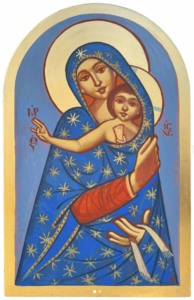
The illustration is a Coptic icon of the Mother of God, revealing the Mystery of the Incarnation.
====================
Notes:
Click on footnote numbers to link back to associated text. Unless otherwise indicated, all quotations from Scripture are from the New Revised Version Updated Edition.
[1] Howard Thurman, The Mood of Christmas & Other Celebrations (Friends United Press, Richmond, IN: 2011)
[2] Matthew 25:31-46
[3] Christian Faith and Democracy, online
[4] Luke Bretherton, Democracy, St. Andrews Encyclopaedia of Theology, 14 March 2024
[5] Genesis 1:26 (NRSVUe)
[6] Ivan Efreaim A. Gozum, The Concept of Logos from Heraclitus, Philo of Alexandria, and the Early Christianity of the First Century CE, Philippiniana Sacra, Vol. LIX, No. 180 (September-December 2024) pp. 585-607, 590, citing Richard G. Geldard, Remembering Heraclitus (Lindisfarne Books, New York: 2001), p. 38
[7] Marian Hillar, The Concept of Logos in Greek Culture, Center for Philosophy and Socinian Studies, 2012, page 1
[8] Omer Aygun, The Middle Included: Logos in Aristotle (Northwestern Univ. Press, Evanston: 2017)
[9] Hillar, op. cit.
[10] Aygun, op. cit., p. 3
[11] Isadore Singer, ed., Memra, Jewish Encyclopedia, 1901, online
[12] Andrew Irvine, Lecture on Hellenistic Philosophy, 24 September 1998, transcript online
[13] Galatians 4:6 (NRSVUe)
[14] Andrew M. Greenwell, St. Justin Martyr: The Spermatikos Logos and the Natural Law, Lex Christianorum, 14 March 2010, online
[15] Frank J. White, Personhood: An Essential Characteristic of the Human Species, The Linacre Quarterly, Vol. 80, No. 1, 1 February 2013, online
[16] Ibid.
[17] Reinhold Niebuhr, The Children of Light and the Children of Darkness: A Vindication of Democracy and a Critique of Its Traditional Defenders (Nisbet & Co., London: 1945), p. xiii
[18] Bretherton, op. cit.
[19] Isaiah 62:1 (NRSVUe)


Leave a Reply