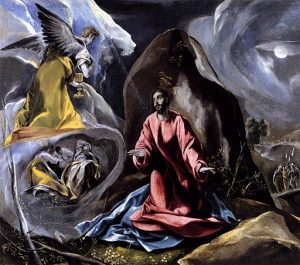
 Across the Kidron valley from Jerusalem, at the foot of the Mount of Olives, is a small grove of olive trees. In the midst of it is a church called “The Church of All Nations” and in the center of that church, surrounded by a low wrought iron fence sculpted to resemble brambles and thorns, is a large, rough, flat rock. It is called “the stone of agony” and tradition tells us it is the place where Jesus prayed on the night before he died.
Our gospel lesson for this evening, for Maundy Thursday, does not mention that olive grove, that stone, or Jesus’ prayers. Our gospel lesson on this day is always the same from year to year. We rehearse John’s story of Jesus washing his disciples’ feet. John’s Jesus is self-assured and in control. He “knew that his hour had come to depart from this world and go to the Father.”[1] He knew “that the Father had given all things into his hands.”[2] “He knew who was to betray him.”[3] He gives his friends a “new commandment” (which, as a colleague of mine noted in our on-line bible study, isn’t really all that new): “Love one another.”[4]
 Today we are commemorating Jesus’ entry into Jerusalem at the beginning of the week that would culminate in his death on the cross of Calvary. Somewhat contrary to common sense, this has come to be called the “triumphal entry.” I don’t know who first applied this term to Jesus making his way from Bethany and Bethphage, through the Kidron Valley, also known as the valley of Jehosophat or the valley of decision, into the holy city. I’ve often thought that whoever it was must surely have been a master of irony, or perhaps of sarcasm, for the procession was anything but a triumph!
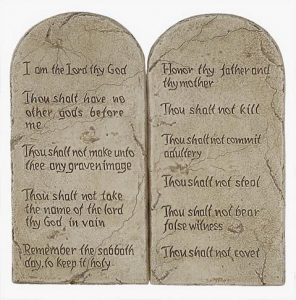 Here they are. The “Big Ten”! The words of Exodus
 The past couple of days, Friday evening and most of the day on Saturday, the vestry and I were on our annual retreat. Our retreat leader was the Rev. Percy Grant, who is on the diocesan staff as the bishop’s canon for ministry. Percy’s been on the diocesan staff for about ten years in basically the same job, but she’s had three job titles.
 I’m a great fan of Sesame Street. The generation after mine in the Funston family, my niece Saskia, my nephew York, and my own children, Patrick and Caitlin, grew up with that show and it taught them a lot of good things. The show taught my kids literacy, counting, simple logic, and social skills. It did so using a rapid-fire mix of puppetry, animation, and short films. Created in 1969, “it was designed to deliberately mimic the fast pace and style of TV advertising in order to ‘sell’ learning to kids: An Aesop-friendly story featuring the recurring characters on the Street would be intercut with rapid-fire ‘commercials’ for that day’s ‘sponsors’ (‘Sesame Street has been brought to you today by the letters A and S, and the number 7…’).”
 So we once again find ourselves at the beginning of Lent, this Day of Ashes on which we are marked with a sign of death, grief, and penance, and encouraged to enter into a time of fasting, a time of “giving up.” What are you giving up for Lent? We have all heard that question; we have probably asked it of others.
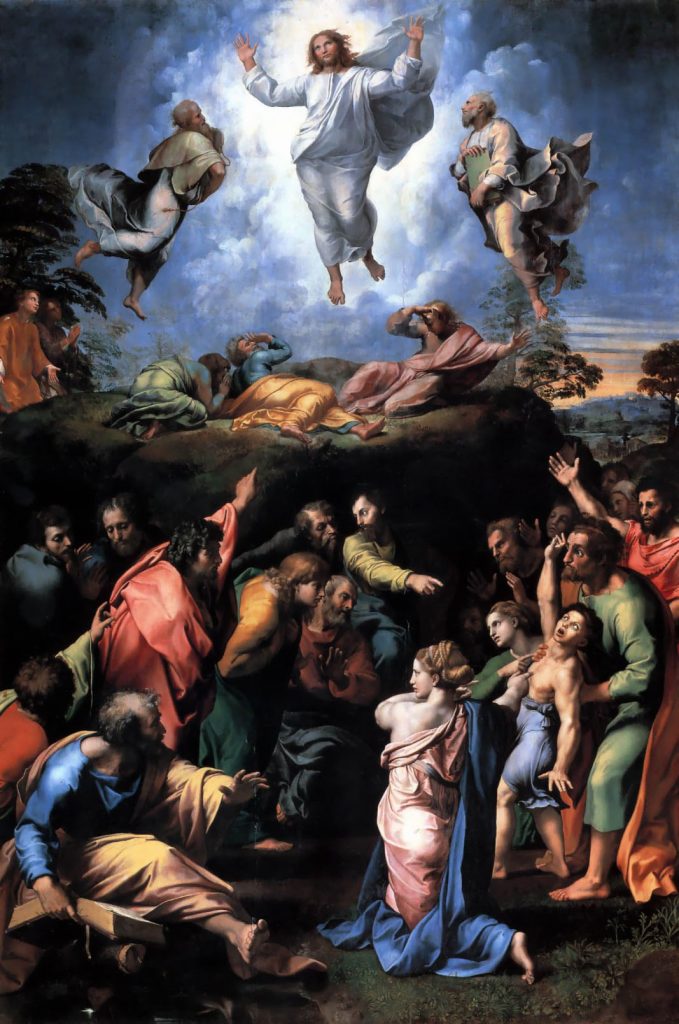 Preachers often focus on Peter’s unthinking outburst offering to make three dwellings for Jesus, Elijah, and Moses on the mountain of the Transfiguration. Such booths would concretize his all-to-human desire to experience continually the radiance of God. Life, however, is not like that; it’s not all mountaintop highs. Life is full of ups and downs, both high mountaintops and low valleys.
 “The Lord your God will raise up for you a prophet like me from among your own people; you shall heed such a prophet.”

