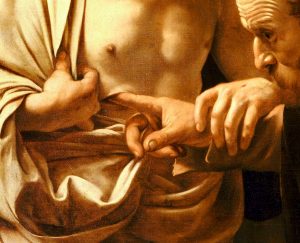
 Every year, for as long as any of us can remember, on the Second Sunday of Easter the church has told the story of Thomas, Thomas the Doubter, “Doubting Thomas” who wouldn’t believe that Jesus had risen, the poster child for those who are uncertain. But, believe me, Thomas gets a bad rap! He was no worse a doubter or disbeliever than any of the others, including Peter!
Consider this from the end of Mark’s Gospel:
Now after he rose early on the first day of the week, he appeared first to Mary Magdalene, from whom he had cast out seven demons. She went out and told those who had been with him, while they were mourning and weeping. But when they heard that he was alive and had been seen by her, they would not believe it. After this he appeared in another form to two of them, as they were walking into the country. And they went back and told the rest, but they did not believe them. Later he appeared to the eleven themselves as they were sitting at the table; and he upbraided them for their lack of faith and stubbornness, because they had not believed those who saw him after he had risen.[1]
 Before coming to Ohio, my wife and I lived in the Kansas City metroplex. For reasons that still remain mysterious, I was somehow added to the mailing list for the newspaper of the Roman Catholic Archdiocese of Kansas City, Kansas, which is called The Leaven. When we moved here, I expected that that would stop, but somehow they got my change of address, so I still get The Leaven. I suppose I could have asked to be taken off, but I enjoy reading some of the articles, especially a column written by the paper’s editor-in-chief Father Mark Goldasich. Fr. Goldasich often relates stories of people from around the archdiocese; some are funny, some are touching, and some, like this recently offered story, bring tears to your eyes:
 Sometimes I find myself at a loss for words. It doesn’t happen often, but once in a while I simply don’t know what to say about a person or an event or a spiritual feeling. On Good Friday, is one of the times when this happens. I don’t know what I want to say about Jesus or his crucifixion or the salvation we enjoy because of his death and resurrection.
 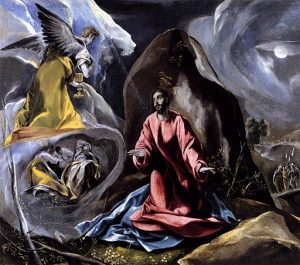 Across the Kidron valley from Jerusalem, at the foot of the Mount of Olives, is a small grove of olive trees. In the midst of it is a church called “The Church of All Nations” and in the center of that church, surrounded by a low wrought iron fence sculpted to resemble brambles and thorns, is a large, rough, flat rock. It is called “the stone of agony” and tradition tells us it is the place where Jesus prayed on the night before he died.
 Today we are commemorating Jesus’ entry into Jerusalem at the beginning of the week that would culminate in his death on the cross of Calvary. Somewhat contrary to common sense, this has come to be called the “triumphal entry.” I don’t know who first applied this term to Jesus making his way from Bethany and Bethphage, through the Kidron Valley, also known as the valley of Jehosophat or the valley of decision, into the holy city. I’ve often thought that whoever it was must surely have been a master of irony, or perhaps of sarcasm, for the procession was anything but a triumph!
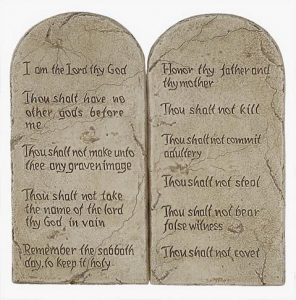 Here they are. The “Big Ten”! The words of Exodus
 The past couple of days, Friday evening and most of the day on Saturday, the vestry and I were on our annual retreat. Our retreat leader was the Rev. Percy Grant, who is on the diocesan staff as the bishop’s canon for ministry. Percy’s been on the diocesan staff for about ten years in basically the same job, but she’s had three job titles.
 I’m a great fan of Sesame Street. The generation after mine in the Funston family, my niece Saskia, my nephew York, and my own children, Patrick and Caitlin, grew up with that show and it taught them a lot of good things. The show taught my kids literacy, counting, simple logic, and social skills. It did so using a rapid-fire mix of puppetry, animation, and short films. Created in 1969, “it was designed to deliberately mimic the fast pace and style of TV advertising in order to ‘sell’ learning to kids: An Aesop-friendly story featuring the recurring characters on the Street would be intercut with rapid-fire ‘commercials’ for that day’s ‘sponsors’ (‘Sesame Street has been brought to you today by the letters A and S, and the number 7…’).”