Occasional thoughts of an Anglican Episcopal priest

Category: Lent (Page 5 of 10)

Lenten Journal 2019 (13 March)

Lenten Journal, Day 7

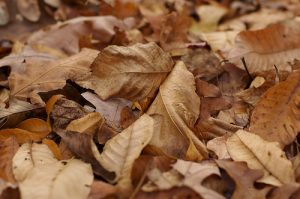
There are leaves
Littering my yard
The moldering detritus of fall
Disturbed dancing in an insistent zephyr
Crumbling into dust
Blowing away
In the Wind moving across the surface
The oranges and golds in which
They once were dressed long gone
The beiges of their nude undergarments bared
Their dusty echoes fading
They have lain thus
Blanketed by snow
Overwintering unseen
Under untrustworthy white
As my sorrows and sins
Have slumbered ‘neath
The eagerness of Advent
The joy of Nativity
The surprise of Epiphany
But spring has come
Lent warmed by burnt palms
Melting prior seasons’ deceits
Baring the moldering detritus of life’s mistakes
Blowing it away crumbling
A streak of ash dancing
“You are dust…” it sings
“You are dust…”
“You are dust…”
Its dusty echo fades
“You are dust…”
“You are…”
“You…”
And a Voice answers
“You are my friends!”

Lenten Leaves, C. Eric Funston, 13 March 2019
Lenten Journal 2019 (12 March)

Lenten Journal, Day 6

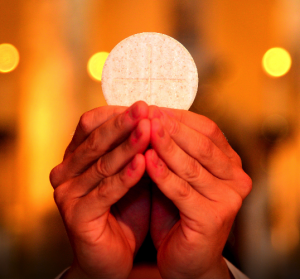
“… rendering unto thee most hearty thanks for the innumerable benefits procured unto us by the same.”[1]

A few days ago, a fellow priest complained about the difficulty of saying these words from the “traditional language” service of Holy Communion in the Episcopal Church’s Book of Common Prayer, especially early in the morning (which is about the only time they are said in most parishes anymore, if they are said at all). I responded with the snarky remark that if my colleague had grown up with them, rather than being a “convert” from another Christian tradition (as he is), they would not be difficult at all.

I did not grow up with them myself, but I did hear them at least three times each week during the academic terms of my high school years. A non-Episcopalian, I was enrolled in an Episcopal Church affiliated boarding school more than a thousand miles from home. Like all the students of that school, I was required to attend chapel which most days followed the liturgy of one of the Daily Offices but twice each week was a celebration of the Eucharist. Then on Sundays, unless one was attending church off campus, there was another mandatory service of Holy Communion.

Continue reading

Lenten Journal 2019 (11 March)

Lenten Journal, Day 5

“Do not say to yourself, ‘My power and the might of my own hand have gained me this wealth.’”[1] This is a verse from today’s Daily Office Old Testament reading; it’s supposed to be Moses’ words spoken to the Hebrews about to enter the Promised Land as recorded in the Book of Deuteronomy, a reminder of the debt of gratitude everyone owes to God, but today it reminds me of a political episode of a few years ago.

President Barack Obama, in a 2012 campaign speech, said, “If you’ve got a business—you didn’t build that.” The “that” in that sentence was meant to refer to “roads and bridges” he had just referenced in the previous sentence, to the infrastructure which he had just described as the “unbelievable American system” that allows businesses to thrive.[2] That was clear to anyone who heard the speech.

Continue reading

Lenten Journal 2019 (10 March)

Lenten Journal, Day 4 (First Sunday in Lent)

I fell in love with science when I was in junior high school. I did well in chemistry and biology  and in math classes in high school. I went to a particular university because it was well-known as a training ground for scientists. I wasn’t sure which of the sciences I wanted to go into – marine biology and medicine were both especially attractive, but so too was physics – but I was definitely headed into the sciences. And then I met integral calculus … and ended up getting a degree in literature, then another in business, another in law, and two more in religion.

I am still in love with science; it’s just that I seem incapable of wrapping my head around abstract mathematics. In another universe, I might have been able to do that and might have followed a different path. Perhaps that is why quantum mechanics, superstring theory, and the multiverse fascinate me. I may not quite grasp the math, but the ideas make all sorts of sense to me, especially the notion of multiple universes and alternate realities.

Continue reading

Lenten Journal 2019 (9 March)

Lenten Journal, Day 3

I have a morning ritual; I suppose everyone does. I get up in the darkness of 5 a.m. and carefully, quietly walk down the stairs from our bedroom to the den and kitchen (a combined “great room” as our house is laid out). I turn on the coffee maker which has been set up the night before, then I sit down in my recliner to await its task completion. My dog, Archbishop Dudley, a black cocker spaniel, rouses himself (he sleeps in the den) and comes to me; I lift him onto my lap and the two of us fall asleep.

When the coffee maker wakes me with its signal that the brew is ready, I put the dog to floor, slip a coat onto me and a leash onto him, and go for a short walk around our cul-de-sac. The dog does what he must and we return home; he gets his breakfast and I get my first cup of coffee along with a handful of pills. While I drink it, I read scan my online subscriptions of the New York Times, the Washington Post, and (occasionally) the Los Angeles Times, and read a few news reports and op-ed pieces. Then I check out Facebook.

Continue reading

Lenten Journal 2019 (8 March)

Lent Journal, Day 2

Yesterday afternoon the dog and I went for a walk in the snow. I should clarify: we went for a walk while the snow was falling and we walked on the sidewalk. The snow was that sort of big, fluffy-flake variety that my wife calls “snow globe snow.” As it coated the sidewalk, the path had the appearance of the first layer of blown-in insulation in an attic, a cottony, almost-fibrous, semi-transparent white coating laid over the concrete.

I was wearing a pair of slip-on canvas shoes with a textured sole, the sort that leaves very distinct patterned footprints in such snow or on the damp sand of undisturbed beaches. We’ve had several such snow falls this year and I’ve noticed that when the snow continues to fall and covers up those footprints, they harden. Later, when my neighbor or I get out our snow blowers and snow shovels and clear the sidewalk, those footprints left in the first snow fall remain, like the white-on-white pattern of an expensive dress shirt, evidence that someone has walked this way before.

Continue reading

Lenten Journal 2019 (7 March)

Where to begin?

I’ve decided to spend at least one hour each morning on the task of writing. That’s the advice given all aspiring writers, “Just do it. Set aside time and discipline yourself to do it. Write whatever comes to mind.” So here I am, coffee cup at my side, fingers on the keyboard of my laptop, sitting at the kitchen table. I would prefer to use a paper and pen, but the arthritis in my hands simply does not allow me to actually write much anymore. I can “type” so much faster and more accurately than I can scrawl now (and auto-correct, as much as I hate it on my phone, is a great aide in my word processing application).

The furnace is on. It’s snowing outside and the Weather.com app on my phone said it was 21ºF when last I looked. There was a weather notice of a burst of snowfall moving through the area limiting visibility and making roads dangerously slick.

Anyway, the furnace is on and I can hear the rush of air through the registers. Normally, I never pay attention to this; I don’t even notice it. It is simply background white noise. This morning, however, it seems to be abnormally loud, very noticeable. If I were still in the preaching business, I might make myself a note about the furnace background noise, a reminder that it could be used a sermon illustration. I don’t know what biblical text or theological idea it might illustrate, but that’s the nature of sermon illustrations, isn’t it? You don’t know how you will use them until you do. File this one under “background noise” for now and move on.

Continue reading

Lenten Community: If I Were Preaching, Lent 1, 10 March 2019

A wandering Aramean was my ancestor; he went down into Egypt and lived there as an alien, few in number, and there he became a great nation, mighty and populous. – Deuteronomy 26:5
I’m not preaching on the First Sunday of Lent, but if I was . . . I might preach about Lenten community.

“What?” some will ask. “The gospel lesson[1] is about Jesus going off into the desert to be alone and to fast for forty days! Shouldn’t we be preaching about solitude and sacrifice and privation and that sort of thing? You know, Lenten discipline?”

Well, sure, you can do that. I’ll bet you’ve done that every year. I’ll bet our congregations have heard dozens, hundreds of Lenten discipline sermons. They can take another one.

However, as I read the gospel lesson again, it occurred to me that Satan’s temptations of Jesus are all the temptations of solitude: the self-sufficiency of miraculously producing bread without any other assistance – to which Jesus answers, “One does not live alone;” the loneliness of rulership – to which Jesus answers, “Worship and service,” an answer implying relationship and community; the selfishness of self-destruction – to which Jesus simply answers “No.”

Continue reading

Stones of Agony – Sermon for Maundy Thursday, March 29, 2018

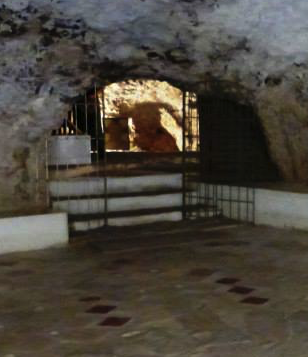
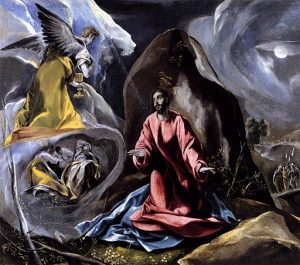
Across the Kidron valley from Jerusalem, at the foot of the Mount of Olives, is a small grove of olive trees. In the midst of it is a church called “The Church of All Nations” and in the center of that church, surrounded by a low wrought iron fence sculpted to resemble brambles and thorns, is a large, rough, flat rock. It is called “the stone of agony” and tradition tells us it is the place where Jesus prayed on the night before he died.

Our gospel lesson for this evening, for Maundy Thursday, does not mention that olive grove, that stone, or Jesus’ prayers. Our gospel lesson on this day is always the same from year to year. We rehearse John’s story of Jesus washing his disciples’ feet. John’s Jesus is self-assured and in control. He “knew that his hour had come to depart from this world and go to the Father.”[1] He knew “that the Father had given all things into his hands.”[2] “He knew who was to betray him.”[3] He gives his friends a “new commandment” (which, as a colleague of mine noted in our on-line bible study, isn’t really all that new): “Love one another.”[4]

Continue reading

Triumphal Entry – Sermon for Palm Sunday, RCL Year B, March 25, 2018

Today we are commemorating Jesus’ entry into Jerusalem at the beginning of the week that would culminate in his death on the cross of Calvary. Somewhat contrary to common sense, this has come to be called the “triumphal entry.” I don’t know who first applied this term to Jesus making his way from Bethany and Bethphage, through the Kidron Valley, also known as the valley of Jehosophat or the valley of decision, into the holy city. I’ve often thought that whoever it was must surely have been a master of irony, or perhaps of sarcasm, for the procession was anything but a triumph!

Two scholars, Marcus Borg and John Dominic Crossan, have suggested that much more than a fulfillment of the Zecharian prophecy that the messiah, the king would come gently bringing salvation, riding on a donkey’s colt,[1] Jesus’ parade was a mockery of the Roman tradition of military parades, particularly the sort Pontius Pilate might have used to enforce imperial domination.[2]

To appreciate their suggestion, it’s necessary for us to understand the nature of these parades. We have a word in English, triumph, the adjectival form of which we apply to Jesus’ parade, which we use and understand as a synonym to the word victory. But it derives from the name of a particular sort of military parade practiced by the Romans, the triumphus. In Roman tradition, the triumph happened after a victory was won, but only in Rome, only after certain victories and only for certain victors. It has been said that the triumph was “one of the most dazzling examples of the theme of spectacle in Roman culture,” imbued with “theatricality” and designed primarily to persuade its audience of the greatness of the conquering general and of Rome itself.[3]

Continue reading

« Older posts Newer posts »